


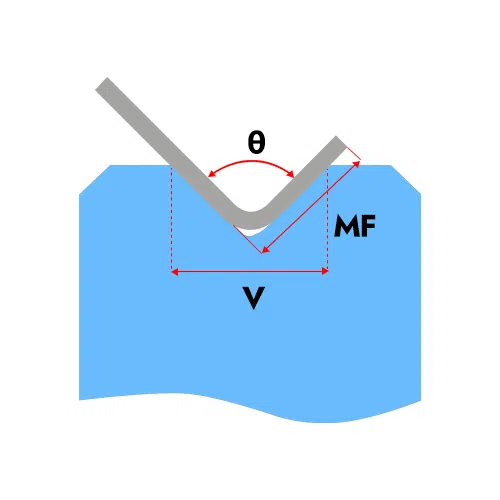
El minimum flange length calculator shows the shortest flange you can bend without it slipping into the V-die. bmin = 1.1 × V / (2 × sin(A/2)): on a 16 mm V-die a 90° bend needs a flange of at least 12.4 mm. You can also enter the flange and get the largest V-die you can use.
- Free, no sign-up
- Metric & imperial
- Instant results
- Shareable link
Resultados
LiveMinimum flange lengthinside length from the bend line
- Flange length (inside)
- 12.4 mm
- As outside dimension
- 14.4 mm
- V-die opening
- 16,0 milímetros
- Half die opening (V/2)
- 8,0 milímetros
Includes a 10% safety factor over the geometric minimum. Measure the flange from the bend line (inside of the bend).
Minimum flange length formula
bmin = 1.1 × V / (2 × sin(A / 2))V = die opening · A = included angle on the part · 1.1 = safety factor
For a 90° bend this is about 0.78 × V. Open angles need less flange (0.6 × V at 135°), while sharp angles need much more. If your flange is shorter than the minimum, choose a narrower V-die — and check the extra tonnage with the bending force calculator — or use a special short-flange or rotary die such as the V-series rotary die.
How to use the Min. Flange Length Calculator
- Choose whether you need the minimum flange or the largest usable V-die.
- Entrar en el V-die opening (or the flange length).
- Entrar en el included angle of the finished part.
- Optionally add thickness to see the minimum as an outside dimension.
Worked example
90° bend on a 16 mm V-die. bmin = 1.1 × 16 / (2 × sin 45°) = 17.6 / 1.414 = 12.4 mm. With 2 mm sheet the outside dimension must be at least 14.4 mm. For a 10 mm flange the largest usable V-die is 10 × 1.414 / 1.1 = 12.9 mm → use a 12 mm die.
Minimum flange chart (mm)
Rows: V-die opening. Columns: included angle of the part.
| V (mm) | 60° | 90° | 120° | 135° | 150° |
|---|---|---|---|---|---|
| 6 | 6.6 | 4.7 | 3.8 | 3.6 | 3.4 |
| 8 | 8.8 | 6.2 | 5.1 | 4.8 | 4.6 |
| 10 | 11.0 | 7.8 | 6.4 | 6.0 | 5.7 |
| 12 | 13.2 | 9.3 | 7.6 | 7.1 | 6.8 |
| 16 | 17.6 | 12.4 | 10.2 | 9.5 | 9.1 |
| 20 | 22.0 | 15.6 | 12.7 | 11.9 | 11.4 |
| 25 | 27.5 | 19.4 | 15.9 | 14.9 | 14.2 |
| 32 | 35.2 | 24.9 | 20.3 | 19.1 | 18.2 |
| 40 | 44.0 | 31.1 | 25.4 | 23.8 | 22.8 |
| 50 | 55.0 | 38.9 | 31.8 | 29.8 | 28.5 |
| 63 | 69.3 | 49.0 | 40.0 | 37.5 | 35.9 |
| 80 | 88.0 | 62.2 | 50.8 | 47.6 | 45.6 |
| 100 | 110.0 | 77.8 | 63.5 | 59.5 | 56.9 |
Frequently asked questions
What is the minimum flange length for a 90° bend?
About 0.78 times the V-die opening (including a 10% safety factor). For example 6.2 mm on an 8 mm die, 12.4 mm on a 16 mm die and 18.7 mm on a 24 mm die.
Why does a short flange fail to bend?
The flange must rest on both die shoulders through the whole stroke. If it is too short, its edge drops into the V, the part slips and the angle and flange length become uncontrolled.
How can I bend a flange shorter than the minimum?
Use a narrower V-die (more tonnage, tighter radius), a gooseneck or acute tool combination, a rotary bending die, or bend a longer flange and trim it afterwards.
Is the minimum flange measured inside or outside?
This calculator gives the length from the bend line, effectively the inside dimension. Add the sheet thickness for the outside (mold-line) dimension.
Reviewed by the HARSLE engineering team · Last updated October 2026. Results are engineering estimates; confirm critical values with your machine and tooling documentation.
Minimum flange length—
