


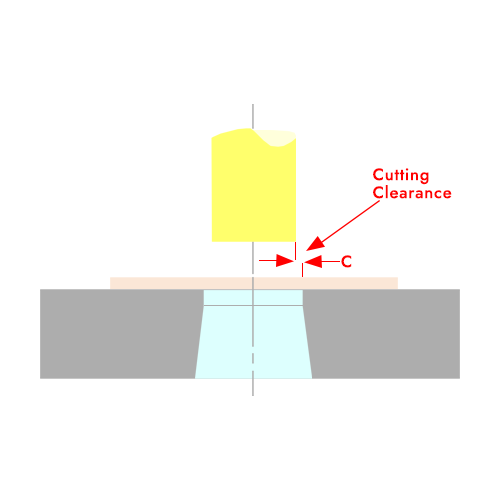
O cutting clearance calculator gives the gap to set between the upper and lower shear blades. Clearance = thickness × coefficient, typically 6–10% for mild steel, 8–12% for stainless steel and 4–8% for aluminum. For 3 mm mild steel the recommended gap is 0.24 mm.
- Free, no sign-up
- Metric & imperial
- Instant results
- Shareable link
Resultados
LiveRecommended blade clearance8.0% of thickness
- Acceptable range
- 0.180–0.300 mm
- Feeler gauge setting
- 0.25 mm feeler gauge
- Clearance coefficient
- 8.0%
Clearance is the total gap between the blades. Many hydraulic shears set it with a handwheel or automatically from the thickness on the CNC.
Blade clearance formula
C = t × cC clearance · t thickness · c clearance coefficient for the material
The blade gap controls how the material fractures. Too small and the blades rub, wear quickly and need more force; too large and the edge rolls over, burrs form and thin sheet folds between the blades. Softer materials need smaller gaps, harder and stronger materials larger ones.
- Gap too small: double shear lines, high force, blade chipping.
- Gap correct: clean shear zone over about one third of the thickness, minimal burr.
- Gap too large: large burr, rolled edge, bent strips.
How to use the Cutting Clearance Calculator
- Selecione o material (or enter your own coefficient).
- Entre no grossura.
- Set the blade gap to the recommended value and check the first cut edge.
Worked example
3 mm mild steel. C = 3 × 0.08 = 0.24 mm (range 0.18–0.30 mm). For 3 mm stainless steel use 3 × 0.10 = 0.30 mm; for 3 mm aluminum 3 × 0.06 = 0.18 mm.
Shear blade clearance chart (mm)
| Espessura (mm) | Mild steel 8% | Stainless 10% | Aluminum 6% |
|---|---|---|---|
| 1 | 0.08 | 0.10 | 0.06 |
| 2 | 0.16 | 0.20 | 0.12 |
| 3 | 0.24 | 0.30 | 0.18 |
| 4 | 0.32 | 0.40 | 0.24 |
| 6 | 0.48 | 0.60 | 0.36 |
| 8 | 0.64 | 0.80 | 0.48 |
| 10 | 0.80 | 1.00 | 0.60 |
| 12 | 0.96 | 1.20 | 0.72 |
| 16 | 1.28 | 1.60 | 0.96 |
| 20 | 1.60 | 2.00 | 1.20 |
| 25 | 2.00 | 2.50 | 1.50 |
Frequently asked questions
What is the correct blade gap for a shear?
About 8% of the thickness for mild steel, 10% for stainless steel and 6% for aluminum. For example 0.16 mm for 2 mm mild steel and 0.48 mm for 6 mm.
How do I know if the blade clearance is wrong?
A large burr or rolled edge means the gap is too large; a double shiny band, rough fracture or excessive noise means it is too small. Bent thin strips also point to a large gap.
Is this the same as punch and die clearance?
No. Punching clearance is usually larger (15–30% of thickness in total). Use the punching force calculator for punch-die clearance.
Reviewed by the HARSLE engineering team · Last updated October 2026. Results are engineering estimates; confirm critical values with your machine and tooling documentation.
Recommended blade clearance—
