


Гидравлический пресс Защитные блокировки are essential protective systems designed to prevent dangerous machine movements when safety conditions are not satisfied. They help protect operators and maintenance personnel from crushing injuries, unexpected ram movement, and other hazards during hydraulic press operation. These systems monitor protective guards, access doors, emergency stop circuits, and other safety devices. In this guide, I’ll explain how hydraulic press safety interlocks work, the main types available, how to inspect them, and how to maintain their effectiveness in industrial production.
Why Are Safety Interlocks Important on Гидравлические прессы?
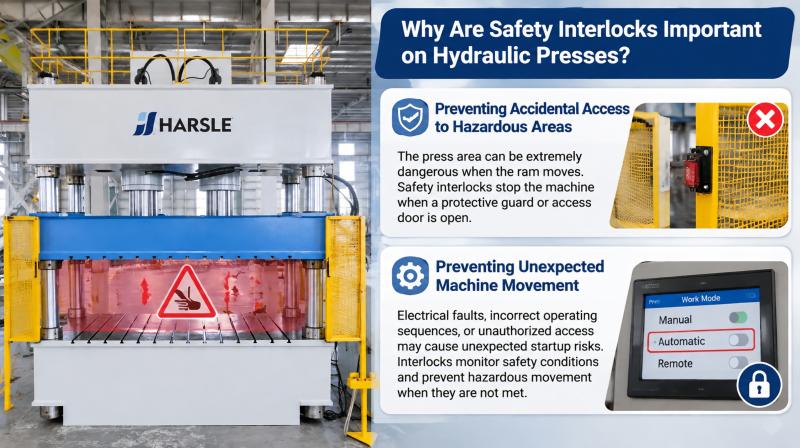
Preventing Accidental Access to Hazardous Areas
Hydraulic presses generate substantial force during forming, stamping, and pressing operations. The area between the upper and lower platens can become extremely dangerous when the ram moves.
Safety interlocks prevent hazardous machine operation when an interlocked protective guard or access door is open. This helps reduce the risk of operators accidentally entering dangerous areas during production.
Preventing Unexpected Machine Movement
Electrical faults, incorrect operating sequences, or unauthorized access may create unexpected startup risks.
An interlock system monitors designated safety conditions and prevents the machine from initiating or continuing hazardous movement when a monitored condition is unsafe.
How Do Hydraulic Press Safety Interlocks Work?
Step 1: Detecting the Position of Safety Guards
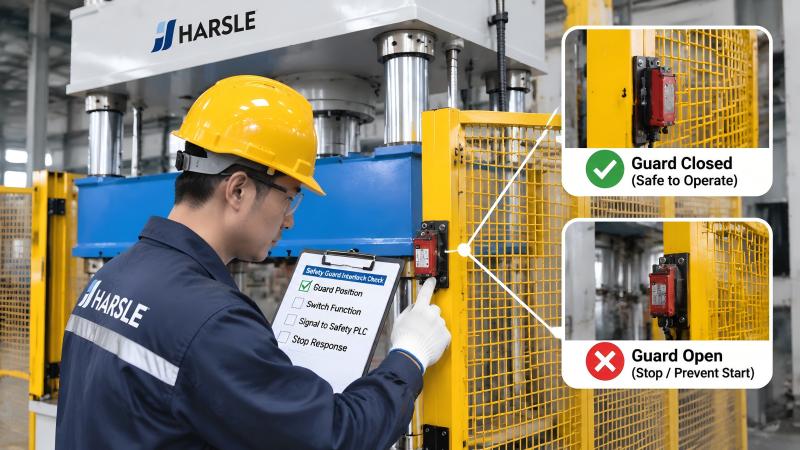
Safety interlocks are commonly installed on movable protective guards and access doors.
When a guard is closed, its associated safety switch provides a signal indicating that the required protective condition is satisfied. If the guard is opened, the switch changes state and sends a signal to the safety control system.
Depending on the machine design, the system prevents a new pressing cycle or initiates a safety-related stop.
Step 2: Processing Signals Through the Safety Control System
Signals from interlock switches are transmitted to a safety relay or safety PLC.
The safety control system evaluates the input signals and determines whether the required safety conditions are satisfied.
Например:
- If all monitored guards are closed, the system may permit operation.
- If an interlocked door opens, the system prevents hazardous movement.
- If a safety circuit detects a fault, the system may prevent the machine from starting.
- If an emergency stop is activated, the safety control system initiates the configured stop response.
The exact response depends on the machine’s safety architecture and risk assessment.
Step 3: Controlling Hydraulic Press Movement
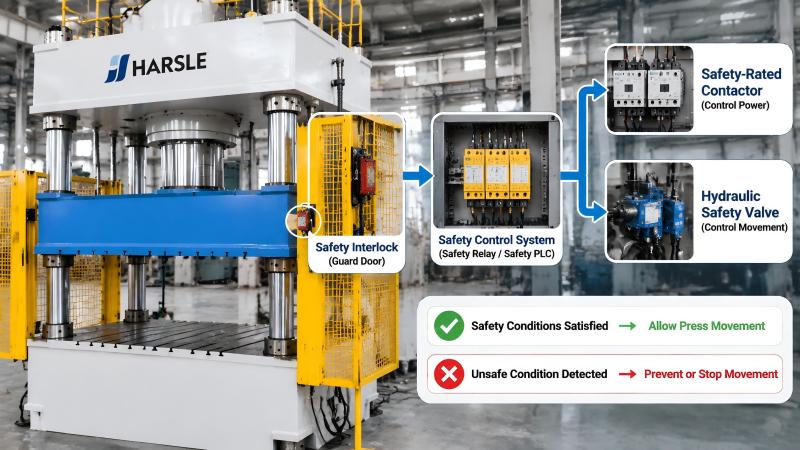
After evaluating the safety signals, the control system communicates with the appropriate output devices.
These may include safety-rated contactors, hydraulic safety valves, or other components designed to control hazardous movement.
When an unsafe condition is detected, the system initiates the designed safety response to prevent or stop hazardous motion.
The interlock system must be designed and validated as part of the complete machine safety system rather than relying on an ordinary PLC command alone.
Step 4: Requiring Safe Conditions Before Restarting
Closing a protective guard does not necessarily mean that the hydraulic press should restart automatically.
Depending on the safety design, the system may require a manual reset and a separate start command before operation can resume.
This helps prevent unexpected startup when an operator closes a guard after entering a hazardous area.
Common Types of Hydraulic Press Safety Interlocks
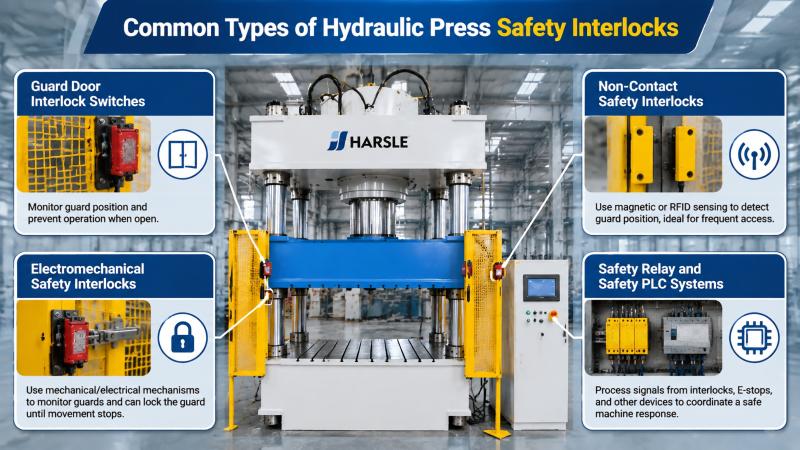
Guard Door Interlock Switches
These switches monitor the position of movable protective doors and access panels. They prevent hazardous operation when the protected access point is open.
Electromechanical Safety Interlocks
These devices use mechanical or electrical switching mechanisms to monitor guard positions. Some designs include guard-locking functions that prevent access until hazardous movement has stopped.
Non-Contact Safety Interlocks
Non-contact interlocks use technologies such as magnetic or RFID sensing to detect whether a protective guard is correctly positioned.
They are useful in applications where frequent guard opening and closing is required.
Safety Relay and Safety PLC Systems
Safety relays and safety PLCs process signals from interlocks, emergency stops, and other protective devices. They coordinate the safety response according to the machine’s validated safety design.
How to Inspect and Maintain Hydraulic Press Safety Interlocks
Step 1: Inspect Switches and Protective Guards
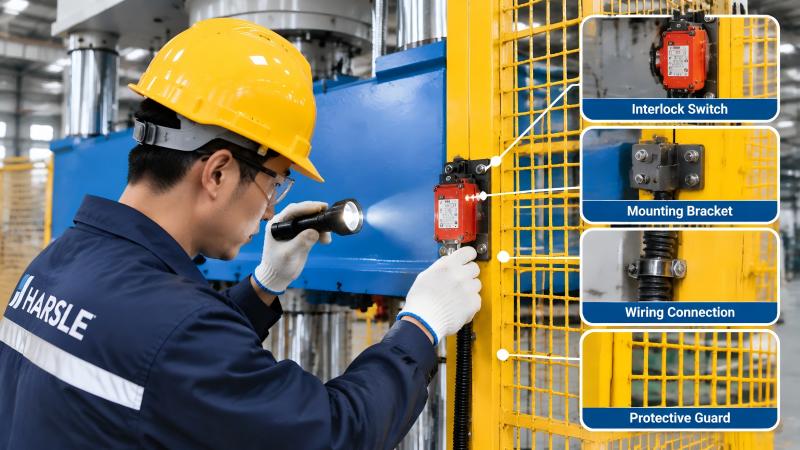
Check interlock switches, mounting brackets, wiring, and protective guards for visible damage, loose connections, or misalignment.
Step 2: Perform Functional Tests
Follow the manufacturer’s approved testing procedure to verify that opening an interlocked guard prevents the hazardous operation specified in the safety design.
Never perform improvised tests that expose personnel to moving components.
Step 3: Check Safety Circuit Faults
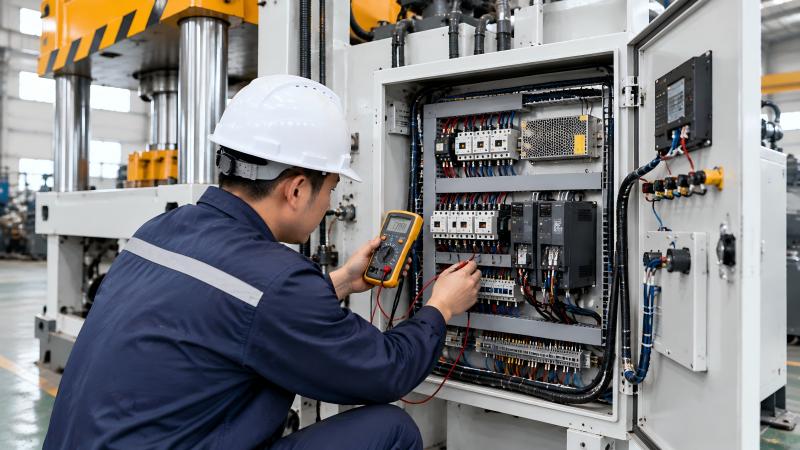
Inspect diagnostic indicators and fault messages from the safety relay or safety PLC. Qualified technicians should investigate abnormal signals and electrical faults.
Step 4: Record Inspection and Maintenance Results
Document inspection dates, identified defects, corrective actions, and functional test results. Replace damaged components with approved parts and verify the complete safety function before returning the machine to production.
Common Safety Interlock Mistakes to Avoid
- Bypassing interlock switches: Never defeat protective devices to maintain production.
- Ignoring damaged wiring: Faulty connections may prevent the safety system from responding correctly.
- Misaligning guard switches: Incorrect installation can affect reliable detection.
- Relying only on ordinary PLC controls: Safety functions require appropriately designed and validated safety-related control systems.
- Skipping functional tests: Regular inspection and testing are essential for maintaining protection.
- Restarting without verification: Confirm that safety functions are restored before authorizing production.
Вопросы и ответы
Can a Hydraulic Press Operate With an Open Safety Guard?
If the guard is protected by an interlock designed to prevent hazardous operation, opening it should initiate the specified safety response. Never operate a machine with a required protective device disabled or faulty.
Do Hydraulic Press Safety Interlocks Replace Emergency Stops?
No. Interlocks and emergency stops perform different safety functions. Both should be provided where required by the machine’s risk assessment and safety design.
How Often Should Safety Interlocks Be Tested?
Follow the manufacturer’s maintenance instructions, applicable safety standards, and the facility’s documented inspection schedule. Additional testing may be necessary after repairs, modifications, or safety-related incidents.
Заключение
Hydraulic press safety interlocks help prevent hazardous machine operation by monitoring protective guards, processing safety signals, and controlling machine movement. Their effectiveness depends on correct installation, reliable safety control components, regular inspections, and proper maintenance.
I recommend treating safety interlocks as an essential part of the hydraulic press protection system. Never bypass or modify these devices without proper engineering authorization and safety validation.


