


ال hydraulic cylinder diameter calculator sizes the bore and rod for the force you need. D = √(4 × F × SF / (π × p)): a 100-ton press at 25 MPa (250 bar) with a 1.3 safety factor needs a 254.8 mm bore, so choose the standard Ø280 mm cylinder. Results are rounded to ISO bore and rod sizes and include pull force and speed.
- Free, no sign-up
- Instant results
- Shareable link
نتائج
LiveRecommended cylinderrod Ø160 mm · 11.02 in / 6.30 in
- Theoretical bore
- 254.8 mm calculated
- Rod diameter
- 160 mm (φ 1.48)
- Push force at pressure
- 157.0 T (1,539 kN)
- Pull force at pressure
- 105.7 T (1,037 kN)
- Piston / annulus area
- 615.8 cm² / 414.7 cm²
- Design force
- 130.0 T (SF 1.30)
- Extend speed
- —
- Retract speed
- —
Bore sizes per ISO 3320. Check rod buckling for long strokes and pivot mountings, and the cylinder manufacturer’s pressure rating.
Hydraulic cylinder sizing formulas
D = √(4 × F × SF / (π × p))D bore in mm · F force in N · p pressure in MPa (N/mm²) · SF safety factor
فpush = p × π D² / 4 · Fpull = p × π (D² − d²) / 4
v = Q / ASpeed from pump flow Q and piston (or annulus) area A
Pressure acts on the full piston area when extending, but only on the ring-shaped annulus when retracting, so pull force is always lower. The area ratio φ = Apiston / Aannulus sets the rod size: φ 1.46 is the industrial standard (rod ≈ 0.56 × bore); φ 2 gives a thick, buckling-resistant rod and twice the retract speed. Higher system pressure gives a smaller cylinder but needs more expensive pumps, valves and seals.
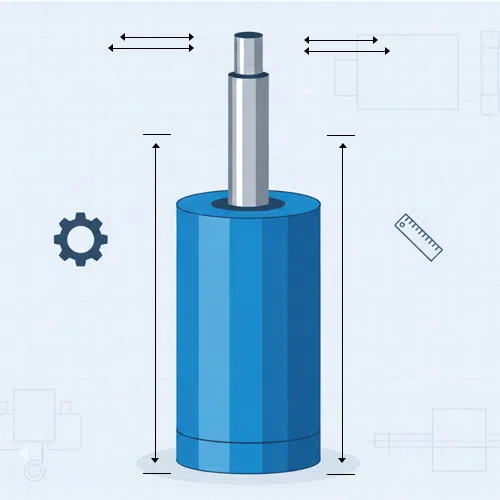
How to use the Hydraulic Cylinder Diameter Calculator
- اختر force unit and enter the push force the load needs.
- أدخل ضغط النظام of the pump (MPa, bar or psi).
- اضبط safety factor و area ratio; optionally add pull force and pump flow.
- Read the standard bore and rod, the real push/pull forces and the cylinder speeds.
Worked example
100 t push force, 25 MPa, safety factor 1.3, φ 1.46.
- Design force = 100 × 9.807 × 1.3 = 1,275 kN
- Area = 1,275,000 / 25 = 50,996 mm² → D = √(4 × 50,996 / π) = 254.8 mm → standard Ø280 mm
- Rod = 280 × √(1 − 1/1.46) = 157 mm → Ø160 mm
- Push force at 25 MPa = 1,539 kN (157 t); pull force = 1,037 kN (106 t)
Cylinder force chart (metric tons)
| Bore (mm) | Area (cm²) | 16 ميجا باسكال | 21 ميجا باسكال | 25 ميجا باسكال | 31.5 ميجا باسكال |
|---|---|---|---|---|---|
| 40 | 12.6 | 2.1 | 2.7 | 3.2 | 4.0 |
| 50 | 19.6 | 3.2 | 4.2 | 5.0 | 6.3 |
| 63 | 31.2 | 5.1 | 6.7 | 7.9 | 10.0 |
| 80 | 50.3 | 8.2 | 10.8 | 12.8 | 16.1 |
| 100 | 78.5 | 12.8 | 16.8 | 20.0 | 25.2 |
| 125 | 122.7 | 20.0 | 26.3 | 31.3 | 39.4 |
| 160 | 201.1 | 32.8 | 43.1 | 51.3 | 64.6 |
| 200 | 314.2 | 51.3 | 67.3 | 80.1 | 100.9 |
| 250 | 490.9 | 80.1 | 105.1 | 125.1 | 157.7 |
| 320 | 804.2 | 131.2 | 172.2 | 205.0 | 258.3 |
Typical system pressures
| ضغط | Typical use |
|---|---|
| 16 ميجا باسكال (160 بار) | Machine tools, light automation |
| 21–25 MPa (210–250 bar) | Industrial presses, press brakes, shears (ISO standard cylinders) |
| 31.5 ميجا باسكال (315 بار) | Heavy presses, metallurgy, marine |
| 35–40 MPa (350–400 bar) | Mobile hydraulics, compact high-force tools |
Frequently asked questions
How do I calculate hydraulic cylinder bore size?
Divide the required force (with safety factor) by the system pressure to get the piston area, then D = √(4A/π). For 50 t at 20 MPa with SF 1.3: A = 50 × 9,807 × 1.3 / 20 = 31,872 mm² → D = 201 mm → use a 220 mm bore.
Why is the pull force smaller than the push force?
When retracting, oil pushes only on the annulus (piston area minus rod area). With the standard area ratio of 1.46, pull force is about 68% of push force.
What safety factor should I use?
1.25–1.5 for static presses and press brakes, 1.5–2 for dynamic or shock loads. It covers seal friction, back-pressure and pressure losses in valves and hoses.
How fast will the cylinder move?
Speed = flow / area. A 100 L/min pump on a 100 mm bore (78.5 cm²) extends at about 212 mm/s. Retracting is faster because the annulus is smaller.
Does this check rod buckling?
No. For long strokes, pivot or clevis mountings and high push loads, check Euler buckling of the rod with the cylinder supplier.
Reviewed by the HARSLE engineering team · Last updated October 2026. Results are engineering estimates; confirm critical values with your machine and tooling documentation.
Recommended cylinder—


