


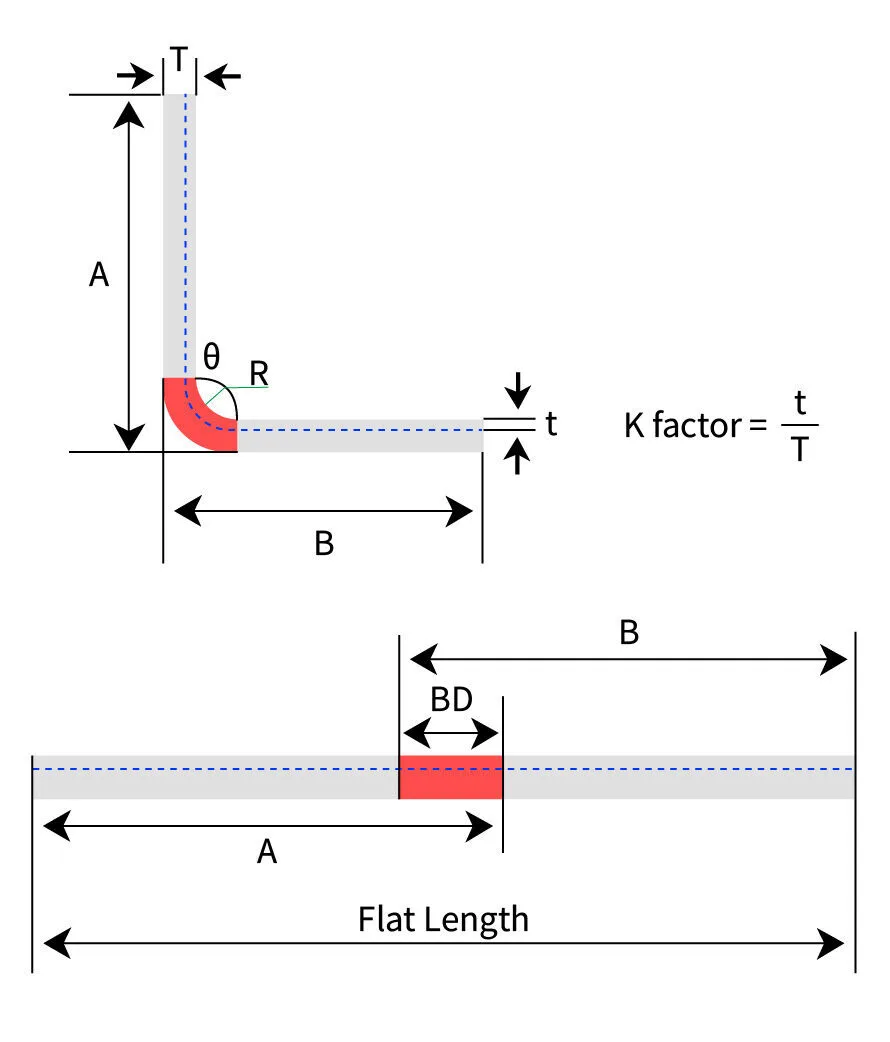
O calculadora de dedução de curvatura tells you how much to subtract from the outside dimensions of a bent part to get its flat blank length. BD = 2 × OSSB − BA, and the flat length is L = A + B − BD. For 2 mm sheet with a 2 mm inside radius and a 90° bend, the bend deduction is 3.84 mm.
- Free, no sign-up
- Metric & imperial
- Instant results
- Shareable link
Resultados
LiveBend deduction (BD)Flat length 76.16 mm
- Flat blank length
- 76.16 mm
- Bend allowance (BA)
- 4.163 mm
- Outside setback (OSSB)
- 4.000 mm
- K-factor used
- 0.325 (DIN 6935)
- Ângulo
- 90.0° bend · 90.0° included
K-factor “Auto” follows DIN 6935 (k = 0.65 + 0.5·log(R/T), K = k/2). For production, calibrate K with a test bend on your own tooling.
Bend deduction formula
BD = 2 × OSSB − BAOSSB = tan(A / 2) × (R + T) · BA = π / 180 × A × (R + K × T)
Flat length L = A + B − BDA, B = outside (mold-line) flange dimensions
- BD bend deduction
- OSSB outside setback – from the tangent point to the mold-line apex
- BA bend allowance
- R inside radius · T thickness · K Fator K
- A bend angle (90° for an L-bracket)
Bend deduction is the natural choice when a drawing gives outside dimensions, which is how most sheet metal parts are dimensioned. For parts with several bends, subtract one BD per bend from the sum of all outside flange dimensions. Need the arc length instead? Use the calculadora de tolerância de curvatura.
How to use the Bend Deduction Calculator
- Entre no grossura e o inside bend radius.
- Entre no ângulo de curvatura (or switch to included angle).
- Keep Fator K on Auto or enter your measured value.
- Enter outside flange lengths A e B to get the flat blank length (L = A + B − BD).
Worked example
U-channel 100 × 40 × 40 mm (outside), 3 mm steel, inside radius 3 mm, two 90° bends.
- K = 0.325 (R/T = 1) → BA = π/2 × (3 + 0.325 × 3) = 6.244 mm
- OSSB = tan 45° × (3 + 3) = 6.000 mm → BD = 12.000 − 6.244 = 5.756 mm
- Flat length = 40 + 100 + 40 − 2 × 5.756 = 168.49 mm
Bend deduction chart for 90° bends (mm)
K-factor per DIN 6935. Columns show inside radius as a multiple of thickness.
| Thickness T | R = 0.5 T | R = 1 T | R = 1.5 T | R = 2 T |
|---|---|---|---|---|
| 1 | 1.78 | 1.92 | 2.06 | 2.23 |
| 1.5 | 2.67 | 2.88 | 3.10 | 3.34 |
| 2 | 3.56 | 3.84 | 4.13 | 4.46 |
| 3 | 5.33 | 5.76 | 6.19 | 6.69 |
| 4 | 7.11 | 7.67 | 8.26 | 8.92 |
| 5 | 8.89 | 9.59 | 10.32 | 11.15 |
| 6 | 10.67 | 11.51 | 12.38 | 13.38 |
K-factor chart (DIN 6935)
The K-factor locates the neutral axis inside the material. It depends mainly on the ratio of inside radius to thickness: tight bends push the neutral axis toward the inside (K ≈ 0.3), while gentle radii keep it in the middle (K = 0.5). Material type has a smaller effect — harder materials run slightly higher at the same R/T.
Typical air-bending values are 0.33 for mild steel, 0.40 for stainless steel and 0.38 for 5052 aluminum when R ≈ T.
| R / T | Fator K |
|---|---|
| 0.5 | 0.278 |
| 0.65 | 0.278 |
| 0.8 | 0.301 |
| 1 | 0.325 |
| 1.5 | 0.369 |
| 2 | 0.400 |
| 2.5 | 0.424 |
| 3 | 0.444 |
| 4 | 0.476 |
| ≥ 5 | 0.500 |
Frequently asked questions
What is bend deduction?
Bend deduction is the amount you subtract from the sum of the outside flange dimensions to get the flat blank length. It equals twice the outside setback minus the bend allowance: BD = 2 × OSSB − BA.
How do I calculate the flat length of a part with several bends?
Add up all outside flange dimensions and subtract one bend deduction for every bend: L = ΣA − n × BD (when all bends have the same angle, radius and thickness). Bends with different angles need their own BD values.
Is bend deduction the same for every angle?
No. For 90° bends OSSB = R + T, but for other angles OSSB = tan(A/2) × (R + T), so the deduction changes with the angle. For very open angles BD becomes small; for bends beyond 90° it grows quickly.
Why is my real flat length different from the calculation?
The K-factor and the actual inside radius vary with material batch, grain direction and tooling. Bend a test strip, measure it, and adjust the K-factor until the calculator matches — then reuse that K for the same material, thickness and V-die.
Should I use bend deduction or bend allowance?
Use bend deduction with outside (mold-line) dimensions and bend allowance with straight leg lengths. They are two ways of reaching the same flat pattern.
Reviewed by the HARSLE engineering team · Last updated October 2026. Results are engineering estimates; confirm critical values with your machine and tooling documentation.
Bend deduction (BD)—


