


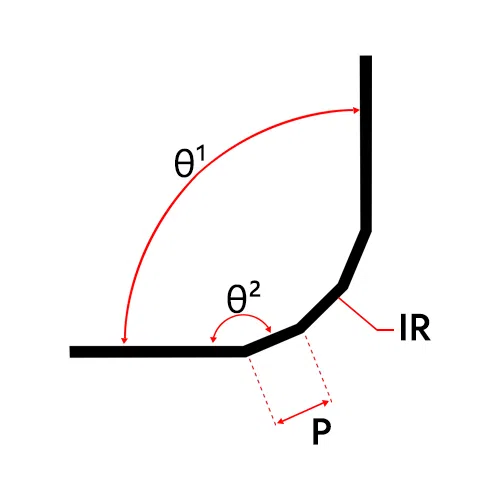
O bump bending calculator turns a large radius into a series of small press brake hits. Number of hits n = R × θ / pitch, and each hit bends θ / n. A 90° bend with a 100 mm radius on a 16 mm V-die (8 mm pitch) needs 20 hits of 4.5° each.
- Free, no sign-up
- Metric & imperial
- Instant results
- Shareable link
Resultados
LiveNumber of hits4.50° per hit · pitch 7.85 mm
- Actual pitch
- 7.85 mm
- Bend angle per hit
- 4.50°
- Included angle per hit (to program)
- 175.50°
- Inside arc length
- 157.1 mm
- Neutral-axis arc (blank length of arc)
- 158.7 mm
Move the backgauge by the pitch after every hit. Allow for springback by programming each hit slightly deeper on the first part.
Bump bending formulas
s = R × θ × π / 180 · n = ⌈ s / p ⌉ · Δθ = θ / ns inside arc length · p pitch · n number of hits · Δθ bend per hit
Each hit makes a small bend; together they approximate the radius as a polygon. A smaller pitch gives a smoother curve but more hits. The rule of thumb is a pitch of about half the V-die opening, and a V-die no wider than the radius itself (ideally R/3 or less). Keep the angle per hit below about 10–15° to avoid visible facets.
The flat blank length of the curved section is the neutral-axis arc, (R + K × t) × θ in radians, with K ≈ 0.5 for large radii.
How to use the Bump Bending Calculator
- Entre no total angle e inside radius of the curve.
- Digitar grossura e o V-die you will use.
- Use the automatic pitch (V/2) or enter your own.
- Program each hit to the included angle per hit and step the backgauge by the pitch.
Worked example
90° curve, R = 100 mm, 2 mm sheet, 16 mm V-die.
- Inside arc s = 100 × π/2 = 157.1 mm
- Pitch = 16/2 = 8 mm → n = ⌈157.1 / 8⌉ = 20 hits
- Actual pitch 157.1/20 = 7.85 mm, angle per hit 90/20 = 4.5° → program 175.5° included
- Blank length of the arc = (100 + 0.5 × 2) × π/2 = 158.7 mm
Bump bending quick reference
| Total angle | Radius (mm) | V-die (mm) | Hits | Pitch (mm) | Angle per hit |
|---|---|---|---|---|---|
| 90° | 50 | 8 | 20 | 3.93 | 4.50° |
| 90° | 100 | 16 | 20 | 7.85 | 4.50° |
| 90° | 200 | 25 | 26 | 12.08 | 3.46° |
| 90° | 300 | 32 | 30 | 15.71 | 3.00° |
| 180° | 100 | 16 | 40 | 7.85 | 4.50° |
| 180° | 250 | 32 | 50 | 15.71 | 3.60° |
| 60° | 500 | 40 | 27 | 19.39 | 2.22° |
Frequently asked questions
What is bump bending?
Bump bending (step bending) forms a large radius on a press brake by making many small bends close together, moving the backgauge a fixed pitch between hits. It replaces expensive radius tooling or a plate roll for cones, hoppers and curved panels.
How do I choose the pitch?
Start with half the V-die opening. Reduce the pitch for a smoother surface; increase it to save cycle time. The angle per hit should usually stay below 10–15°.
Which V-die should I use for bump bending?
Use the smallest die the thickness allows (about 6–8 × t) and make sure it is narrower than the radius. A narrow die with a small pitch gives the best finish.
Can a CNC press brake bump bend automatically?
Yes. DELEM and ESA controllers on HARSLE press brakes have a radius/bump function: enter radius, angle and pitch and the control generates every step and backgauge position.
Reviewed by the HARSLE engineering team · Last updated October 2026. Results are engineering estimates; confirm critical values with your machine and tooling documentation.
Number of hits—
