


Safe material feeding practices and operator positioning for nożyce do metalu are fundamental safety protocols designed to prevent catastrophic industrial accidents, including crush injuries and amputations. These practices apply to all operators, supervisors, and maintenance personnel working with hydraulic swing beam or nożyce gilotynowe. By maintaining a strict distance from the point of operation and utilizing integrated safeguards like finger guards and light curtains, operators can ensure high-precision cuts without compromising personal safety. These guidelines are intended for use with HARSLE machinery and similar industrial metal fabrication equipment under standard operating conditions.
Scope, Responsibilities, and Training Prerequisites
The operation of industrial metal shears requires a comprehensive understanding of machine physics, material behavior, and safety systems. This documentation covers the manual and semi-automated feeding of sheet metal into hydraulic shearing machines. It is not a substitute for the specific model manual provided by HARSLE but serves as a standardized framework for safe workshop conduct.
Operator Responsibilities
Operators are responsible for the daily inspection of the machine and for adhering to the “Never-In” rule: no part of the body should ever enter the restricted zone behind the finger guards or under the hold-down cylinders. Operators must also ensure that the material being fed does not exceed the machine’s rated capacity (thickness and tensile strength), as overloading can cause material kickback or structural failure.
Employer and Supervisor Responsibilities
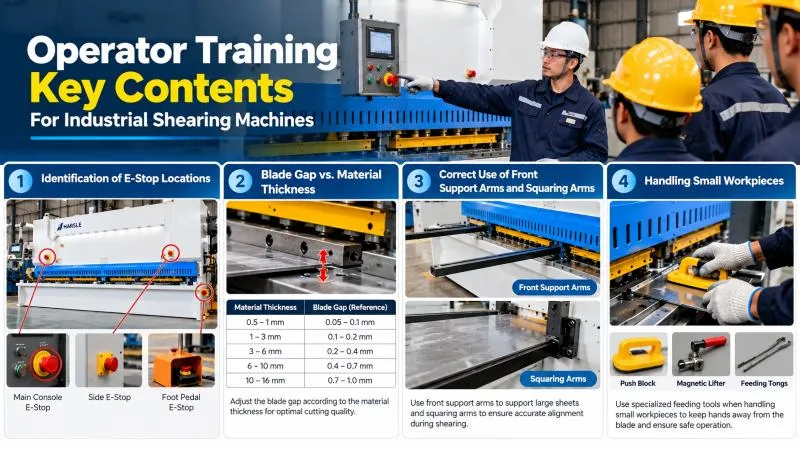
Management must provide adequate PPE (Personal Protective Equipment), ensure all safety interlocks are functional, and verify that operators have completed a formal training program. Training should include:
- Identification of all emergency stop (E-stop) locations.
- Understanding the relationship between blade gap and material thickness.
- Correct use of front support arms and squaring arms.
- Procedures for handling small workpieces that require specialized feeding tools.
Qualified Personnel vs. General Operators
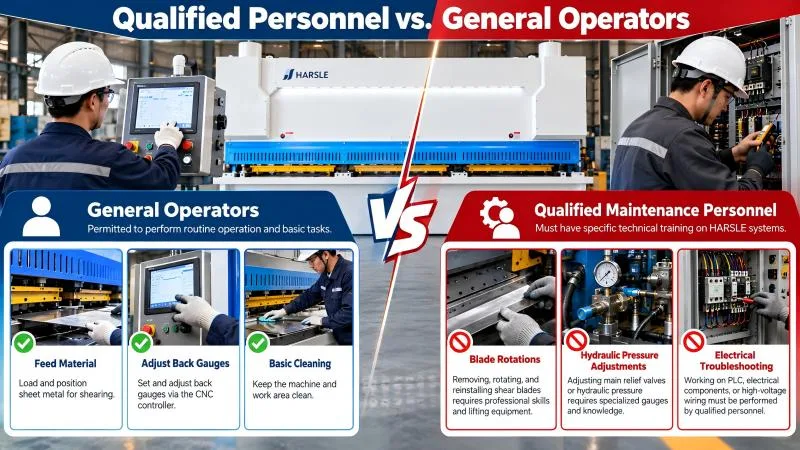
It is critical to distinguish between routine operation and technical intervention. General operators are permitted to feed material, adjust back gauges via the CNC controller, and perform basic cleaning. However, tasks such as blade rotations, hydraulic pressure adjustments, and electrical troubleshooting must be reserved for qualified maintenance personnel who have undergone specific technical training on HARSLE systems.
Hazard and Control Measure Table
The following table outlines the primary risks associated with material feeding and the corresponding control measures required to mitigate them.
| Hazard Source | Potential Risk | Control Measure / Safeguard |
|---|---|---|
| Hold-down Cylinders | Crushing of fingers/hands | Fixed finger guards; minimum 100mm safety distance from cylinders. |
| Shear Blades | Amputation or severe laceration | Interlocked rear gates; light curtains; shadow line feeding. |
| Material Kickback | Blunt force trauma to torso | Proper blade gap setting; use of front support arms; correct operator stance. |
| Sharp Edges/Burrs | Lacerations to hands/arms | Cut-resistant gloves (Level A4+); deburring of sheets before feeding. |
| Hydraulic Failure | Unintended blade descent | Regular inspection of valves and seals; use of safety blocks during maintenance. |
Pre-Operation Safety Checklist
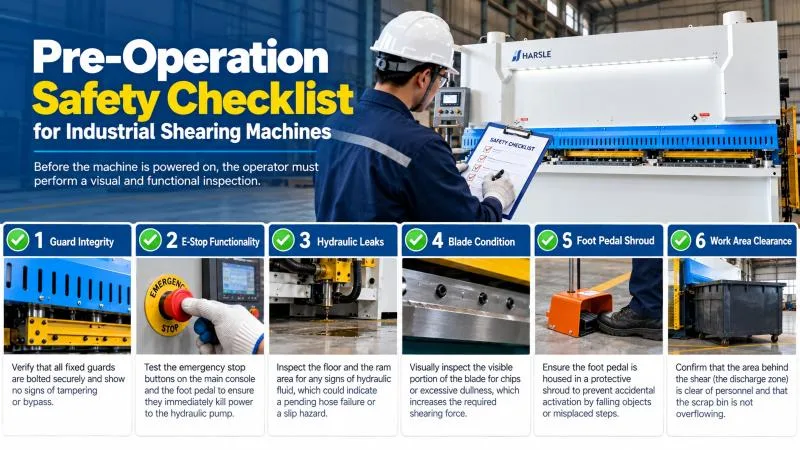
Before initiating any material feeding, the operator must perform a visual and functional audit of the machine. If any item on this checklist fails, the machine must be locked out and tagged out (LOTO) immediately.
- Guard Integrity: Verify that the front finger guard is securely bolted and shows no signs of deformation.
- E-Stop Functionality: Test the main E-stop button and the foot pedal E-stop (if equipped) to ensure the motor shuts down instantly.
- Light Curtains: If the machine is equipped with rear light curtains, trigger them to ensure the shearing cycle is interrupted.
- Hold-down Pads: Check that the polyurethane or rubber pads on the hold-down cylinders are intact to prevent material slippage.
- Blade Condition: Visually inspect the visible portion of the blade for nicks or dullness that could cause excessive feeding force.
- Work Area: Ensure the floor is free of oil, off-cuts, and debris that could cause a slip or trip during feeding.
Safe Material Feeding Practices
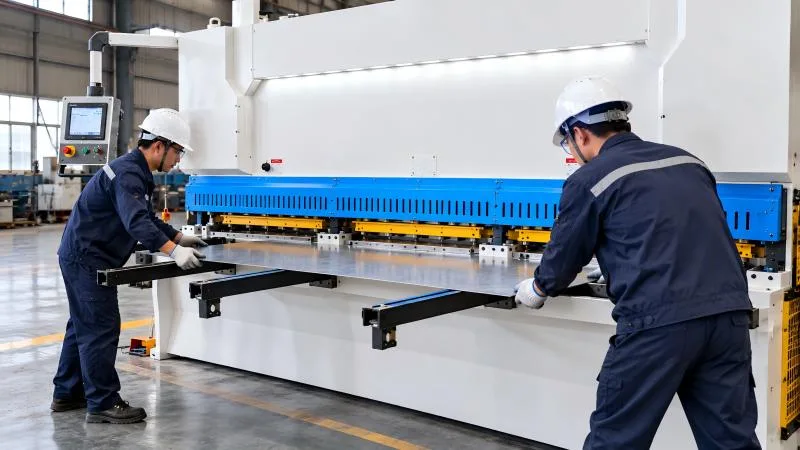
Safe material feeding practices operator positioning metal shears involve more than just pushing a sheet of metal. It requires a systematic approach to handling different sizes and weights of material to maintain stability and control.
Using the Squaring Arm and Support Arms
The squaring arm, typically located on the left side of the machine, is essential for ensuring 90-degree cuts. When feeding material, the sheet should be held firmly against the squaring arm. For long sheets, front support arms with ball transfers should be used to reduce the physical strain on the operator and prevent the material from sagging, which can lead to inaccurate cuts and unpredictable material movement.
Feeding Small Workpieces
Feeding small pieces of metal poses the highest risk of hand injury. If a workpiece is too small to be held while maintaining a 100mm (4-inch) distance from the finger guard, the operator must use a push stick or a specialized feeding jig. Never attempt to hold a small piece of metal by hand under the hold-down cylinders.
The Shadow Line Technique
Many HARSLE shears are equipped with a shadow line (optical cut line) generator. This projects a line onto the material, indicating exactly where the blade will fall. Operators should use this feature to align the material from a safe distance, rather than leaning over the machine to look through the finger guard.
Material Handling Equipment
For heavy plates, the use of vacuum lifters or magnetic sheet handlers is highly recommended. These tools allow the operator to position the material while standing well back from the machine’s intake. When two operators are required for large sheets, one must be designated as the primary operator in control of the foot pedal, and clear verbal communication must be maintained at all times.
Operator Positioning and Stance
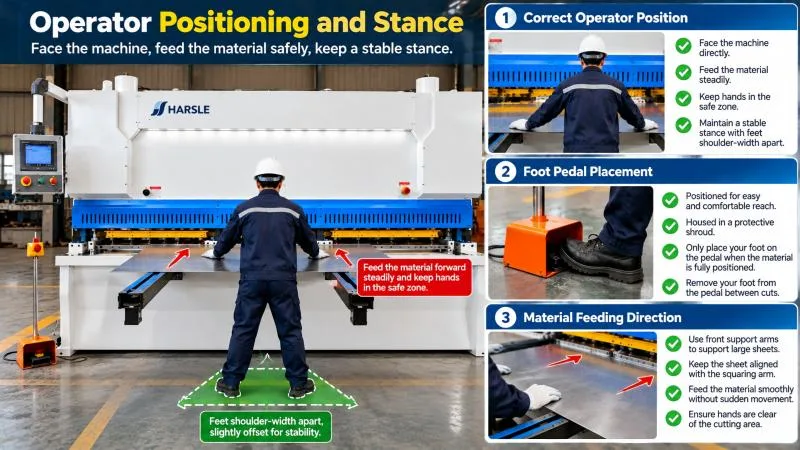
Correct operator positioning is the second pillar of shearing safety. The goal is to maintain a stable center of gravity while staying clear of the machine’s moving parts and potential material movement.
The “Golden Triangle” Stance
The operator should stand with feet shoulder-width apart, slightly offset. This provides the stability needed to resist any sudden movement of the material. The operator should never stand directly in front of the sheet being cut; instead, stand slightly to the side of the squaring arm. This protects the operator’s torso in the event of a “kick-up,” where the rear of the sheet lifts rapidly during the shearing stroke.
Foot Pedal Placement
The foot pedal should be positioned so that the operator does not have to stretch or lean to reach it. It must be housed in a protective shroud to prevent accidental activation by falling off-cuts or debris. The operator should only place their foot on the pedal when the material is fully positioned and hands are in the safe zone. Between cuts, the foot should be removed from the pedal entirely.
Restricted Zones
The area behind the shear is a high-danger zone. No person should be in the rear of the machine while it is powered on. If the machine does not have an automatic sheet stacker or conveyor, the machine must be fully stopped and isolated before any personnel enter the rear area to retrieve finished parts.
Safe Operation Boundaries and Stop Conditions
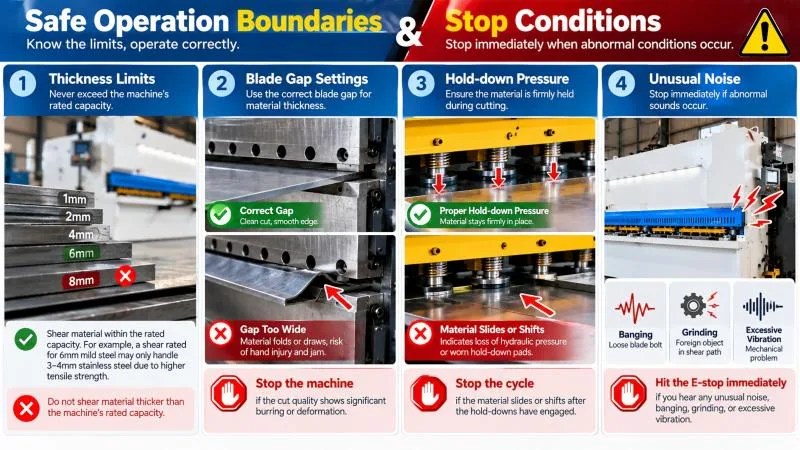
Operators must recognize the limits of the machine and the conditions under which operation must cease immediately. Adhering to these boundaries prevents mechanical failure and operator injury.
- Thickness Limits: Never shear material thicker than the machine’s rated capacity. For example, a shear rated for 6mm mild steel may only be able to handle 3mm or 4mm stainless steel due to higher tensile strength.
- Blade Gap Settings: If the blade gap is too wide for the material thickness, the metal will “fold” or “draw” between the blades. This can pull the operator’s hands toward the blade and cause a catastrophic jam. Stop the machine if the cut quality shows significant burring or deformation.
- Hold-down Pressure: If the material slides or shifts after the hold-downs have engaged, stop the cycle. This indicates a loss of hydraulic pressure or worn hold-down pads.
- Unusual Noise: Any banging, grinding, or excessive vibration is a signal to hit the E-stop. This often indicates a loose blade bolt or a foreign object in the shear path.
Emergency Response and Qualified-Personnel Escalation
In the event of an incident or a mechanical failure, the following steps must be taken:
Immediate Emergency Actions
- Depress the E-Stop: Immediately stop all machine motion.
- Power Isolation: Turn off the main isolator switch at the electrical cabinet.
- First Aid: If an injury has occurred, follow the facility’s emergency medical protocol. Do not attempt to move the machine if a limb is trapped; wait for emergency services and qualified technicians to safely vent hydraulic pressure.
When to Call a Qualified Technician
Operators must not attempt to repair the following issues:
- Hydraulic leaks or pressure drops.
- Electrical faults or CNC controller errors.
- Blade changes or gap adjustments requiring the removal of safety guards.
- Structural cracks in the machine frame or swing beam.
Safety FAQs
Can I remove the finger guard if I am wearing cut-resistant gloves?
No. Finger guards are a primary engineering control designed to prevent physical access to the hold-down cylinders and blades. Gloves provide protection against sharp edges but offer zero protection against the tons of force exerted by hydraulic cylinders. Removing guards is a violation of safety protocols and significantly increases the risk of amputation.
What is the safest way to handle material that is vibrating during a cut?
Vibration usually indicates that the blade gap is incorrect or the blades are dull. Do not attempt to hold the material down with your hands. Stop the machine, check the blade gap settings against the material thickness chart, and ensure the hold-down cylinders are functioning correctly. Use front support arms to stabilize the sheet.
How should I stand when shearing very long, narrow strips?
When shearing narrow strips (slitting), the material has a tendency to twist. Stand to the side of the material, using the squaring arm as a guide. Ensure that the back gauge is properly calibrated so you do not have to reach into the machine to pull the material forward. Use a magnetic gripper if the strip is too narrow to hold safely.
Safety Review Checklist and Model-Manual References
To maintain a safe working environment, perform this review weekly with the shop supervisor:
- Manual Consistency: Ensure the HARSLE model-specific manual is accessible at the machine station.
- PPE Audit: Verify that all operators have access to Level A4 cut-resistant gloves, safety glasses, and steel-toed boots.
- Training Logs: Confirm that all operators have signed off on the latest safety training module for “Safe Material Feeding Practices and Operator Positioning for Metal Shears.”
- Hydraulic Fluid: Check fluid levels and look for signs of aeration, which can cause erratic machine behavior.
- Signage: Ensure all warning labels (e.g., “Keep Hands Clear,” “High Voltage”) are legible and not obscured by oil or dust.
For further technical specifications regarding blade gap tolerances and hydraulic pressure settings, refer to your HARSLE User Manual. Always prioritize safety over production speed; a well-positioned operator and a correctly fed machine are the most efficient tools in any fabrication shop.


