


A Pre-Operation Safety Checklist for Industrial Maszyny do strzyżenia is a mandatory daily protocol designed to identify mechanical, hydraulic, and electrical risks before production begins. This checklist applies to operators and maintenance personnel working with hydraulic swing beam or nożyce gilotynowe. By verifying the integrity of safety guards, blade clearances, and emergency stops, facilities can prevent catastrophic equipment failure and severe workplace injuries in metal fabrication environments.
Scope, Responsibilities, and Training Prerequisites
The implementation of a Pre-Operation Safety Checklist for Industrial Shearing Machines is not merely a recommendation; it is a critical component of industrial risk management. The scope of this documentation covers all hydraulic and mechanical shearing equipment used for cutting sheet metal and plate. Responsibilities are divided between the machine operator, who performs the daily walk-around, and the qualified maintenance technician, who addresses technical discrepancies found during the inspection.
Operator Training Requirements
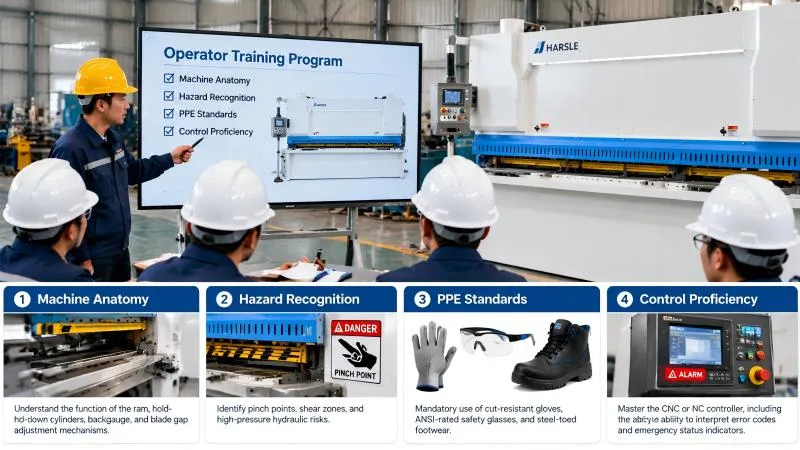
Before an individual is permitted to perform a safety check or operate an industrial shear, they must complete a comprehensive training program. This training should include:
- Machine Anatomy: Understanding the function of the ram, hold-down cylinders, backgauge, and blade gap adjustment mechanisms.
- Hazard Recognition: Identifying pinch points, shear zones, and high-pressure hydraulic risks.
- PPE Standards: Mandatory use of cut-resistant gloves, ANSI-rated safety glasses, and steel-toed footwear.
- Control Proficiency: Mastery of the CNC or NC controller, including the ability to interpret error codes and emergency status indicators.
Qualified Personnel vs. Operator Tasks
It is vital to distinguish between a visual inspection and a technical repair. Operators are responsible for identifying leaks, loose bolts, or dull blades. However, tasks such as adjusting hydraulic relief valves, replacing shear blades, or rewiring safety interlocks must be reserved for qualified personnel with specific electrical or mechanical certification. Attempting unauthorized repairs on high-pressure hydraulic systems (often exceeding 200 bar / 2,900 PSI) can result in fatal injection injuries.
Hazard and Control Measure Table
The following table outlines the primary hazards associated with industrial shearing machines and the corresponding control measures that must be verified during the pre-operation phase.
| Hazard Type | Description of Risk | Control Measure / Verification |
|---|---|---|
| Mechanical Shearing | Amputation or crushing from the descending ram or hold-downs. | Verify finger guards and light curtains are active and unobstructed. |
| Hydraulic Failure | High-pressure fluid injection or unexpected ram descent. | Inspect hoses for “sweating,” bulging, or leaks; check fluid levels. |
| Electrical Shock | Contact with exposed wiring or faulty grounding. | Ensure all cabinet doors are locked and conduits are undamaged. |
| Material Kickback | Unsecured material shifting during the cut cycle. | Check hold-down cylinder pressure and condition of grip pads. |
| Sharp Edges | Lacerations from handled material or the shear blades. | Mandatory use of cut-resistant PPE; use of magnetic lifters for small parts. |
Comprehensive Pre-Operation Safety Checklist
This checklist should be completed at the start of every shift. If any item fails inspection, the machine must be tagged out (LOTO) until a qualified technician clears it for use.
1. Visual and Environmental Inspection
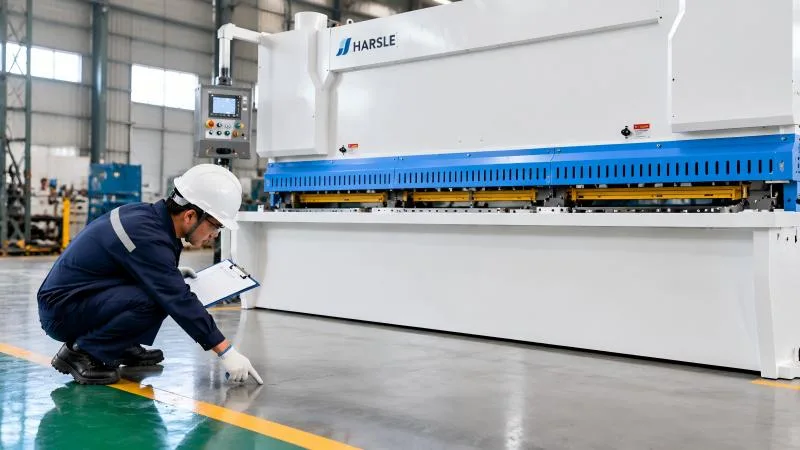
- Work Area Clarity: Ensure the floor around the shear is free of oil, metal off-cuts, and tripping hazards. There should be a minimum of 1 meter (approx. 3.3 feet) of clear space around the machine’s perimeter.
- Lighting: Verify that the shadow line lighting or work area LEDs are functioning. Proper visibility is essential for aligning material with the cutting edge.
- Machine Stability: Check the foundation bolts. Industrial shears generate significant vibration; any movement in the frame can lead to blade misalignment.
2. Mechanical Integrity and Blade Condition
- Blade Sharpness: Inspect the upper and lower blades for chips, cracks, or excessive rounding. Dull blades increase the required shearing force and can damage the hydraulic system.
- Blade Gap (Clearance): Ensure the blade gap is set according to the material thickness. For example, a common rule of thumb is 5% to 10% of the material thickness. Refer to the manufacturer’s chart for specific settings.
- Hold-Down Cylinders: Check that all hold-down feet are present and that the rubber or plastic pads are not worn down to the metal, which could mar the workpiece or allow it to slip.
3. Hydraulic System Verification
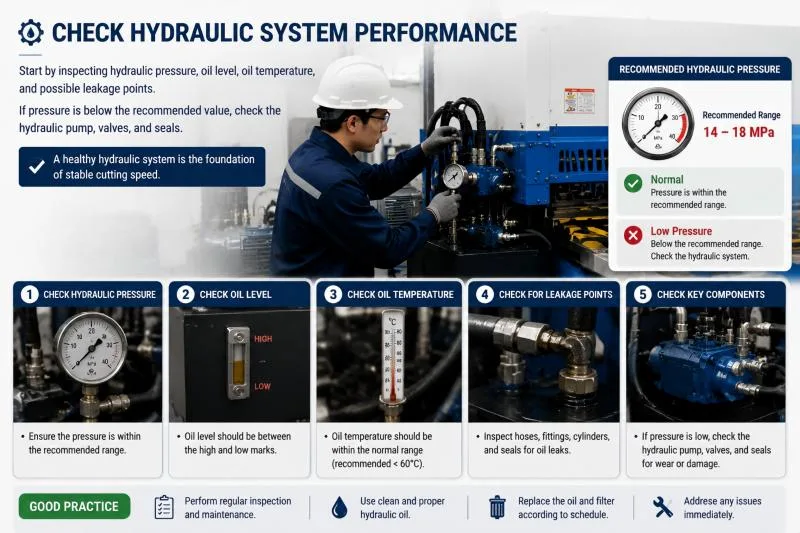
- Fluid Levels: Check the sight glass on the hydraulic reservoir. The oil (typically ISO 46 or 68) should be at the recommended level and appear clear, not milky (which indicates water contamination).
- Hose and Fitting Integrity: Look for signs of hydraulic weeping at the junctions. A small leak under low pressure can become a dangerous spray under load.
- Accumulator Pressure: For machines using nitrogen return cylinders, verify the pressure gauge is within the manufacturer’s specified range (often around 6-8 MPa for standard models).
4. Electrical Systems and Safety Devices
- Emergency Stop (E-Stop) Buttons: Test the E-stop on the main console and the remote foot pedal. The ram should stop immediately upon depression.
- Light Curtains / Photoelectric Sensors: Pass an object through the light beam while the ram is in a non-critical movement phase to ensure the system triggers a stop.
- Interlocked Rear Guards: Ensure the rear cage or fencing is secure. If the machine is equipped with interlocked doors, opening them should prevent the machine from cycling.
- Foot Pedal Condition: Inspect the foot pedal housing. The protective shroud must be intact to prevent accidental activation by falling objects.
Safe Operation Boundaries and Stop Conditions
Operating an industrial shearing machine requires staying within defined technical boundaries. Exceeding these limits not only risks the machine’s structural integrity but also poses a severe safety threat to the operator.
Material Thickness and Hardness Limits
Every shear has a maximum rated capacity based on mild steel (usually rated at 450 N/mm² tensile strength). If you are shearing stainless steel or high-carbon alloys, the maximum thickness capacity is significantly reduced—often by as much as 50%. Never attempt to shear material that exceeds the machine’s tonnage rating, as this can cause the frame to deflect or the blades to shatter.
Immediate Stop Conditions
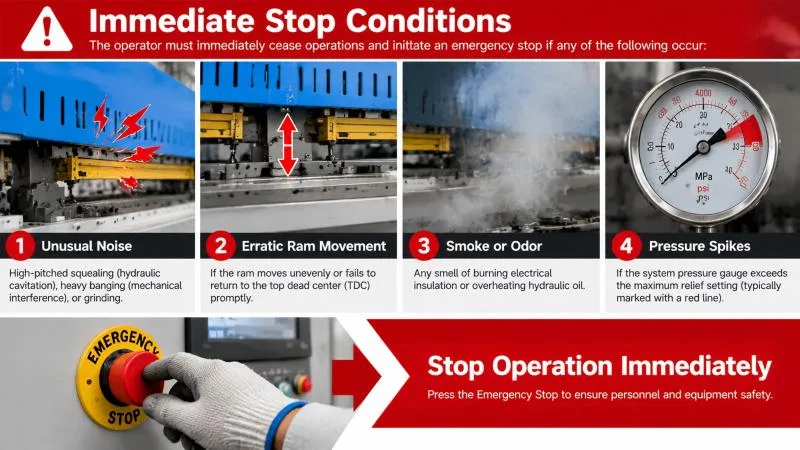
The operator must immediately cease operations and initiate an emergency stop if any of the following occur:
- Unusual Noise: High-pitched squealing (hydraulic cavitation), heavy banging (mechanical interference), or grinding.
- Erratic Ram Movement: If the ram moves unevenly or fails to return to the top dead center (TDC) promptly.
- Smoke or Odor: Any smell of burning electrical insulation or overheating hydraulic oil.
- Pressure Spikes: If the system pressure gauge exceeds the maximum relief setting (typically marked with a red line).
Emergency Response and Qualified-Personnel Escalation
In the event of a safety device failure or a mechanical breakdown, the following protocol must be observed:
- Immediate Shutdown: Press the nearest E-stop and turn off the main power disconnect.
- Lockout/Tagout (LOTO): Apply a personal lock and tag to the power source to ensure the machine cannot be restarted while being inspected.
- Report: Notify the floor supervisor and the maintenance department. Provide specific details regarding the failure (e.g., “Light curtain failed to reset” or “Hydraulic leak on cylinder 2”).
- Qualified Assessment: Only a certified technician should open the electrical cabinet or disassemble hydraulic manifolds. They must verify that all residual energy (including nitrogen pressure in accumulators) is bled off before beginning work.
Często zadawane pytania
How often should the blade gap be checked?
The blade gap should be checked and adjusted every time the material thickness or material type changes. Even if the material remains the same, a visual verification of the gap setting should be part of the daily Pre-Operation Safety Checklist for Industrial Shearing Machines to ensure no settings were accidentally altered during previous shifts.
Can I bypass a faulty light curtain for a single urgent job?
No. Bypassing, shunting, or disabling any safety device is a violation of international safety standards (such as OSHA 1910.212 or CE Machinery Directive) and is grounds for immediate disciplinary action. Safety systems are designed to protect life and limb; if they are non-functional, the machine is legally and practically “out of service.”
What is the purpose of the nitrogen accumulator in a hydraulic shear?
In many hydraulic shears, the nitrogen accumulator (or return cylinder) provides the force necessary to return the ram to its upper position. This system is faster and more energy-efficient than using hydraulic pressure for the return stroke. If the nitrogen pressure is too low, the ram may return slowly or not at all, creating a mechanical hazard.
Safety Review Checklist and Model-Manual References
To maintain a high standard of safety, management should conduct a weekly review of the daily checklists. This ensures that operators are performing diligent inspections rather than simply “pencil-whipping” the forms. Always refer to the specific operation manual provided with your machine (e.g., HARSLE QC11K or QC12Y series manuals) for model-specific torque values, pressure settings, and lubrication schedules.
Final Safety Reminder: The Pre-Operation Safety Checklist for Industrial Shearing Machines is your first line of defense. Never prioritize production speed over the verification of these safety protocols. If the machine doesn’t feel or sound right, stop and seek assistance.
For further technical guidance on maintaining your equipment, consult our comprehensive maintenance logs or contact a certified service representative for a professional safety audit.


