


When operators search for Shearing Machine Backgauge Calibration, they are usually trying to solve one clear problem—why their cutting dimensions are inconsistent or drifting over time. In this guide, I’ll walk you through how I normally calibrate the backgauge system on a shearing machine step by step, so you can restore accuracy, reduce scrap, and keep production stable. Whether you’re dealing with a new machine setup or correcting long-term deviation, this process will help you get back to reliable precision.
How to Prepare Before آلة القص معايرة المقياس الخلفي

Step 1: Ensuring Machine Stability and Safety
Before I start any Shearing Machine Backgauge Calibration, I always make sure the machine is completely powered off during inspection. Safety is the first priority. I also check that the machine is placed on a stable, level foundation, because even a slight tilt can affect measurement accuracy later in the process.
Step 2: Cleaning the Backgauge System
Dust, metal chips, and oil residues are common issues in daily production. I clean the backgauge rails, screws, and sensors carefully before calibration. A clean system ensures that no external resistance affects movement accuracy during adjustment.
Step 3: Checking Mechanical Wear
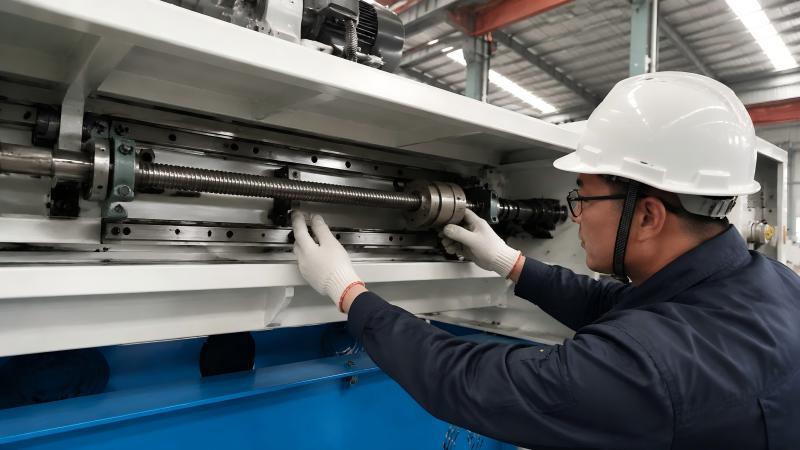
I inspect lead screws, guide rails, and coupling parts for wear or looseness. If there is mechanical backlash, calibration alone will not solve the problem. In that case, worn parts should be replaced first before continuing with Shearing Machine Backgauge Calibration.
How to Perform Shearing Machine Backgauge Calibration Step by Step
Step 1: Setting a Reference Position
I usually start by moving the backgauge to its zero reference position. Using a standard measuring tool such as a steel ruler or digital caliper, I verify the actual distance between the blade and the backgauge finger.
Step 2: Inputting Control System Parameters
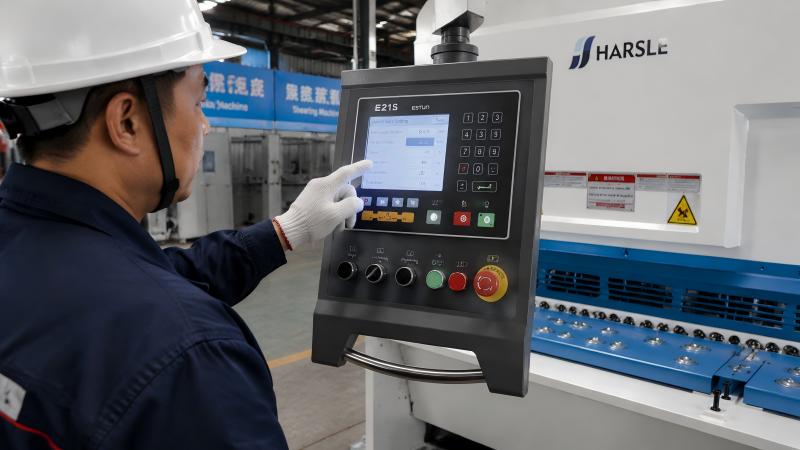
Next, I enter the machine’s control system and locate the backgauge parameter settings. Most modern shearing machines allow digital offset adjustment. I compare the displayed value with the actual measured distance and record any deviation.
Step 3: Adjusting Backgauge Offset Value
If there is a mismatch, I adjust the offset value in small increments. I never make large changes at once. Instead, I fine-tune gradually and recheck the measurement after each adjustment to ensure accuracy improves steadily.
Step 4: Testing Repeat Positioning Accuracy
After adjustment, I move the backgauge forward and backward several times. I measure the position repeatedly to confirm that the system returns to the same point consistently. Repeatability is a key indicator of correct Shearing Machine Backgauge Calibration.
Step 5: Performing a Trial Cut
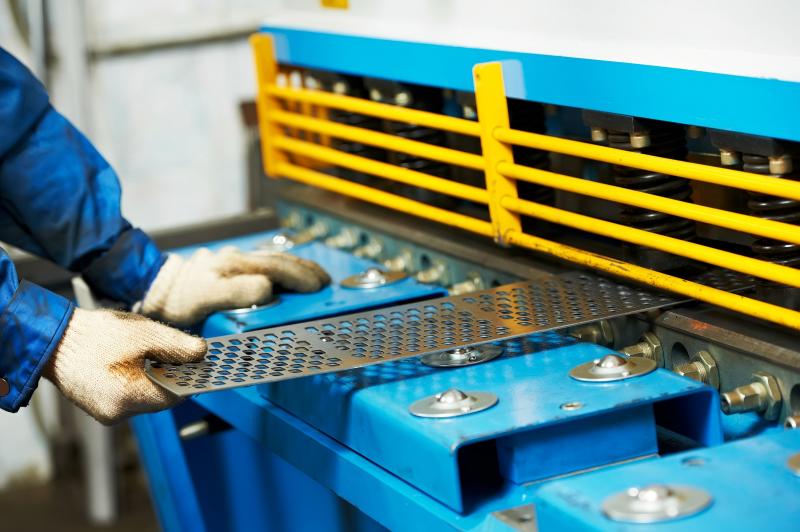
Finally, I perform a trial cutting test using a standard sheet size. I measure the finished product against the target dimension. If the error is within tolerance, the calibration is successful. If not, I repeat the fine adjustment process.
Common Issues During Shearing Machine Backgauge Calibration
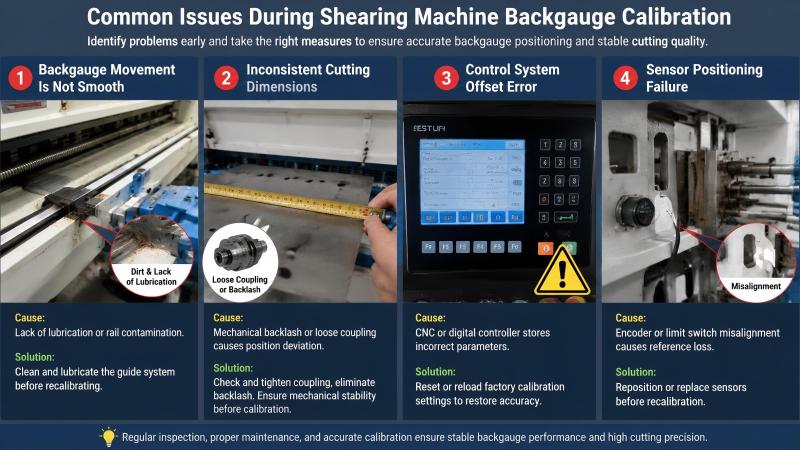
Backgauge Movement Is Not Smooth
This usually happens due to lack of lubrication or rail contamination. I recommend cleaning and lubricating the guide system before recalibrating.
Inconsistent Cutting Dimensions
If dimensions vary between cuts, the issue is often mechanical backlash or loose coupling. Calibration alone cannot fix this unless the mechanical system is stable.
Control System Offset Error
Sometimes the CNC or digital controller stores incorrect parameters. Resetting or reloading factory calibration settings can help restore accuracy.
Sensor Positioning Failure
If the encoder or limit switch is misaligned, the backgauge may lose its reference point. Repositioning or replacing sensors is necessary before recalibration.
التعليمات
What is the purpose of Shearing Machine Backgauge Calibration?
The main purpose is to ensure cutting accuracy by aligning the backgauge position with the machine’s control system, reducing dimensional errors during shearing operations.
How often should I perform Shearing Machine Backgauge Calibration?
In my experience, calibration should be checked every 3–6 months, or immediately if you notice inconsistent cutting dimensions or after mechanical maintenance.
Can I calibrate the backgauge without special tools?
Basic calibration can be done with a steel ruler or caliper, but for high precision work, I recommend using digital measuring tools.
خاتمة
Proper Shearing Machine Backgauge Calibration is essential for maintaining cutting accuracy, reducing waste, and improving overall production efficiency. By following a structured calibration process—checking mechanical condition, adjusting system parameters, and verifying repeat accuracy—you can keep your machine performing reliably over the long term.
If you’re still experiencing accuracy issues or need technical support for your shearing machine, feel free to contact our HARSLE engineering team. We’re always here to help you improve production stability and achieve better machining results.


