


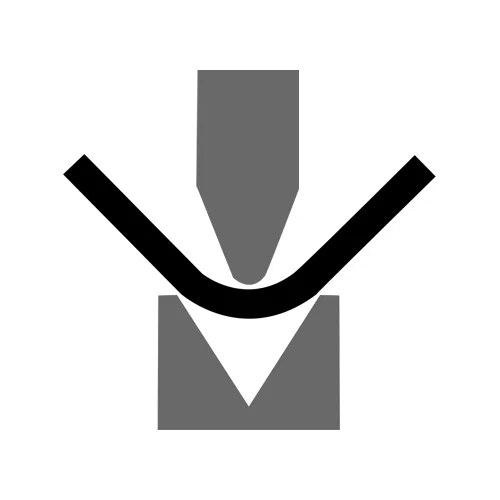
The radius air bending calculator helps you form large inside radii with a radius punch. Die selection gives the V-opening window, 2.2 to 2.5 × (t + R); Radius result predicts how much the radius opens after springback. Example: a 25 mm radius in 3 mm steel needs a 61.6–70 mm die — use a standard 63 mm V-die.
- Free, no sign-up
- Metric & imperial
- Instant results
- Shareable link
Results
LiveRecommended V-diestandard V-die · range 61.6–70.0 mm
- Minimum V-opening
- 61.6 mm
- Maximum V-opening
- 70.0 mm
- Standard die to use
- 63 mm
- Radius increase
- —
- Angle factor Ks
- —
Radius result uses the elastic springback equation with typical yield strength and modulus for the material.
Radius air bending formulas
Vmin = 2.2 × (t + R) · Vmax = 2.5 × (t + R)Die window for a radius punch of radius R
Rf = R / (4x³ − 3x + 1), x = R × Y / (E × t)Final radius after springback
A normal sharp punch in air bending produces a natural radius of about 16% of the V-die. When the drawing asks for a larger radius, use a punch with that radius and a die wide enough for the sheet to wrap around it: too narrow and the sheet is pinched between punch and shoulders; too wide and the sheet does not follow the punch, so the radius becomes uncontrolled. Once the radius exceeds roughly 8–10 × t, consider bump bending or a plate roll instead.
How to use the Radius Air Bending Calculator
- Choose Die selection to size the V-die, or Radius result to predict the final radius.
- Enter thickness and the punch radius.
- For Radius result, also pick the material.
Worked example
3 mm mild steel, 25 mm radius punch. Vmin = 2.2 × 28 = 61.6 mm, Vmax = 2.5 × 28 = 70 mm → standard 63 mm V-die. After springback the radius opens to 25.78 mm and a 90° bend relaxes to about 87.4°, so program about 92.6°.
Die window for radius punches (mm)
| Thickness t | Punch radius R | Min. V | Max. V |
|---|---|---|---|
| 2 | 10 | 26.4 | 30.0 |
| 3 | 15 | 39.6 | 45.0 |
| 3 | 25 | 61.6 | 70.0 |
| 4 | 30 | 74.8 | 85.0 |
| 5 | 40 | 99.0 | 112.5 |
| 6 | 50 | 123.2 | 140.0 |
| 8 | 60 | 149.6 | 170.0 |
| 10 | 80 | 198.0 | 225.0 |
| 12 | 100 | 246.4 | 280.0 |
Frequently asked questions
What V-die do I need for a radius punch?
Between 2.2 and 2.5 times the sum of thickness and punch radius. For a 10 mm radius in 2 mm sheet that is 26.4–30 mm, so a standard 30 mm die (or a 25–32 mm die) is used.
Why is the final radius bigger than the punch radius?
After the punch retracts the sheet springs back elastically. The radius opens slightly and the angle opens with it. Harder materials and larger radii open more.
When should I use bump bending instead?
When the radius is much larger than a practical radius punch — typically above 8–10 × thickness or above about 100 mm. Bump bending forms the radius from many small bends.
Can I get a large radius just by using a wider V-die?
Partly: the natural air-bend radius is about 16% of V. But a very wide die with a sharp punch gives a less consistent, slightly elliptical radius. A radius punch gives a far more accurate result.
Reviewed by the HARSLE engineering team · Last updated October 2026. Results are engineering estimates; confirm critical values with your machine and tooling documentation.
Recommended V-die—