


The V-opening calculator recommends the right bottom die for your sheet thickness. As a rule, the V-die opening should be 6 to 12 times the thickness, typically 8 ×. For 3 mm mild steel the optimal V-die is 25 mm (minimum 18 mm, maximum 40 mm), giving an inside radius of about 4 mm at 23.5 T/m.
- Free, no sign-up
- Metric & imperial
- Instant results
- Shareable link
Results
LiveOptimal V-die openingOptimal V-die · 8.3 × thickness
- Minimum V-die
- 18 mm
- Maximum V-die
- 40 mm
- Inside radius (optimal die)
- ≈ 4.0 mm
- Minimum flange (90°)
- 19.5 mm
- Force per meter (optimal die)
- 23.5 T/m
- Source
- HARSLE die chart (3 mm row)
Stainless steel uses about 20% wider dies and aluminum about 20% narrower dies than mild steel. Force is for air bending.
How to choose the V-die opening
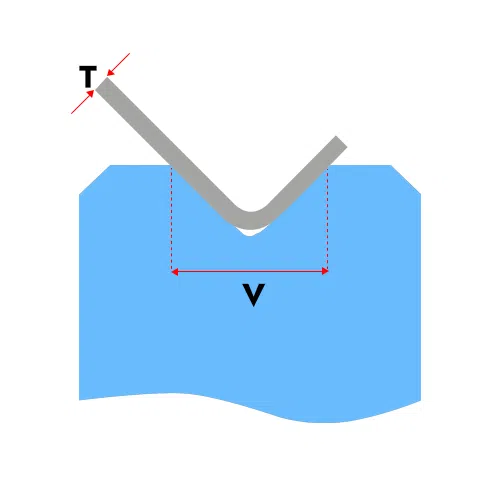
V ≈ 8 × tCommon range 6 × t (minimum) to 12 × t (maximum); 10–12 × t above 12 mm
The V-opening is the single most important tooling choice on a press brake because it sets three things at once:
- Inside radius – in air bending the sheet forms a natural radius of about 16% of V for mild steel (20–22% for stainless).
- Tonnage – force is inversely proportional to V: halve the die and you double the force.
- Minimum flange – the flange must bridge the die, so it must be at least about 0.78 × V for a 90° bend.
Choose the minimum die when you need a tight radius or short flange and have tonnage to spare; choose the maximum die to reduce force, avoid marking, or bend high-strength steel.
How to use the V-Opening Calculator
- Select the material.
- Enter the sheet thickness in mm or inch.
- Read the optimal, minimum and maximum V-die and check the radius, flange and force for the optimal die.
Worked example
3 mm mild steel. The die chart gives V = 18 / 25 / 40 mm (minimum / optimal / maximum). On the 25 mm die: inside radius ≈ 0.16 × 25 = 4.0 mm, minimum flange ≈ 0.78 × 25 = 19.5 mm, force = 1.42 × 450 × 3² / 25 = 230 kN/m = 23.5 T/m.
V-die opening chart (mild steel)
| Thickness (mm) | Thickness (in) | Min. V (mm) | Optimal V (mm) | Max. V (mm) | Radius at optimal V (mm) | Force at optimal V (T/m) |
|---|---|---|---|---|---|---|
| 0.5 | 0.020 | 4 | 4 | 6 | 0.6 | 4.1 |
| 0.6 | 0.024 | 4 | 4 | 8 | 0.6 | 5.9 |
| 0.8 | 0.031 | 6 | 6 | 10 | 1.0 | 7.0 |
| 1 | 0.039 | 6 | 6 | 12 | 1.0 | 10.9 |
| 1.2 | 0.047 | 7 | 8 | 16 | 1.3 | 11.7 |
| 1.4 | 0.055 | 8 | 8 | 18 | 1.3 | 16.0 |
| 1.6 | 0.063 | 10 | 10 | 20 | 1.6 | 16.7 |
| 2 | 0.079 | 12 | 12 | 25 | 1.9 | 21.7 |
| 2.3 | 0.091 | 14 | 14 | 32 | 2.2 | 24.6 |
| 2.6 | 0.102 | 16 | 16 | 32 | 2.6 | 27.5 |
| 3 | 0.118 | 18 | 25 | 40 | 4.0 | 23.5 |
| 3.2 | 0.126 | 20 | 25 | 50 | 4.0 | 26.7 |
| 3.5 | 0.138 | 22 | 25 | 63 | 4.0 | 31.9 |
| 4 | 0.157 | 25 | 32 | 63 | 5.1 | 32.6 |
| 4.5 | 0.177 | 32 | 40 | 63 | 6.4 | 33.0 |
| 5 | 0.197 | 32 | 40 | 80 | 6.4 | 40.7 |
| 6 | 0.236 | 40 | 50 | 100 | 8.0 | 46.9 |
| 7 | 0.276 | 63 | 63 | 125 | 10.1 | 50.7 |
| 8 | 0.315 | 63 | 63 | 125 | 10.1 | 66.2 |
| 9 | 0.354 | 80 | 100 | 125 | 16.0 | 52.8 |
| 10 | 0.394 | 80 | 100 | 160 | 16.0 | 65.2 |
| 12 | 0.472 | 100 | 125 | 200 | 20.0 | 75.1 |
| 16 | 0.630 | 125 | 200 | 250 | 32.0 | 83.4 |
| 19 | 0.748 | 160 | 250 | 250 | 40.0 | 94.1 |
Frequently asked questions
What V-die should I use for 2 mm sheet?
A 12 mm V-die is the standard choice for 2 mm mild steel (6 × t); 16 mm is common in practice for longer parts and lower force, and 25 mm is the maximum. Stainless steel of the same thickness usually runs on 16 mm.
What is the 8 times rule for press brake dies?
The V-die opening should be about eight times the sheet thickness. It balances force, inside radius and minimum flange for most mild steel up to about 12 mm. Thicker plate and high-strength steel need 10–12 × t.
What happens if the V-die is too small?
Force rises sharply, the sheet can crack on the outside of the bend, the die shoulders leave marks, and you risk overloading the tooling. Below about 6 × t is only used for bottoming thin sheet.
What happens if the V-die is too large?
The inside radius grows (about 16% of V), the minimum flange gets longer and the angle becomes less consistent. Very wide dies are used deliberately for high-strength steel and large radii.
Reviewed by the HARSLE engineering team · Last updated October 2026. Results are engineering estimates; confirm critical values with your machine and tooling documentation.
Optimal V-die opening—