


The shearing force calculator estimates the force a plate shear needs with an inclined (raked) blade: F = 0.6 × σb × t² / tan α. Cutting 6 mm mild steel with a 1.5° rake angle takes about 38 T (371 kN). It also converts any material to the mild-steel thickness that shear ratings are based on.
- Free, no sign-up
- Metric & imperial
- Instant results
- Shareable link
Results
LiveShearing force371 kN · 41.7 US tons
- Recommended capacity (+30%)
- 483 kN (49.2 T)
- Equivalent thickness
- 6.0 mm mild steel
- Blade length in contact
- 229 mm
- Suggested blade gap
- 0.48 mm (≈ 8% of t)
The 30% margin covers blade wear, blade gap and plate hold-down. Shear ratings (e.g. 6 × 3200) refer to mild steel of 450 MPa.
Shearing force formula
F = 0.6 × σb × t² / tan αF in N · σb tensile strength in MPa · t thickness in mm · α blade rake angle
- σb ultimate tensile strength of the material
- t plate thickness
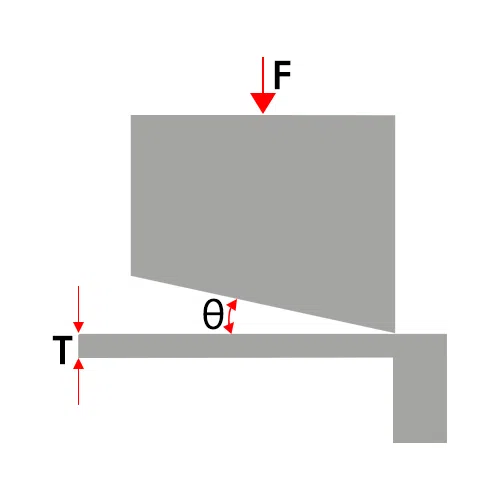
- α rake angle of the upper blade
- 0.6 ratio of shear strength to tensile strength (≈ 0.6–0.8)
Because the upper blade is inclined, only a short length of blade (t / tan α) is cutting at any moment, so the force does not depend on the plate width. A larger rake angle cuts with less force but bends and twists narrow strips more. To compare a material with a shear rated for mild steel, use the equivalent thickness t × √(σb / 450): 6 mm stainless steel needs the same force as about 7.2 mm mild steel.
How to use the Shearing Force Calculator
- Select the material (or enter its tensile strength).
- Enter the plate thickness.
- Enter the shear’s rake angle (from the machine specification).
- Compare the equivalent thickness with the shear’s rated capacity.
Worked example
6 mm mild steel, rake angle 1.5°. F = 0.6 × 450 × 6² / tan 1.5° = 9,720 / 0.02619 = 371 kN (37.9 T). With a 30% margin choose a shear rated for at least 483 kN — a standard 6 mm hydraulic shear. The same cut in 304 stainless steel (650 MPa) needs 536 kN, equivalent to 7.2 mm mild steel, so use an 8 mm shear.
Shearing force chart (metric tons, T)
Typical rake angle for each thickness. Mild steel 450 MPa, stainless steel 650 MPa, aluminum 5052 230 MPa.
| Thickness (mm) | Rake angle | Mild steel (T) | Stainless steel (T) | Aluminum (T) |
|---|---|---|---|---|
| 3 | 1.5° | 9.5 | 13.7 | 4.8 |
| 4 | 1.5° | 16.8 | 24.3 | 8.6 |
| 6 | 1.5° | 37.9 | 54.7 | 19.3 |
| 8 | 2° | 50.5 | 72.9 | 25.8 |
| 10 | 2° | 78.8 | 113.9 | 40.3 |
| 12 | 2° | 113.5 | 164.0 | 58.0 |
| 16 | 2.5° | 161.4 | 233.2 | 82.5 |
| 20 | 2.5° | 252.2 | 364.3 | 128.9 |
| 25 | 3° | 328.3 | 474.3 | 167.8 |
| 32 | 3° | 538.0 | 777.0 | 275.0 |
| 40 | 3° | 840.6 | 1,214.1 | 429.6 |
Frequently asked questions
How do you calculate shearing force?
For a guillotine or swing-beam shear with an inclined blade, F = 0.6 × σb × t² / tan α (N), with tensile strength σb in MPa, thickness t in mm and rake angle α. For straight (parallel) blades, F = 0.8 × σb × t × L, where L is the length of the cut.
What shear do I need for stainless steel?
Stainless steel needs about 45% more force than mild steel. Multiply the stainless thickness by about 1.2 to get the equivalent mild-steel thickness: a 6 mm mild steel shear cuts about 5 mm stainless; to cut 6 mm stainless you need an 8 mm class machine.
What is the rake angle of a shear?
It is the angle of the upper blade relative to the lower blade. Swing-beam shears usually have a fixed angle of about 1.5–2°; guillotine shears often allow 0.5–3.5° to balance force against strip distortion.
Why do I need a 30% margin?
Worn blades, an incorrect blade gap, harder material batches and plate thickness tolerance all raise the real cutting force. A 25–30% margin keeps the machine within its rated load.
Reviewed by the HARSLE engineering team · Last updated October 2026. Results are engineering estimates; confirm critical values with your machine and tooling documentation.
Shearing force—