


The metal weight calculator gives the weight of plate, bar, tube and profiles in kg and lb. Weight = volume × density: a 2,000 × 1,000 × 3 mm steel sheet weighs 47.1 kg (7.85 kg per m² per mm of thickness). Choose the material and shape, enter the sizes in mm, cm, m, inch or feet, and add a quantity and price for quoting.
- Free, no sign-up
- Instant results
- Shareable link
Results
LiveTotal weight103.84 lb
- Weight per piece
- 47.10 kg (103.84 lb)
- Total weight
- 47.10 kg (103.84 lb)
- Weight per meter / m²
- 23.55 kg/m² (4.823 lb/ft²)
- Volume per piece
- 6,000 cm³
- Material cost
- —
Nominal weight from nominal dimensions. Rolled plate and tube can be 2–5% heavier because of thickness tolerance and corner radii.
Metal weight formulas
Weight = cross-section area × length × density
- Plate W × T × L
- Round bar π × D² / 4 × L
- Square bar S² × L · Hex bar 0.866 × S² × L
- Round tube π × (D² − (D − 2T)²) / 4 × L
- Rectangular tube (W × B − (W − 2T)(B − 2T)) × L
- Angle T × (W + B − T) × L
- Sphere π × D³ / 6
Shortcut for steel plate: kg = length (m) × width (m) × thickness (mm) × 7.85. For aluminum use 2.7, for stainless steel 7.93.
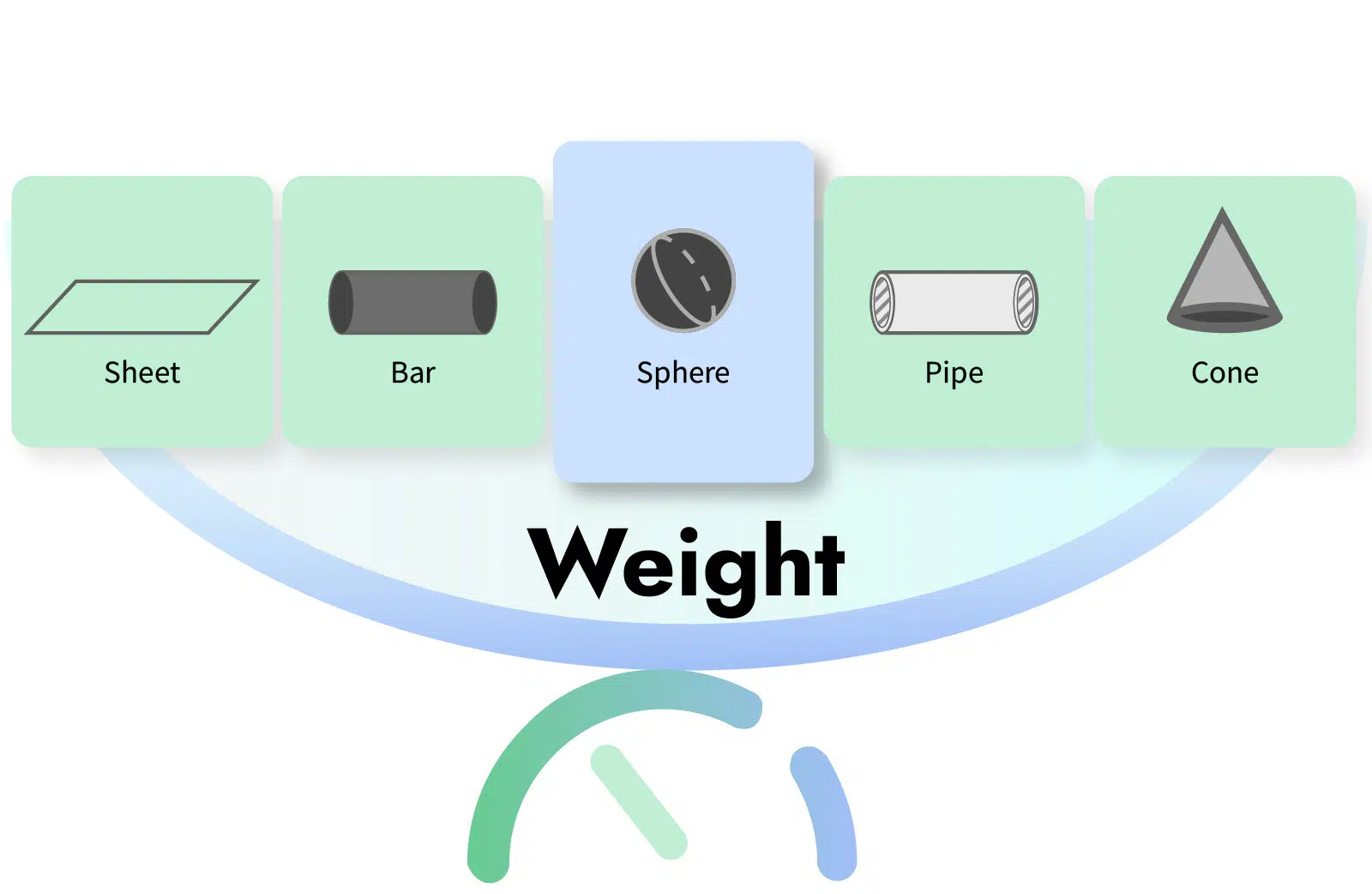
How to use the Metal Weight Calculator
- Choose the material and the shape.
- Pick the unit of your drawing (mm, cm, m, inch or feet).
- Enter the dimensions and the quantity.
- Optionally enter a price per kg or lb to get the material cost.
Worked example
Steel plate 2,000 × 1,000 × 3 mm. Volume = 2 × 1 × 0.003 = 0.006 m³ → 0.006 × 7,850 = 47.1 kg (103.8 lb). A Ø50 mm round bar 1 m long weighs π × 0.05²/4 × 7,850 = 15.4 kg.
Metal density table
| Material | kg/m³ | g/cm³ | lb/in³ | kg/m² per mm |
|---|---|---|---|---|
| Carbon / mild steel | 7,850 | 7.85 | 0.2836 | 7.85 |
| Stainless steel 304 / 316 | 7,930 | 7.93 | 0.2865 | 7.93 |
| Stainless steel 430 | 7,700 | 7.70 | 0.2782 | 7.70 |
| Cast iron | 7,200 | 7.20 | 0.2601 | 7.20 |
| Aluminum 6061 / 1050 | 2,700 | 2.70 | 0.0975 | 2.70 |
| Aluminum 5052 / 5083 | 2,680 | 2.68 | 0.0968 | 2.68 |
| Copper | 8,960 | 8.96 | 0.3237 | 8.96 |
| Brass | 8,500 | 8.50 | 0.3071 | 8.50 |
| Bronze | 8,800 | 8.80 | 0.3179 | 8.80 |
| Titanium | 4,510 | 4.51 | 0.1629 | 4.51 |
| Zinc | 7,140 | 7.14 | 0.2579 | 7.14 |
| Nickel | 8,900 | 8.90 | 0.3215 | 8.90 |
| Lead | 11,340 | 11.34 | 0.4097 | 11.34 |
| Magnesium | 1,740 | 1.74 | 0.0629 | 1.74 |
Frequently asked questions
How do I calculate the weight of a steel plate?
Multiply length (m) × width (m) × thickness (mm) × 7.85. A 2.5 × 1.25 m sheet of 5 mm steel weighs 2.5 × 1.25 × 5 × 7.85 = 122.7 kg.
What is the density of steel and aluminum?
Carbon steel is about 7,850 kg/m³ (0.284 lb/in³), stainless steel 7,930 kg/m³ and aluminum 2,700 kg/m³ — about one third of steel.
How much does a meter of steel pipe weigh?
kg/m = (D − T) × T × 0.02466 with D and T in mm. A 60.3 × 3.9 mm pipe weighs about 5.42 kg/m.
Why is my real weight different?
Mills supply plate within thickness tolerances, tubes have rounded corners and profiles have root radii. Expect differences of a few percent from nominal weight.
Reviewed by the HARSLE engineering team · Last updated October 2026. Results are engineering estimates; confirm critical values with your machine and tooling documentation.
Total weight—