


The offset calculator sets up a one-hit offset (Z-bend) with press brake offset tooling. Angle ≈ 90° × H / Htool and stroke ≈ 0.707 × H. For a 10 mm offset with a 15 mm offset tool, each leg bends about 60° and the stroke depth is 7.07 mm.
- Free, no sign-up
- Metric & imperial
- Instant results
- Shareable link
Results
LiveEstimated bend angleestimated bend angle in each leg
- Stroke depth
- 7.07 mm
- Bend angle per leg
- 60.0°
- Included angle per leg
- 120.0°
- Tool utilisation
- 67% of tool height
Offset tool behaviour varies by tool design; use these values for the first part and fine-tune the stroke.
Offset bending formulas
θ = 90° × H / HtoolEstimated bend angle of each leg of the offset
Stroke depth = H × sin 45° = 0.7071 × H
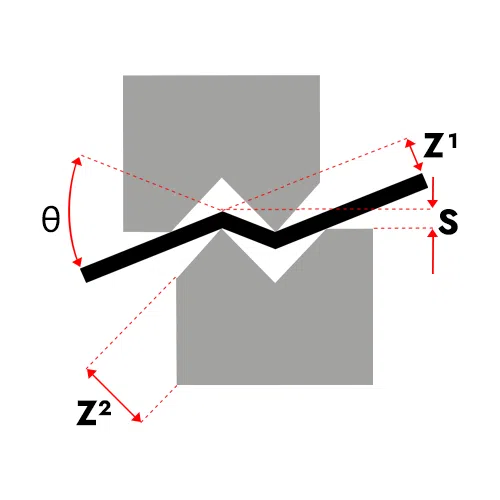
Offset (joggle) tools form both bends of a Z-shape in a single stroke. The tool is designed to produce its full offset height at 90°; a smaller offset is produced by a shallower stroke and a proportionally smaller angle. Use it for flanges that overlap, lap joints and stepped panels. For offsets deeper than the tool, form two separate bends.
How to use the Offset Calculator
- Enter the offset height you need.
- Enter the offset tool height from the tool data.
- Read the bend angle and stroke depth and run a test part.
Worked example
10 mm offset with a 15 mm offset tool. θ = 90 × 10/15 = 60° per leg (included 120°); stroke = 0.7071 × 10 = 7.07 mm.
Frequently asked questions
What is an offset bend?
An offset (Z-bend or joggle) is two opposite bends close together that shift a flange sideways by a fixed height, for example so one panel overlaps another flush.
Can I make an offset without offset tooling?
Yes, with two separate bends, but the minimum distance between them is limited by the die width. Offset tools form both bends in one stroke and allow very short offsets.
What if the offset is larger than the tool?
The tool cannot form it in one stroke. Use a taller offset tool or two independent bends with standard tooling.
Reviewed by the HARSLE engineering team · Last updated October 2026. Results are engineering estimates; confirm critical values with your machine and tooling documentation.
Estimated bend angle—