


Learn how to remove the Y27 hydraulic press piston rod, including cylinder cover disassembly, ram support, piston removal, and essential safety precautions.
Introduzione
Removing the Y27 hydraulic press piston rod is an important maintenance procedure when technicians need to inspect the hydraulic cylinder, examine the piston assembly, or investigate possible internal component problems. Because the piston rod and cylinder components are connected to heavy moving structures, the disassembly process requires careful preparation, controlled support, and a clear understanding of the machine’s mechanical arrangement.
In this HARSLE after-sales maintenance tutorial, we demonstrate the main disassembly sequence, including removing the cylinder cover bolts, supporting the cylinder cover, lowering the ram to expose the piston rod, and removing the piston assembly.
The following instructions are based on the demonstrated procedure and are intended to help qualified maintenance personnel understand the sequence before performing similar work.
Understanding the Y27 Hydraulic Cylinder Assembly
The hydraulic cylinder is one of the main working components of a Y27 hydraulic press, converting hydraulic pressure into the mechanical force required for pressing operations.
Inside the cylinder, the piston and piston rod work together to transmit force and control the movement of the connected machine structure. The cylinder cover forms part of the assembly and must be handled carefully during disassembly.
When inspecting the Y27 hydraulic press piston rod, technicians may need access to the piston, sealing components, and other internal surfaces to determine whether wear, deformation, or damage has occurred.
However, removing these components without adequate support can create serious mechanical hazards. The weight of the cylinder cover and ram must therefore be considered before any retaining bolts are loosened.
Preparation Before Piston Rod Disassembly
Before beginning the removal procedure, the machine must be taken out of service and prepared for maintenance by qualified personnel.
Electrical power should be isolated using the appropriate lockout procedure, and stored hydraulic pressure must be safely released according to the machine’s maintenance requirements. The ram and other moving components must also be mechanically secured against unexpected movement.
The demonstrated procedure uses a forklift to assist with supporting the cylinder cover and ram. Before attempting similar work, technicians must verify the weight of the components, the lifting equipment’s rated capacity, and the stability of the proposed lifting arrangement.
A forklift should not be assumed to provide adequate support simply because its forks can reach the component. Suitable load restraints, approved lifting attachments, and independent mechanical supports may be necessary to prevent movement or falling loads.
The work area should remain clear of unnecessary personnel, and nobody should stand beneath an unsupported component or place their hands between moving parts.
These precautions are particularly important because the Y27 hydraulic press piston rod cannot be accessed safely unless the surrounding assembly is properly supported.
How to Remove the Y27 Hydraulic Press Piston Rod
Remove the Lower Section Bolts
The demonstrated disassembly procedure begins with removing the retaining bolts from the lower section of the cylinder cover assembly.
Rather than removing every fastener at once, the technician first loosens and removes the bolts in the lower section while maintaining the remaining connections.
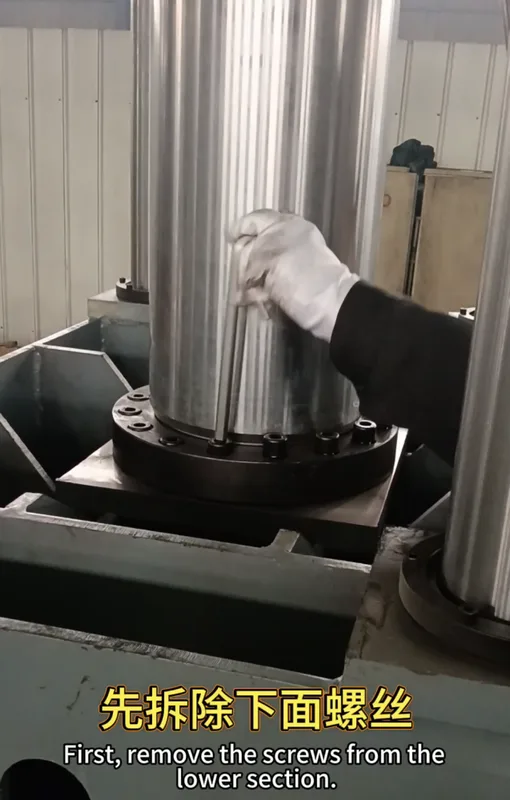
Two bolts are then inserted to provide temporary retention of the assembly during the following operations.
This temporary fastening arrangement is part of the demonstrated sequence, but it should not be treated as a substitute for a verified load-support system. The bolts must not be relied upon to carry an unverified suspended load.
Remove the Upper Section Bolts
After completing the lower section, the technician proceeds to remove the bolts from the upper section of the cylinder cover assembly.
Two bolts are initially left in place to retain the cover while the lifting equipment is positioned.
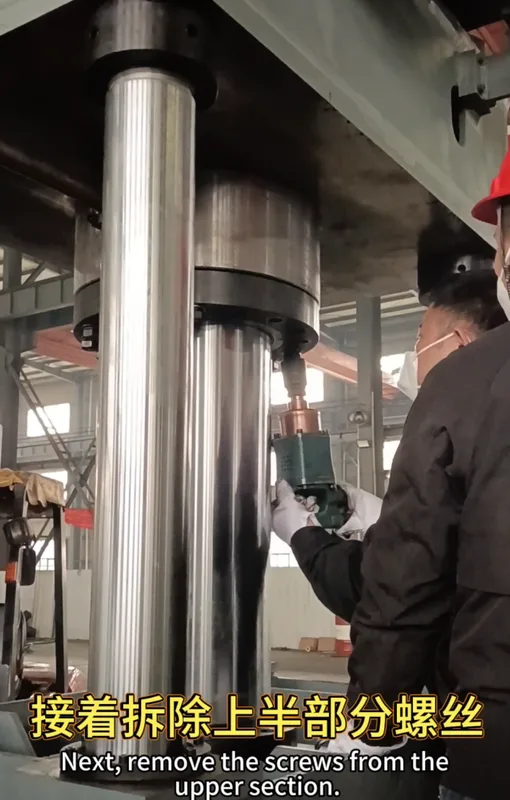
Removing the fasteners in stages allows the technician to prepare the assembly for the next operation without releasing all of its mechanical connections simultaneously.
The exact fastener arrangement and loading conditions must be checked against the particular machine before proceeding.
Support and Remove the Hydraulic Cylinder Cover
The next stage of Y27 hydraulic press piston rod removal involves supporting the cylinder cover before releasing its final retaining bolts.
In the video, the forklift forks are raised beneath the hydraulic cylinder cover to provide support during removal.
Once the cover is supported, the technician removes the two remaining bolts from the upper section and carefully separates the cover from the cylinder assembly.
Because the cylinder cover may be heavy and its center of gravity may not be obvious, the lifting arrangement must be verified before the final fasteners are released. The cover must remain stable throughout the removal process.
The demonstrated use of a forklift illustrates the general handling sequence, but the specific support method must be approved for the component’s weight, geometry, and lifting points.
Support the Ram and Expose the Piston Rod
After removing the cylinder cover, the technician proceeds to the next stage by supporting the ram with the forklift.
The video demonstrates the ram being lowered gradually until the hydraulic cylinder piston rod becomes exposed.
This is a critical stage because the ram is a heavy moving component, and uncontrolled movement could damage the equipment or cause serious injury.
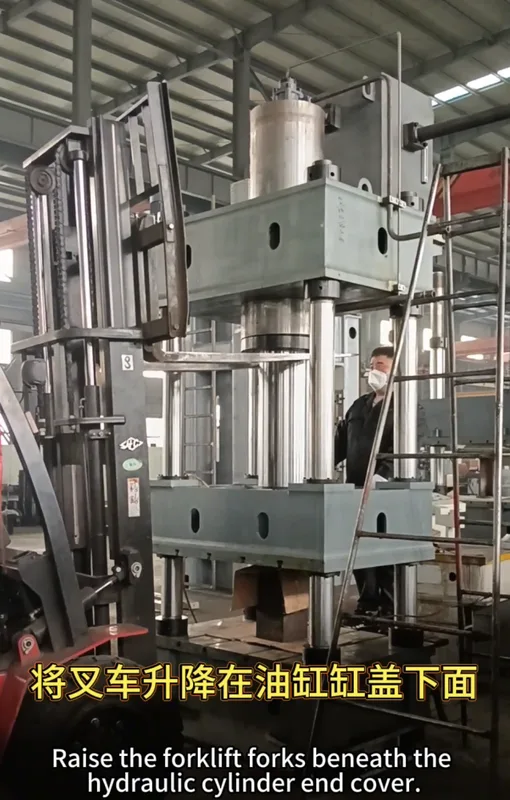
Any lowering operation must therefore be performed using a verified, controlled method with suitable mechanical support. Personnel must remain outside the potential movement and pinch-point areas.
Once the ram has been lowered to the required position and securely supported, the Y27 hydraulic press piston rod becomes accessible for the following disassembly operation.
Remove the Piston from the Piston Rod
The final operation demonstrated in the video is the removal of the piston from the exposed piston rod.
At this stage, the technician has gained access to the piston assembly and can proceed with the required maintenance inspection.
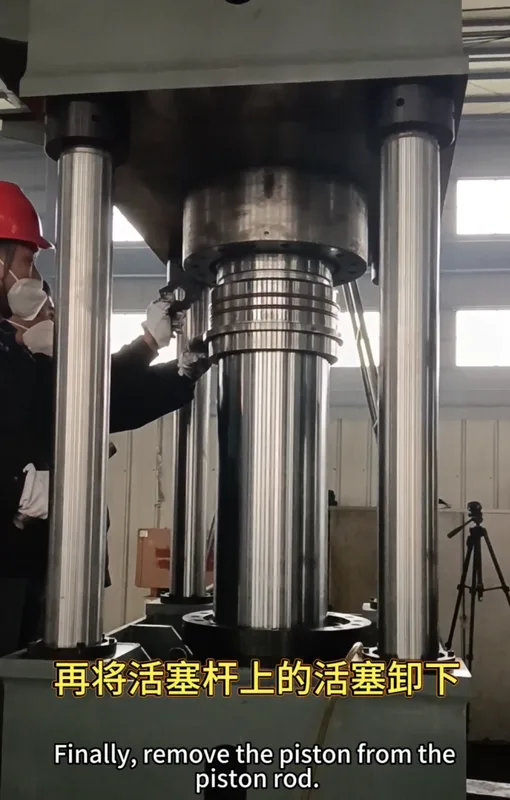
The video identifies piston removal as the final step but does not provide sufficient detail to establish a universal method for releasing its retaining mechanism.
Before removing the piston, technicians should confirm the actual fixing structure and follow the applicable manufacturer-approved disassembly procedure.
After the piston has been removed, the relevant components can be examined to determine whether further maintenance or replacement is required.
Important Inspection Points After Disassembly
Una volta che il Y27 hydraulic press piston rod and piston assembly are accessible, technicians can begin checking the components associated with the reported maintenance problem.
Depending on the reason for disassembly, inspection may include examining the piston surface, visible sealing components, rod condition, and accessible cylinder surfaces for signs of abnormal wear or damage.
Particular attention should be paid to sealing components that appear deformed, cut, displaced, or otherwise damaged. Any suspected defect should be documented with clear photographs before the components are cleaned or replaced.
The condition of the piston rod surface is also important because scratches, corrosion, or other surface defects may affect the performance of the hydraulic sealing system.
If the cause of a malfunction remains unclear, technicians should contact the HARSLE technical support team and provide photographs or videos of the relevant components for further evaluation.
Precautions for Reassembly and Maintenance
After inspecting the Y27 hydraulic press piston rod, technicians should determine whether the existing components can be reused or whether replacement parts are required.
Before reassembly, the condition of the sealing components, fastening surfaces, and related mechanical connections should be confirmed.
Reassembly must follow the applicable machine documentation, including the correct component orientation, fastener specifications, tightening requirements, and approved lifting arrangements.
Because the provided video focuses on disassembly, it should not be used as the sole reference for reinstalling the piston and cylinder cover.
After the assembly has been restored, qualified technicians should complete the necessary inspections and controlled functional checks before returning the machine to normal production.
Conclusione
Capire il Y27 hydraulic press piston rod removal procedure helps maintenance personnel prepare for hydraulic cylinder inspection and related repair work.
The HARSLE tutorial demonstrates a staged disassembly process involving lower and upper retaining bolts, temporary fastening, cylinder cover support, controlled ram lowering, and piston removal.
Throughout the procedure, proper load support, hydraulic pressure isolation, and careful component handling are essential to preventing equipment damage and personal injury.
For technical assistance with hydraulic press maintenance, spare parts, or cylinder inspection, contact the HARSLE after-sales service team.
Visita HARSLE for more hydraulic press maintenance guides and technical support.


