


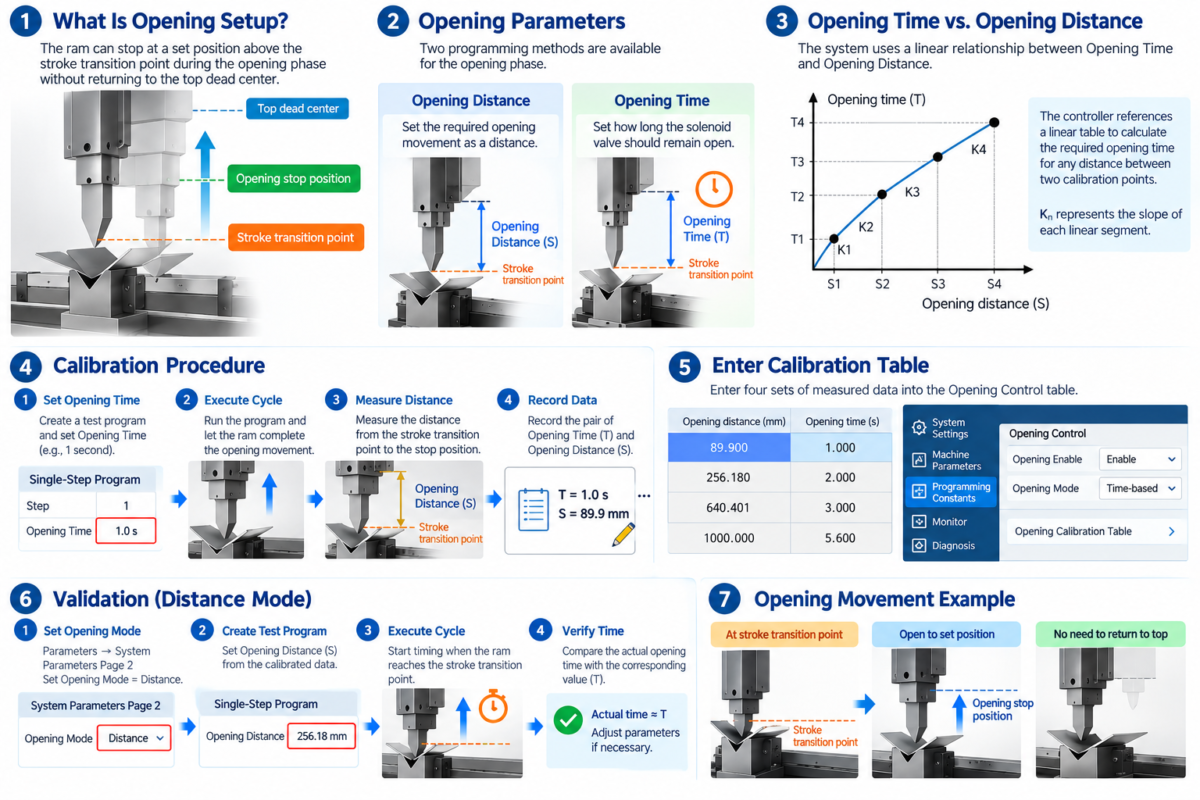
ESTUN E315P Opening Setup determines how the press brake ram moves during the opening phase after a bending operation. Instead of requiring the ram to return to the top dead center after every cycle, the E315P can stop the ram at a selected position above the stroke transition point.
The controller supports opening control based on either Opening Distance ou Opening Time. To use these modes accurately, the E315P establishes a linear relationship between opening distance and solenoid valve opening duration.
This article explains the operating principle, calibration procedure, parameter relationship, and validation process used for ESTUN E315P Opening Setup.
What Is ESTUN E315P Opening Setup?
The opening phase occurs when the ram moves upward after the relevant bending process.
With ESTUN E315P Opening Setup, the ram can stop at a programmed position above the stroke transition point instead of returning completely to the top dead center.
This can be useful when the next operation does not require a full ram return.
During single-step or multi-step programming, users can select the required opening method according to the machine setup and operating preference.
The two main programming methods are:
- Opening Distance
- Opening Time
The controller uses the configured calibration relationship to convert these values into the required opening behavior.
What Is the Difference Between Opening Distance and Opening Time?
Opening Distance specifies the required ram opening movement as a distance.
Opening Time specifies how long the corresponding opening action should continue.
Although the operator may program one of these values, the controller establishes a relationship between the two.
The manual describes this relationship as a linear relationship between:
Opening Distance (S) et Opening Time (T)
The E315P uses the preconfigured calibration table to determine the required solenoid valve opening duration.
This calibration is an important part of ESTUN E315P Opening Setup because it allows the controller to relate the programmed opening requirement to actual ram movement.
How Does Opening Calibration Work?
Opening calibration requires several measured data points.
The relationship can be represented by multiple calibration points:
(S1, T1), (S2, T2), (S3, T3), (S4, T4)
où:
- S = Opening Distance
- T = Opening Time
The controller calculates the relationship between adjacent points. During operation, when a requested value falls between two calibration points, the system uses linear interpolation to determine the corresponding opening value.
This allows ESTUN E315P Opening Setup to accommodate different opening requirements rather than relying on only one fixed distance or time.
How to Access Opening Control
To begin calibration, enter:
System Settings → Programming Constants → Opening Control
Level 1 permission is required.
Set:
Opening Enable = Enable
Then select:
Opening Mode = Time-based
This prepares the controller for collecting the calibration data required to establish the relationship between Opening Time and Opening Distance.
How to Collect the First Calibration Point
Return to the Étape unique interface and create a test program.
Set:
Opening Time = 1 second
Then execute one machine cycle.
When the ram completes the opening movement and stops, measure the physical distance from the stroke transition point to the stop position.
Record the measured distance together with the programmed time.
Par exemple:
Opening Time (T) → Opening Distance (S)
This produces the first calibration point for the ESTUN E315P Opening Setup table.
How to Collect Additional Calibration Data
One point is not sufficient to establish the required calibration relationship.
Repeat the same procedure to collect three additional data sets, giving four calibration points in total.
For each test:
- Set an Opening Time.
- Execute the cycle.
- Allow the ram to complete its opening movement.
- Measure the actual Opening Distance.
- Record the Time and Distance pair.
The commissioning guide recommends making each subsequent Opening Time larger than the previous value.
This provides multiple points across the required opening range.
How to Enter the Calibration Table
After collecting all four data sets, return to:
Programming Constants → Opening Control
Enter the four Opening Distance and Opening Time pairs into the calibration table.
The manual provides an example with four pairs ranging from a short opening movement to a larger opening distance.
These values are only an example of the calibration result. Actual values should come from measurements performed on the machine being commissioned.
Once entered, the table allows the controller to establish the relationship required for subsequent ESTUN E315P Opening Setup calculations.
How Does Linear Interpolation Work?
The E315P uses the slope between neighboring calibration points to determine values that fall between the measured points.
Suppose the requested opening distance falls between S2 and S3. The controller uses the relationship between:
S2/T2 and S3/T3
to calculate the required intermediate opening time.
This process is called linear interpolation.
As a result, users do not need to manually measure every possible opening distance. The calibration table provides several reference points, and the controller derives intermediate values automatically.
How to Validate Opening Distance Mode
After completing the calibration table, the result should be validated.
Navigate to:
Parameters → System Parameters Page 2
and select:
Opening Mode = Distance
Create a test program and set:
Opening Distance = S
using a value based on the calibrated data.
Execute the machine cycle.
When the ram reaches the stroke transition point, begin timing the opening movement. Then compare the actual opening time with the corresponding calibrated value T.
If the measured result differs from the expected relationship, fine-tune the relevant parameters and repeat the verification.
Why Is Opening Calibration Important?
Without an appropriate calibration relationship, the programmed Opening Distance or Opening Time may not correspond accurately with the actual ram stopping position.
ESTUN E315P Opening Setup therefore uses measured machine behavior rather than assuming that every machine produces the same opening distance for a given valve activation time.
Calibration connects the programmed value with the actual hydraulic and mechanical response of the press brake.
Once the relationship is established and verified, the controller can calculate the required opening behavior using the stored calibration data.
This provides a systematic method for configuring ram opening movement according to the actual machine condition.
Frequently Asked Questions(FAQ)
Can I Use the Example Calibration Values From the Manual?
The example values demonstrate how the calibration table works, but they should not automatically be treated as the correct values for every machine. ESTUN E315P Opening Setup should be calibrated using measurements obtained from the actual press brake being commissioned.
What If the Actual Opening Distance Does Not Match the Programmed Value?
First confirm that the calibration table contains the correct measured Time-Distance pairs. Then verify the selected Opening Mode and perform another test cycle. If deviations remain, fine-tune the relevant parameters and repeat the validation.
What Happens If the Requested Value Falls Between Two Calibration Points?
The E315P uses linear interpolation between the neighboring calibration points. It calculates an intermediate value according to the relationship established by those two points rather than requiring an exact calibration point for every possible opening position.
Conclusion
ESTUN E315P Opening Setup controls how the ram opens and where it stops after the relevant bending phase. The system supports both Opening Distance and Opening Time, using a calibrated relationship between the two values to determine the required opening behavior.
During commissioning, technicians collect four Time-Distance data pairs and enter them into the Opening Control calibration table. The E315P then uses linear interpolation to calculate intermediate opening requirements.
After calibration, the result should be validated with an actual test program and fine-tuned when necessary. Correct ESTUN E315P Opening Setup allows the controller to match programmed opening requirements more closely with the actual hydraulic and mechanical response of the presse plieuse.


