


ESTUN E315P X-Retract Detection is designed to coordinate backgauge retraction with ram movement during press brake processing. Its primary purpose is to prevent interference or collisions between the backgauge fingers and the workpiece when the bending cycle reaches the required transition point.
During operation, the controller uses the Speed Change Signal to determine when X-axis retraction should begin. Depending on the X-Retract Delay and X-Retract Wait settings, the ram can either wait for retraction to finish or continue its work stroke immediately.
Understanding this sequence is important when commissioning the E315P, especially when a bending program requires the backgauge to retract before the ram continues downward.
What Is ESTUN E315P X-Retract Detection?
ESTUN E315P X-Retract Detection is a control sequence that coordinates the X-axis backgauge and the ram during a bending cycle.
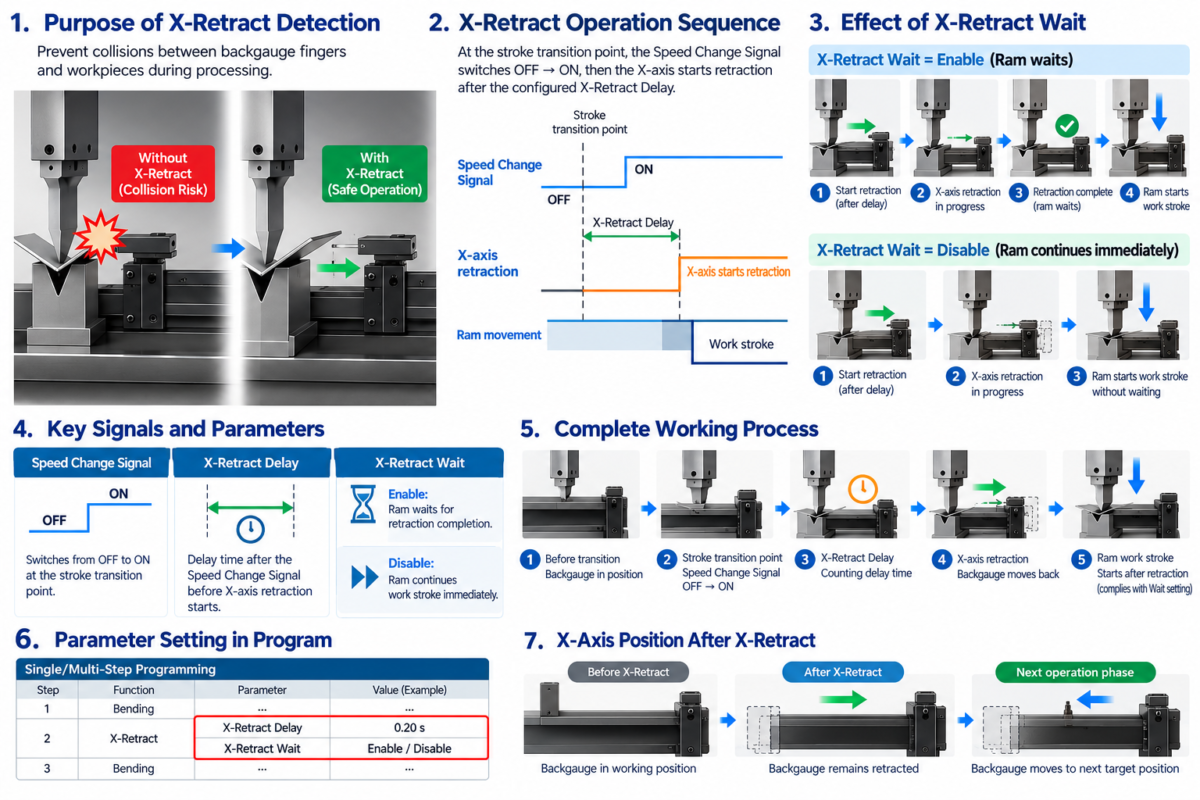
When the machine reaches the stroke transition point, the Speed Change Signal switches from OFF to ON. This signal initiates X-axis retraction according to the programmed X-Retract Delay.
The basic sequence is:
Stroke Transition Point → Speed Change Signal OFF→ON → X-Retract Delay → X-Axis Retracts
When X-Retract Wait is enabled, the ram does not proceed with its work stroke until the required X-axis retraction has been completed.
This sequence helps create clearance between the backgauge fingers and the workpiece before further ram movement.
Why Is X-Axis Retraction Important?
During some bending operations, the workpiece changes position or shape as the ram moves downward. If the backgauge fingers remain in their original position, they may interfere with the workpiece.
ESTUN E315P X-Retract Detection allows the backgauge to move away at the appropriate stage of the bending cycle.
The purpose is not simply to move the X-axis backward. The controller must coordinate this movement with the ram so that retraction occurs at the correct time.
For this reason, X-Retract Delay and X-Retract Wait should be considered together when checking the sequence.
What Triggers X-Retract?
The trigger is related to the Speed Change Signal.
At the stroke transition point, the Speed Change Signal changes:
OFF → ON
The X-axis then starts its retraction sequence according to the configured X-Retract Delay.
The delay determines the timing relationship between the trigger signal and the beginning of X-axis movement.
Therefore, if retraction does not begin when expected, technicians should first confirm the operating sequence and relevant retraction settings rather than immediately treating the X-axis servo as faulty.
What Does X-Retract Delay Do?
X-Retract Delay defines the delay associated with the start of X-axis retraction after the required trigger condition occurs.
This parameter is configured in the Single/Multi-step programming interface.
During ESTUN E315P X-Retract Detection, the controller reaches the stroke transition point and detects the Speed Change Signal transition. It then applies the programmed delay before initiating X-axis retraction.
The appropriate setting depends on the required bending sequence and workpiece condition.
The objective is to ensure that the backgauge retracts at the intended stage of the process without creating unnecessary interference with ram movement.
What Is X-Retract Wait?
X-Retract Wait determines whether the ram must wait for X-axis retraction to finish before continuing the work stroke.
Quand X-Retract Wait is enabled:
X-axis retracts → Ram waits → Retraction completes → Ram continues work stroke
This creates a controlled sequence in which the ram cannot continue until the required X-axis movement has been completed.
Quand X-Retract Wait is disabled, the ram does not wait for X-axis retraction completion before starting its work stroke.
This difference is important when validating ESTUN E315P X-Retract Detection during commissioning.
How to Validate the X-Retract Sequence
Start by checking the programmed X-Retract Delay in the Single/Multi-step interface.
Next, confirm the state of X-Retract Wait.
If X-Retract Wait is enabled, execute the bending cycle and observe whether the ram pauses until X-axis retraction is complete.
The expected sequence is:
Speed Change Signal → X-Retract Delay → X-Axis Retraction → Retraction Completion → Ram Work Stroke
If X-Retract Wait is disabled, the ram should begin the work stroke without waiting for retraction to finish.
Comparing the actual machine response with the selected setting helps determine whether the sequence is operating as intended.
What Happens After X-Retract Is Completed?
After the required X-axis retraction has been completed, the ram can continue the bending process according to the selected operating logic.
The X-axis does not necessarily return immediately to its previous position.
According to the commissioning sequence, after X-Retract, the X-axis remains positioned until the next operation phase.
This is an important characteristic of ESTUN E315P X-Retract Detection. Technicians should not assume that the backgauge should automatically return as soon as the retraction itself is complete.
Its subsequent movement depends on the next operation in the programmed sequence.
What Should Be Checked If X-Retract Does Not Work Correctly?
If the retraction sequence appears abnormal, check the process systematically.
First, verify that X-Retract Delay has been configured for the required bending step.
Then confirm whether X-Retract Wait is enabled or disabled and compare the setting with the expected ram behavior.
Also observe whether the sequence reaches the stroke transition point and whether the expected Speed Change Signal condition occurs.
Finally, compare the actual X-axis and ram movements with the programmed sequence.
Using this approach helps distinguish a timing or programming issue from an actual axis movement problem.
Using ESTUN E315P X-Retract Detection Correctly
Correct ESTUN E315P X-Retract Detection depends on coordination between the stroke transition point, Speed Change Signal, X-Retract Delay, X-axis movement, and ram work stroke.
When X-Retract Wait is enabled, retraction completion becomes a condition for subsequent ram movement. When it is disabled, the ram can continue without waiting.
During commissioning, technicians should verify the complete sequence rather than checking only whether the X-axis physically moves.
A correctly coordinated retraction sequence helps maintain the required clearance between the backgauge fingers and workpiece while allowing the programmed bending cycle to continue correctly.
Frequently Asked Questions(FAQ)
Why Does the Ram Pause During X-Axis Retraction?
First check whether X-Retract Wait is enabled. When this function is enabled, the ram waits until the X-axis completes its retraction before continuing the work stroke. In this case, the pause is part of the programmed sequence rather than necessarily indicating a machine fault.
What If the X-Axis Retracts Too Early or Too Late?
Check the programmed X-Retract Delay and confirm when the Speed Change Signal switches from OFF to ON. The delay affects when retraction begins after the trigger condition occurs. Avoid changing unrelated X-axis parameters before verifying this timing relationship.
Does X-Retract Delay Control How Far the Backgauge Moves?
No. X-Retract Delay concerns the timing of the retraction sequence rather than simply defining the physical travel distance. The programmed X-axis movement and the delay should be treated as separate aspects of the bending sequence.
Conclusion
ESTUN E315P X-Retract Detection coordinates backgauge retraction with ram movement to reduce the risk of interference between the backgauge fingers and workpiece during bending.
The sequence begins when the Speed Change Signal changes from OFF to ON at the stroke transition point. X-Retract Delay determines the timing of the retraction, while X-Retract Wait determines whether the ram must wait for the X-axis to complete its movement before continuing the work stroke.
During commissioning, technicians should verify the complete sequence instead of evaluating X-axis movement alone. Correct ESTUN E315P X-Retract Detection ensures that the backgauge, workpiece, and ram movements remain properly coordinated throughout the required bending operation.


