


ESTUN E315P Step Change determines when the press brake controller transitions from the current bending step to the next step in a machining program. During multi-step bending operations, the controller must coordinate slide movement, pressure holding, unloading, and opening before the next processing step can begin.
According to the E315P commissioning guide, a step transition depends on the completion of a defined operating sequence. The foot pedal up signal also affects whether the controller allows the processing step to advance.
Understanding these conditions helps technicians distinguish normal step-transition behavior from abnormal machine operation. This guide explains the required bending phases, the role of the foot pedal signal, and the conditions that may prevent ESTUN E315P Step Change during commissioning.
What Is ESTUN E315P Step Change?
ESTUN E315P Step Change refers to the transition from one processing step to the next after the current step has been completed.
In a multi-step bending program, different processing steps may contain different bending requirements. The controller must determine when the current step has finished before advancing to the next one.
However, completing the downward bending movement alone does not necessarily mean that the entire processing step is complete.
The E315P commissioning guide identifies a specific sequence of slide operations that must be executed before step transition can occur.
The controller also considers the timing of the foot pedal up signal during the bending cycle.
Therefore, step transition depends on both the machine’s operating sequence and the relevant control signals.
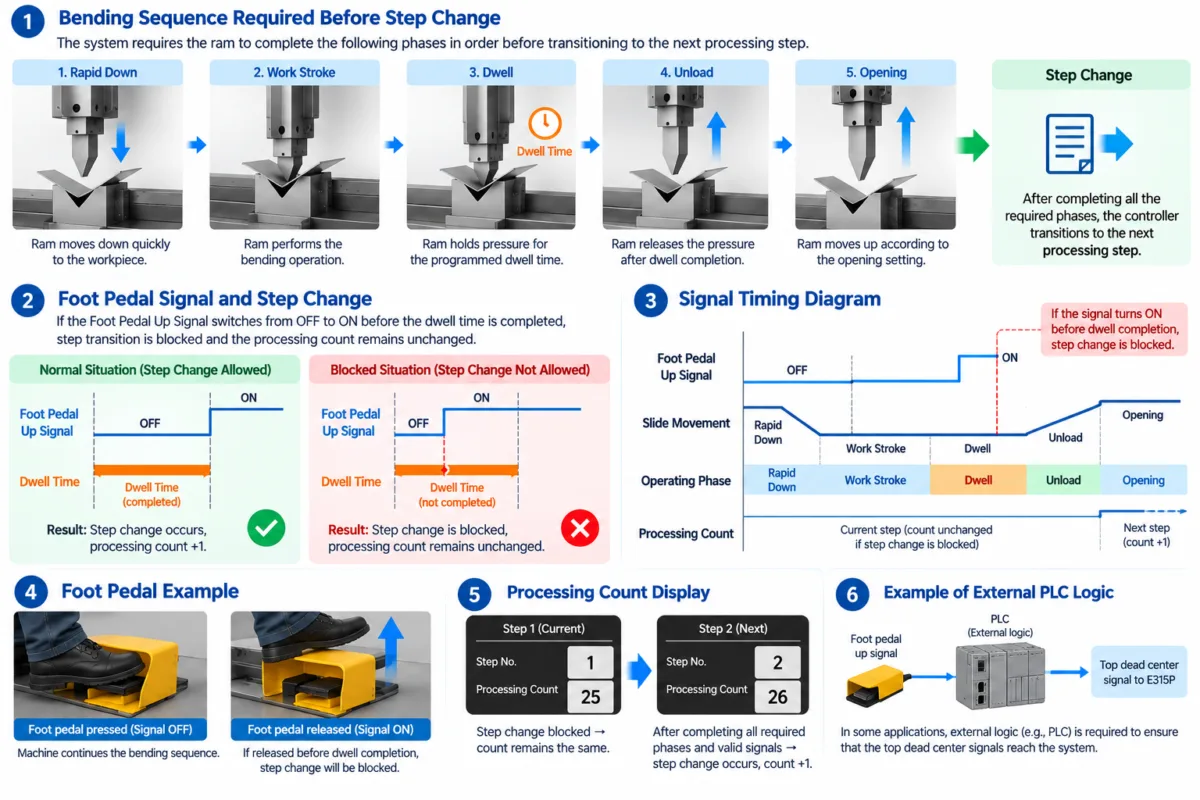
What Are the Required Phases Before Step Change?
Before ESTUN E315P Step Change can occur, the ram must execute the following sequential phases:
Rapid Down → Work Stroke → Dwell → Unload → Opening
Each phase represents a different part of the bending cycle.
Rapid Down
During Rapid Down, the ram moves downward toward the workpiece.
This phase is part of the initial approach movement before the bending operation enters the work stroke.
Work Stroke
The Work Stroke is the processing phase in which the ram performs the required bending movement.
During this phase, the upper tooling moves against the workpiece to carry out the programmed bending operation.
Verweilen
Dwell is the pressure-holding phase of the bending cycle.
The controller maintains the required dwell condition according to the programmed Dwell Time.
This phase is particularly important because the timing of the foot pedal up signal relative to dwell completion affects step transition.
Unload
After the dwell phase, the ram enters the unloading phase.
This is part of the required operating sequence before opening.
Öffnung
During Opening, the ram moves upward according to the machine’s opening control settings.
The opening movement completes the required sequence of operating phases associated with the processing step.
These phases form the operating sequence that must be considered when evaluating ESTUN E315P Step Change.
How Does the Foot Pedal Signal Affect Step Change?
The foot pedal up signal is one of the critical conditions affecting ESTUN E315P Step Change.
According to the commissioning guide, if the Foot Pedal Up Signal switches from OFF to ON before Dwell Time is completed, step transition is blocked.
The processing count remains unchanged.
The relationship can be summarized as:
Foot Pedal Up Signal OFF → ON Before Dwell Completion → Step Transition Blocked
This means that an early foot pedal up signal can prevent the controller from advancing to the next processing step.
When analyzing a step-transition problem, technicians should therefore pay attention not only to whether the foot pedal signal is present but also to when the signal changes during the bending sequence.
Why Does the Processing Count Remain Unchanged?
If the foot pedal up signal switches from OFF to ON before the dwell phase has been completed, the controller blocks the step transition.
As a result, the processing count does not advance.
This behavior should not automatically be interpreted as a controller malfunction.
The E315P is responding to a specific signal condition identified in its commissioning instructions.
For example, if a bending program remains on the same processing step after the operator activates the foot pedal up signal, technicians should first check whether the signal occurred before Dwell Time was completed.
The important distinction is between a step that has completed its required operating conditions and a step whose transition has been blocked by an early signal.
What Is the Role of External PLC Logic?
The commissioning guide identifies an exception involving external control logic.
If the foot pedal up signal changes before dwell completion, step transition is normally blocked. However, the manual notes an exception requiring external logic, such as a PLC, to ensure that the top dead center signals reach the system.
This means that ESTUN E315P Step Change may also depend on the electrical control arrangement used by the particular machine.
The manual does not specify a universal PLC program or wiring configuration for this exception.
Therefore, technicians should refer to the actual machine’s electrical diagram and control design before evaluating any external logic associated with step transition.
It should not be assumed that every E315P-equipped press brake uses the same external PLC arrangement.
How to Check Step Change During Commissioning
When checking ESTUN E315P Step Change, the most useful approach is to observe the complete bending sequence and identify the point at which the controller should advance.
First, confirm that the machine is operating with the intended bending program and working mode.
Then observe the required operating phases:
Rapid Down → Work Stroke → Dwell → Unload → Opening
Pay particular attention to the dwell phase and the foot pedal up signal.
If the foot pedal up signal changes before Dwell Time has been completed, the processing count should remain unchanged according to the manual’s blocking condition.
If step transition does not occur as expected, check the signal timing and confirm whether the required processing phases have been completed.
Where external control logic is involved, the corresponding top dead center signal arrangement should also be considered.
What Should Be Checked If Step Change Fails?
When ESTUN E315P Step Change does not occur as expected, technicians should avoid immediately changing unrelated machine parameters.
Start by identifying whether the current bending step has completed the required operating sequence.
Next, check the programmed Dwell Time and determine whether the foot pedal up signal changed before the dwell phase was completed.
If the processing count remains unchanged, compare the observed signal timing with the blocking condition described in the commissioning guide.
Also confirm that the selected operating mode corresponds with the intended program behavior. For example, Single-cycle Mode and Continuous Mode have different step-transition behavior, as explained in the E315P slide operating modes instructions.
Finally, if the machine uses external logic associated with the top dead center signal, verify that the relevant signals are being delivered according to the machine’s electrical design.
Understanding Step Change During Multi-Step Bending
Correct ESTUN E315P Step Change operation requires coordination between the ram’s movement sequence and the controller’s signal conditions.
The completion of a bending movement does not, by itself, establish that the controller should immediately advance to the next processing step.
Instead, the required operating phases and the timing of the foot pedal up signal must be considered together.
During commissioning, observing the processing count alongside the actual machine movement can help identify whether the current step is progressing normally or whether a transition condition has been blocked.
By understanding the relationship between Dwell Time, foot pedal signals, top dead center signals, and the selected operating mode, technicians can evaluate step-transition behavior more systematically and avoid unnecessary parameter changes.
Frequently Asked Questions(FAQ)
Why Does the Controller Stay on the Same Bending Step?
If the controller does not advance to the next bending step, check whether the foot pedal up signal was activated before Dwell Time was completed. According to the commissioning guide, this condition blocks step transition and keeps the processing count unchanged.
Can an Incorrect Dwell Time Affect Step Transition?
Yes. The timing of the dwell phase is directly related to the step-transition condition. If the foot pedal up signal changes before the configured Dwell Time has elapsed, the controller blocks the transition. Technicians should verify that the programmed dwell duration matches the intended bending process.
Does Releasing the Foot Pedal Always Stop Step Change?
Not necessarily. The manual identifies a specific blocking condition: the foot pedal up signal changing from OFF to ON before dwell completion. The actual result also depends on the machine’s control arrangement and operating conditions.
Abschluss
ESTUN E315P Step Change controls the transition between processing steps during press brake operation. The controller requires the ram to execute the defined sequence of Rapid Down, Work Stroke, Dwell, Unload, and Opening before progressing through the bending program.
A critical condition is the timing of the foot pedal up signal. If this signal changes from OFF to ON before Dwell Time is completed, step transition is blocked and the processing count remains unchanged. External control logic may also affect signal handling in certain machine configurations.
During commissioning, technicians should verify the complete bending sequence, foot pedal signal timing, and relevant control conditions before modifying parameters. Understanding ESTUN E315P Step Change helps distinguish expected controller behavior from genuine step-transition problems and supports more systematic troubleshooting.


