


Accurate bending results depend on proper machine configuration, especially when processing sheets of different lengths. ESTUN E315P Stiffness settings help compensate for bending deviations associated with workpiece length and machine structural deformation.
During long-sheet bending, the machine structure may respond differently to the applied bending force. If this effect is not considered, the actual bending angle may deviate from the programmed value.
The E315P controller provides Stiffness and Structural Strength parameters to address these conditions. This guide explains their functions, recommended settings, and practical adjustment procedures.
What Is ESTUN E315P Stiffness?
ESTUN E315P Stiffness is a compensation parameter used to account for deformation-related effects during bending operations.
The parameter is particularly relevant when the controller needs to consider how workpiece length influences bending results.
According to the E315P parameter documentation, the Stiffness setting works together with the machine structural stiffness compensation parameter.
These settings allow technicians to configure whether length-related compensation is applied and adjust its influence according to actual bending conditions.
They should not be confused with basic axis teaching or clamping point calibration, which establish machine position references.
Why Does Sheet Length Affect Bending Accuracy?
During bending, force is transmitted through the punch, die, and press brake structure.
Longer workpieces may require different bending force distributions, and structural deformation can influence the resulting زاوية.
If the controller does not account for these effects, the programmed angle and actual bending result may differ.
ESTUN E315P Stiffness provides a way to include length-related effects in the bending calculation.
However, the appropriate compensation depends on the machine structure, tooling, material, and actual bending conditions.
For this reason, the recommended parameter values should be treated as initial settings rather than universal correction values.
Understanding the Stiffness Parameters
The E315P documentation identifies two related settings.
| المعلمة | Range | وحدة |
|---|---|---|
| Stiffness | 0.00–999.99 | μm/kN |
| Structural Strength | 0.00–100.00 | % |
The Stiffness parameter represents the compensation-related value used in the calculation.
Structural Strength, described in the manual as machine structural stiffness, determines the percentage setting associated with this compensation.
The two parameters should be considered together when adjusting ESTUN E315P Stiffness.
Increasing the relevant compensation setting can increase the resulting compensation offset, but the correct adjustment must be determined from actual bending measurements.
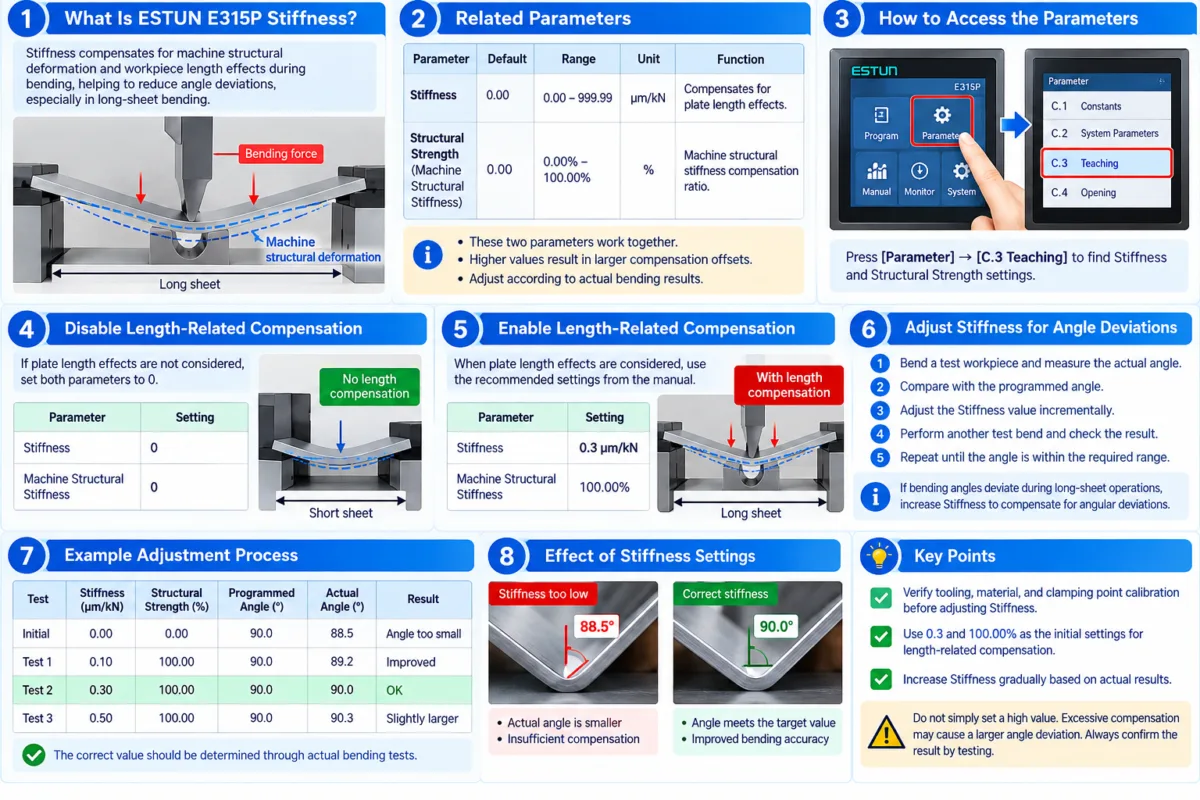
Step 1: Access the Stiffness Parameters
Begin by opening the relevant teaching or parameter configuration interface on the E315P controller.
Locate the Stiffness and Structural Strength settings.
Before modifying either value, record the existing parameters so they can be restored if necessary.
Confirm that the machine has been configured correctly for the current tooling and workpiece.
Stiffness adjustment should be performed only after the basic bending parameters and positional calibration have been verified.
Step 2: Disable Length-Related Compensation
If the bending program does not need to consider plate-length effects, the manual specifies the following settings:
| المعلمة | Setting |
|---|---|
| Stiffness | 0 |
| Machine Structural Stiffness | 0 |
With both values set to zero, the length-related compensation described in the manual is not applied.
This configuration is suitable when the operator intentionally chooses not to account for workpiece length in the relevant compensation calculation.
It should not be assumed that disabling compensation is appropriate for every bending application.
Step 3: Enable Length-Related Compensation
When workpiece length needs to be considered, the E315P manual provides the following recommended configuration:
| المعلمة | Setting |
|---|---|
| Stiffness | 0.3 μm/kN |
| Structural Strength | 100.00% |
Set Stiffness = 0.3 and retain Structural Strength = 100.00%.
This establishes the manual’s recommended starting configuration for length-sensitive bending operations.
The 0.3 value is a suggested setting rather than a guaranteed correction for every machine.
After entering the parameters, verify the bending result using a suitable test workpiece.
Step 4: Adjust Stiffness for Angle Deviations
If long-sheet bending produces an angle deviation, ESTUN E315P Stiffness may require further adjustment.
Start by measuring the actual bending angle and comparing it with the programmed value.
Before changing compensation, confirm that the selected tooling, sheet thickness, material, and clamping point calibration are correct.
If these conditions are verified, adjust the Stiffness parameter incrementally and perform another test bend.
Record the measured angle after each adjustment.
The manual indicates that increasing the compensation parameters produces a larger compensation offset. However, it does not establish a universal relationship between a specific parameter increase and a particular angle correction.
Therefore, adjustments should be based on measured results rather than assumed correction formulas.
Step 5: Verify the Bending Result
After changing ESTUN E315P Stiffness, verify the effect through controlled test bending.
Use consistent material, tooling, and bending conditions when comparing results.
Measure the actual angle and determine whether the adjustment improves the deviation.
If the result becomes less accurate, review the latest parameter change before making further adjustments.
A simple adjustment record can help technicians evaluate the effect of each setting.
| Test | Stiffness | Structural Strength | Actual Angle |
|---|---|---|---|
| Initial | Original setting | Original setting | Measured value |
| Test 1 | Adjusted value | Recorded value | Measured value |
| Test 2 | Further adjustment, if required | Recorded value | Measured value |
This method provides a practical way to evaluate compensation changes without introducing unnecessary variables.
Important Precautions During Stiffness Adjustment
ESTUN E315P Stiffness should be adjusted carefully because incorrect compensation values may affect bending accuracy.
Avoid changing several unrelated parameters simultaneously.
Before adjusting stiffness, verify that the basic machine calibration is correct and that the workpiece specifications match the programmed values.
Do not assume that increasing Stiffness will always improve the bending result. The appropriate adjustment depends on the actual deviation and machine response.
Where possible, retain a record of the original settings and all subsequent test results.
The objective is to establish a suitable compensation value for the actual bending conditions rather than simply applying the largest available setting.
الأسئلة الشائعة
Does Every Bending Program Require Stiffness Compensation?
No. The E315P manual provides a configuration in which both Stiffness and Machine Structural Stiffness are set to zero when plate-length effects are not considered. Whether compensation is needed depends on the bending application and required accuracy.
What Is the Difference Between Stiffness and Structural Strength?
Stiffness is expressed in μm/kN and represents a compensation-related parameter. Structural Strength is expressed as a percentage and determines the corresponding machine structural stiffness setting. The manual specifies how these values should be combined when length-related compensation is enabled or disabled.
خاتمة
ESTUN E315P Stiffness settings provide a method for compensating for bending deviations associated with workpiece length and machine structural deformation.
According to the E315P documentation, Stiffness and Machine Structural Stiffness should both be set to zero when plate-length effects are not considered. When length-related compensation is required, the manual recommends starting with Stiffness = 0.3 μm/kN and Structural Strength = 100.00%.
These settings should be verified through actual bending tests rather than treated as universal correction values.
By confirming the basic bending parameters, making controlled adjustments, and recording measured results, technicians can use ESTUN E315P Stiffness more effectively to improve bending consistency and reduce angle deviations.


