


Accurate bending angle calculation is essential for producing consistent results on a CNC press brake. ESTUN E315P Angle Programming allows the controller to calculate bending requirements automatically based on the machine’s configured parameters and the information entered during programming.
However, reliable angle calculation depends on several important factors. According to the E315P commissioning guide, four essential parameters must be correctly configured: Die, Sheet Thickness, Material, and Clamping Point Teaching.
These parameters describe the tooling, workpiece characteristics, and positional relationships required for bending calculations.
This guide explains how each parameter affects ESTUN E315P Angle Programming and what technicians should verify before starting a bending operation.
What Is ESTUN E315P Angle Programming?
ESTUN E315P Angle Programming is a programming method that allows operators to enter the required bending angle while the controller performs the corresponding calculations using predefined machine and workpiece parameters.
Instead of relying entirely on manually entered bending positions, the system uses relevant technical information to determine the bending requirements.
However, automatic calculation does not eliminate the need for correct parameter configuration.
The controller depends on accurate information about the lower die, sheet thickness, material properties, and clamping point position.
If these parameters do not correspond with the actual machine and workpiece, the calculated result may differ from the required bending angle.
Therefore, checking the essential parameters is an important part of preparing an angle-based bending program.
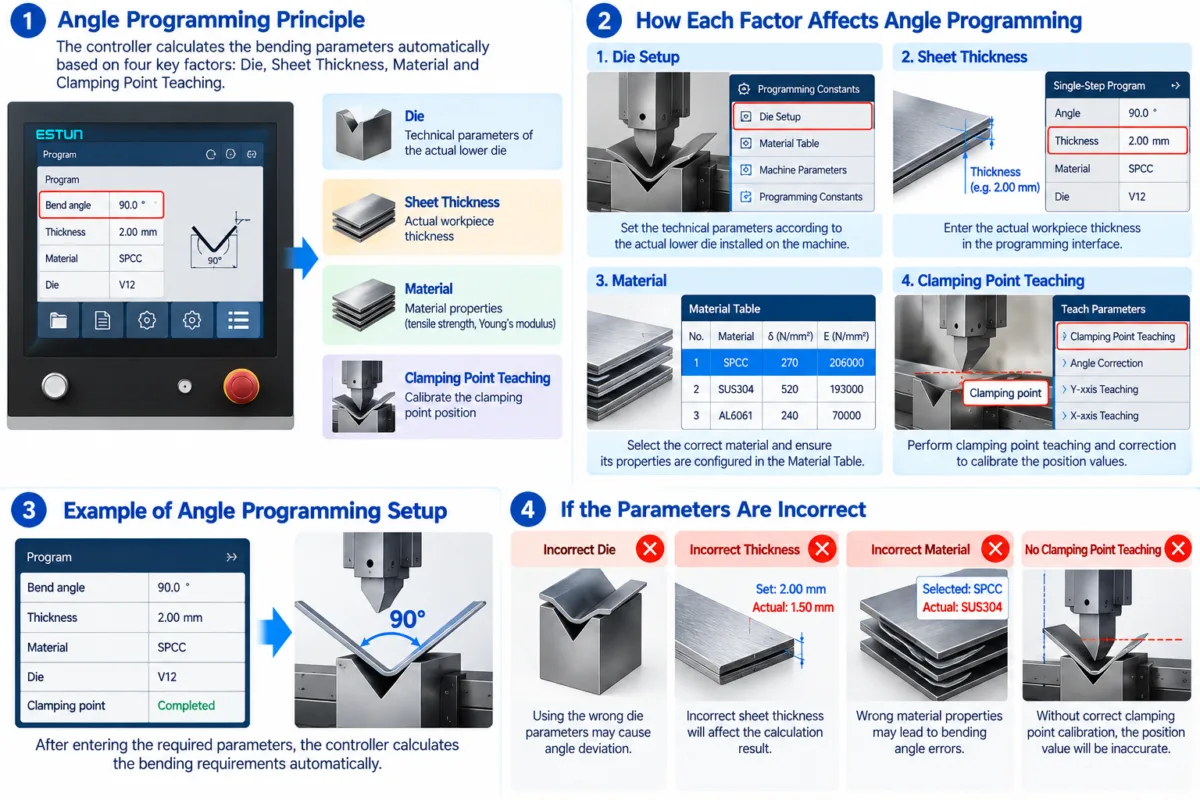
What Are the Four Essential Parameters?
According to Section 5.11 of the E315P commissioning guide, four parameters are required for automatic bending angle calculation.
| Параметр | Configuration Requirement |
|---|---|
| Умереть | Configure technical parameters according to the actual lower die |
| Толщина листа | Enter the actual workpiece thickness |
| Материал | Select the corresponding material with predefined properties |
| Clamping Point Teaching | Perform clamping point correction to calibrate position values |
Each parameter provides different information for ESTUN E315P Angle Programming.
The following sections explain their individual functions and why they should be verified before bending.
How Does Die Setup Affect Angle Programming?
The lower die is one of the essential components affecting bending geometry.
During ESTUN E315P Angle Programming, the controller uses the technical parameters configured for the selected die.
To configure the die information, access:
Programming Constants → Die Setup
The parameters should correspond to the actual lower die installed on the machine.
Different lower dies can have different geometric characteristics. Therefore, selecting a die configuration that does not match the installed tooling may affect the calculated bending requirements.
Before programming the bending angle, operators should confirm that the correct die has been installed and that its corresponding technical information has been configured.
If the lower die is replaced, the die setup should be reviewed before continuing with angle-based programming.
Why Is Sheet Thickness Important?
Sheet Thickness is another essential parameter used during bending angle calculation.
The E315P commissioning guide requires operators to enter the actual thickness of the processed sheet in the Single-Step or Multi-Step programming interface.
This value should represent the workpiece being bent.
For example, if the actual sheet thickness differs from the value entered into the controller, the system performs its calculation using information that does not accurately represent the workpiece.
This can affect the resulting bending operation.
When preparing ESTUN E315P Angle Programming, technicians should therefore verify the actual sheet thickness before entering the corresponding value.
If different workpieces are processed using the same machine, the thickness setting should be checked whenever the material specifications change.
Accurate thickness information provides an essential basis for the controller’s automatic bending calculations.
How Do Material Properties Affect Bending Angles?
Different materials respond differently to bending forces.
The E315P controller uses material information during its bending calculations. Therefore, the correct material must be selected when preparing an angle-based program.
The commissioning guide specifies that the selected material must have its properties configured in advance in the Material Table.
The E315P material setup includes two important properties:
- Tensile Strength (δ): Expressed in N/mm².
- Young’s Modulus (E): Expressed in N/mm².
These properties describe aspects of the material’s mechanical behavior.
Because different materials have different mechanical characteristics, incorrect material selection may affect the bending calculation.
For reliable ESTUN E315P Angle Programming, operators should confirm that the selected material corresponds with the actual sheet and that the material parameters have been configured appropriately.
If the required material is not correctly configured, its properties should be reviewed in the Material Table before proceeding.
What Is the Role of Clamping Point Teaching?
Clamping Point Teaching is a critical prerequisite for bending angle accuracy.
According to the commissioning guide, Clamping Point Correction must be performed to calibrate the relevant position values.
The clamping point establishes an important positional relationship between the upper and lower tooling.
If this relationship is inaccurate, the controller may use incorrect positional information when calculating the bending operation.
During ESTUN E315P Angle Programming, the clamping point information should therefore correspond with the actual machine configuration.
The E315P provides teaching and correction functions that allow technicians to establish and adjust the clamping point relationship.
Before relying on automatic bending angle calculations, confirm that the required clamping point teaching and correction procedures have been completed.
This is especially important after changes that affect the tooling position or the machine’s positional reference.
How to Prepare for Angle Programming
Before creating an angle-based bending program, technicians should verify the four essential parameters systematically.
Step 1: Confirm the Lower Die
Check the installed lower die and verify that its technical parameters correspond with the configuration in Programming Constants → Die Setup.
Step 2: Enter the Actual Sheet Thickness
Open the Single-Step or Multi-Step programming interface and enter the actual thickness of the workpiece.
Step 3: Select the Correct Material
Choose the material corresponding to the sheet being processed.
Confirm that the required material properties have already been configured in the Material Table.
Step 4: Verify Clamping Point Correction
Check that Clamping Point Teaching and the necessary correction have been completed.
Once these conditions are satisfied, the controller has the essential information identified in the manual for automatic angle calculation.
This preparation helps establish a more reliable foundation for ESTUN E315P Angle Programming.
What Causes Inaccurate Bending Angles?
If the actual bending angle differs from the programmed value, the four essential parameters should be reviewed before making unrelated adjustments.
First, check whether the configured lower die matches the installed tooling.
Next, verify that the programmed Sheet Thickness corresponds with the actual workpiece.
Then confirm that the correct material has been selected and that its predefined properties are appropriate.
Finally, review the Clamping Point Teaching and correction status.
These checks help identify whether the bending calculation is based on incorrect machine or workpiece information.
Although other mechanical and operating conditions can also influence actual bending results, the E315P commissioning guide specifically identifies these four parameters as mandatory for angle calculation.
Improving Angle Programming Accuracy
Reliable ESTUN E315P Angle Programming begins with accurate machine and workpiece information.
The controller can perform automatic bending calculations, but the quality of those calculations depends on the parameters provided.
Die Setup establishes the relevant tooling information, Sheet Thickness describes the workpiece dimension, Material Setup provides the required mechanical properties, and Clamping Point Teaching calibrates the positional relationship.
By checking these four parameters before programming and reviewing them whenever the tooling or workpiece changes, operators can reduce errors caused by incorrect configuration.
This systematic approach supports more consistent bending results and provides a practical basis for troubleshooting angle-related problems during E315P press brake operation.
Frequently Asked Questions(FAQ)
Should Die Parameters Be Updated After Changing the Lower Die?
Yes. If the replacement lower die has different technical specifications, the corresponding information should be updated in Programming Constants → Die Setup. Using parameters from a different die may affect automatic angle calculations.
Can the Same Bending Program Be Used for Different Materials?
The program should be reviewed before processing a different material. Even when sheet thickness and the required bending angle remain unchanged, different materials may have different mechanical properties. Select the correct material and verify its parameters before running the program.
Does Clamping Point Correction Need to Be Performed Before Every Bend?
Not necessarily. The commissioning guide identifies Clamping Point Correction as a prerequisite for accurate angle calculation, but it does not require repeating the procedure before every bending cycle. The calibration should be checked when the machine’s positional relationship changes or when a relevant positioning error is suspected.
Заключение
Accurate ESTUN E315P Angle Programming depends on four essential parameters: Настройка штампа, Sheet Thickness, Material Properties, and Clamping Point Teaching. Together, these settings provide the controller with the tooling, workpiece, and positional information required for automatic bending angle calculations.
Before starting production, operators should confirm that the installed lower die matches its configured parameters, the actual sheet thickness is entered correctly, and the appropriate material properties are selected. Clamping Point Correction should also be completed to establish the required positional relationship.
Although the E315P performs bending calculations automatically, correct parameter configuration and verification of actual bending results remain important. Following these procedures helps improve bending consistency, reduce configuration-related errors, and support reliable press brake operation.


