


Accurate backgauge positioning is essential for reliable press brake operation. During bending, the X-axis and R-axis must move in a coordinated sequence to prevent interference between the backgauge, tooling, and workpiece.
ESTUN E315P R-Axis Transition provides a positioning function that allows the R-axis to move to a predefined transitional position before the X-axis completes its movement.
This function is particularly useful when backgauge positioning requires coordinated horizontal and vertical movements.
According to the E315P operating manual, the R-Transition Position parameter determines whether this function is enabled and how the R-axis participates in the positioning sequence.
This guide explains the parameter settings, movement sequence, and practical verification procedures.
What Is ESTUN E315P R-Axis Transition?
ESTUN E315P R-Axis Transition is a backgauge positioning function designed to coordinate movement between the X-axis and R-axis.
The X-axis controls the forward and backward movement of the backgauge, while the R-axis controls its vertical position.
During certain positioning operations, directly moving both axes to their final destinations may create interference risks.
The R-Axis Transition function introduces an intermediate R-axis position into the movement sequence.
Instead of moving directly to its final position, the R-axis first moves to a transitional position. The X-axis then performs its positioning movement, after which the R-axis moves to its final target.
This sequence helps coordinate backgauge movement during operations requiring different axis positions.
Understanding the R-Transition Position Parameter
The E315P controller provides a parameter called R-Transition Position.
According to Appendix C.1 of the operating manual, its specifications are:
| Parâmetro | Valor |
|---|---|
| Parameter Name | R-Transition Position |
| Default Value | 5 |
| Setting Range | 0.00–99.99 |
| Unidade | mm |
| Function Disabled | 0 |
| Function Enabled | Non-zero value |
The parameter defines the transitional position used during coordinated X-axis and R-axis movement.
When the value is set to zero, the transition function is disabled.
When a non-zero value is entered, the controller uses the R-axis transitional positioning logic described in the manual.
The appropriate value should be selected according to the machine’s actual backgauge structure and positioning requirements.
Why Is R-Axis Transition Important?
The backgauge must move accurately between different programmed positions during bending operations.
When the X-axis moves forward or backward, the vertical position of the backgauge fingers can influence the available movement clearance.
If the R-axis remains at an unsuitable height, interference may occur during positioning.
ESTUN E315P R-Axis Transition addresses this issue by introducing an intermediate positioning stage.
The R-axis moves to the specified transitional position before the X-axis proceeds to its target.
After the X-axis positioning operation, the R-axis moves to its final programmed position.
This arrangement helps reduce potential interference during coordinated backgauge movement.
However, the transition setting must match the actual tooling and machine configuration. It should not be treated as a substitute for verifying physical clearances.
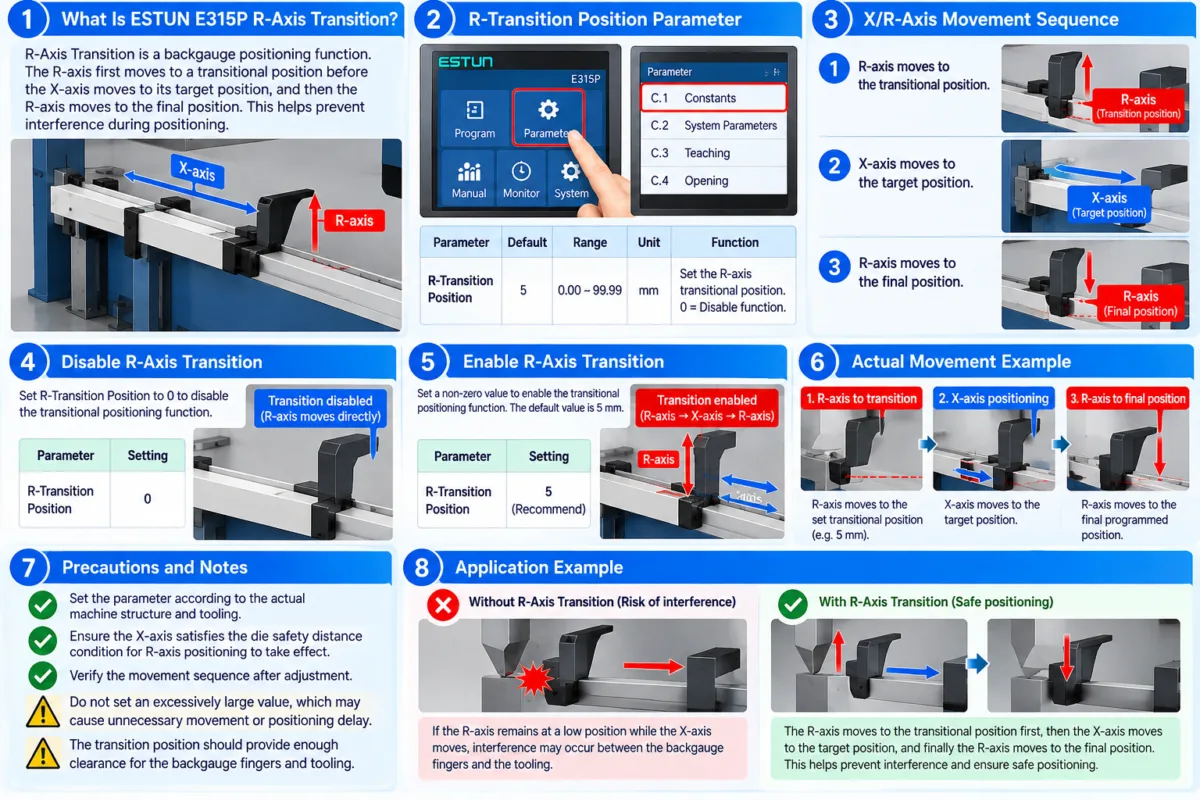
Step 1: Locate the R-Transition Position Setting
To configure ESTUN E315P R-Axis Transition, access the controller’s relevant programming constants or parameter settings.
Locate the parameter labeled:
R-Transition Position
Before making changes, record the original parameter value.
The default value specified in the manual is 5 mm.
If the existing machine has already been configured and operates correctly, avoid changing the setting without a specific positioning requirement.
Any adjustment should be based on the actual movement conditions of the X-axis and R-axis.
Step 2: Configure the Transition Position
Enter the required R-Transition Position value within the permitted range of 0.00–99.99 mm.
The parameter has two operating conditions.
Setting the value to 0:
The R-axis transition function is disabled.
Setting a non-zero value:
The controller applies the transitional positioning function according to its programmed movement logic.
For example, the manual provides a default value of 5 mm.
However, this value should not automatically be considered suitable for every backgauge configuration.
When adjusting ESTUN E315P R-Axis Transition, technicians should confirm that the selected position provides suitable clearance for the installed tooling and backgauge fingers.
Step 3: Understand the X/R-Axis Movement Sequence
When the transition function is active, the E315P manual describes the following positioning sequence.
First: R-Axis Moves to the Transitional Position
The R-axis moves to the specified transitional position.
This prepares the backgauge for the subsequent X-axis positioning movement.
Second: X-Axis Moves to Its Target Position
After the required transition stage, the X-axis moves toward its programmed target.
The manual also identifies an X-axis die safety distance condition associated with activation of the R-axis positioning logic.
This condition must be satisfied according to the controller’s programmed sequence.
Third: R-Axis Moves to Its Final Position
Once the X-axis positioning stage is completed, the R-axis moves to its final programmed location.
The resulting sequence is:
R-Axis Transitional Position → X-Axis Target Position → R-Axis Final Position
This is the primary operating principle of ESTUN E315P R-Axis Transition.
Step 4: Verify the Transition Movement
After configuring the parameter, verify the actual movement sequence before normal production.
First, confirm that the programmed X-axis and R-axis positions are appropriate for the installed tooling.
Next, perform a controlled positioning test under suitable machine safety conditions.
Observe whether the R-axis moves to the transitional position before the X-axis completes its movement.
Then verify that the X-axis reaches its programmed target and the R-axis subsequently moves to its final position.
Pay attention to the clearance between the backgauge fingers, tooling, and other machine components.
If the movement does not match the expected sequence, review the transition parameter and the relevant X-axis positioning conditions.
What Happens When R-Transition Position Is Zero?
Setting R-Transition Position to zero disables the transitional positioning function.
In this condition, the controller does not apply the additional R-axis transition sequence described in Appendix C.1.
However, disabling the function does not automatically guarantee that all backgauge movements are free from interference.
The actual movement remains dependent on the machine configuration, programmed positions, and available physical clearance.
Therefore, ESTUN E315P R-Axis Transition should only be disabled when the machine’s positioning requirements allow it.
Common R-Axis Transition Problems
If the R-axis does not perform the expected transitional movement, first check whether R-Transition Position is set to a non-zero value.
Next, confirm that the X-axis positioning conditions satisfy the requirements described in the manual.
If the R-axis moves but the final positioning result is incorrect, verify the programmed R-axis target and the corresponding axis calibration.
Also inspect whether the backgauge movement is physically restricted.
Avoid increasing the transition value without checking the actual movement clearance.
Correct ESTUN E315P R-Axis Transition configuration requires both appropriate parameter settings and verification of the machine’s physical movement.
Practical Tips for Reliable Backgauge Positioning
When adjusting ESTUN E315P R-Axis Transition, always begin with the existing machine configuration.
Record the original parameter value, verify the intended movement sequence, and make adjustments only when necessary.
After changing the setting, perform a controlled test to confirm that the R-axis reaches the transitional position, the X-axis completes its positioning movement, and the R-axis reaches its final target.
Proper configuration helps maintain coordinated backgauge positioning and reduces the risk of interference during press brake operation.
Perguntas frequentes (FAQ)
Why Does the R-Axis Move Before the X-Axis?
This movement may be part of the normal ESTUN E315P R-Axis Transition sequence. When the function is enabled, the R-axis first moves to a transitional position before the X-axis performs its target positioning. This helps coordinate backgauge movement and reduce potential interference.
What Is the Difference Between R-Transition Position and R-Axis Teaching?
ESTUN E315P R-Axis Transition controls an intermediate movement during coordinated backgauge positioning. R-Axis Teaching establishes the actual R-axis position reference through calibration. These functions serve different purposes and should not be confused.
Conclusão
ESTUN E315P R-Axis Transition helps coordinate X-axis and Eixo R movements during backgauge positioning. By introducing an intermediate R-axis position, the controller can organize the movement sequence to reduce potential interference.
The R-Transition Position parameter has a default value of 5 mm and a setting range of 0.00–99.99 mm. Setting it to zero disables the transition function, while a non-zero value enables the corresponding positioning logic.
For reliable operation, technicians should verify the selected transition position, X-axis safety conditions, and final R-axis target. Proper ESTUN E315P R-Axis Transition configuration supports coordinated backgauge movement and helps maintain safe, accurate positioning during press brake operation.


