


Tube Bender Installation Acceptance is often the first thing customers ask about once a tube bender has been installed, because the real concern is not simply turning the machine on, but ensuring it is truly ready for stable, long-term production. This final and critical step verifies that the machine meets technical specifications, safety standards, and real production requirements. In this article, I’ll explain how the acceptance process works in actual factory conditions, what needs to be checked step by step, and how a proper acceptance procedure helps you avoid hidden issues, expensive rework, and premature failures. Whether you are commissioning a new CNC tube bender or reviewing a recently completed installation, this guide will provide clear and practical guidance.
What Is Tube Bender Installation Acceptance?
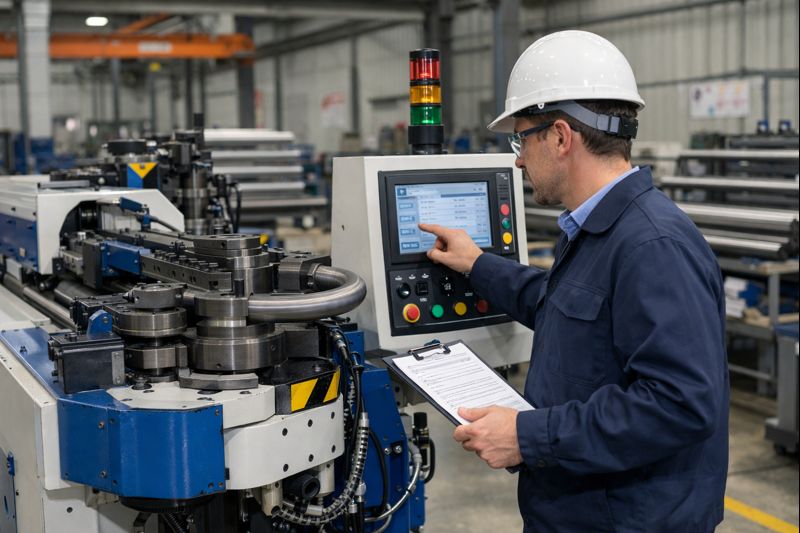
Tube Bender Installation Acceptance is a systematic verification process carried out after installation and commissioning. Its purpose is to confirm that the tube bending machine has been installed correctly, operates safely, and achieves the required bending accuracy and productivity under real working conditions.
From my experience, many issues that appear months later—such as inconsistent bending angles, unstable repeatability, or unexpected downtime—can often be traced back to a rushed or incomplete acceptance process. A structured acceptance helps both the customer and supplier confirm that the machine is truly production-ready.
Preparation Before Tube Bender Acceptance Testing
Reviewing Installation and Foundation Conditions
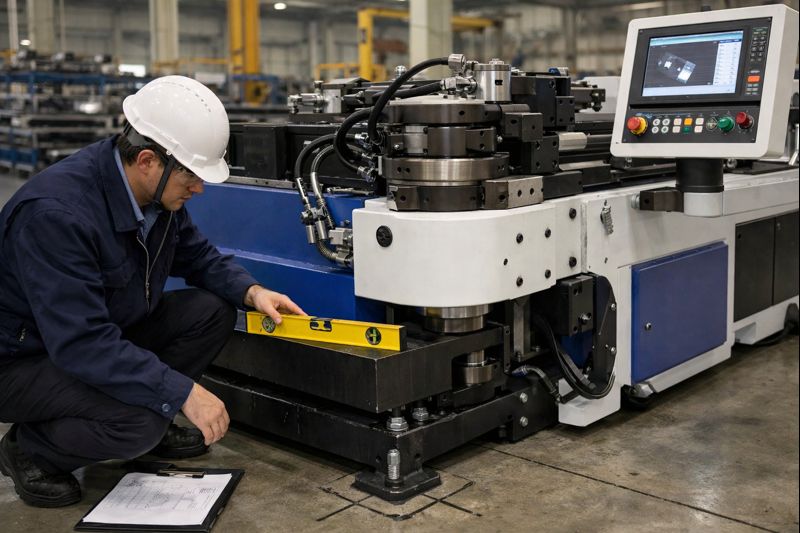
Before any acceptance testing begins, I always start by checking the installation basics. The machine foundation must meet load-bearing and flatness requirements, anchor bolts should be correctly installed, and the machine level must fall within the manufacturer’s tolerance. Even a small deviation at this stage can affect bending accuracy later.
Power supply, air supply, and hydraulic connections are also verified to ensure voltage, pressure, and flow match the machine specifications. This step is often overlooked, but mismatched utilities are a common cause of early electrical or hydraulic faults.
Confirming Documentation and Technical Parameters

Before testing the machine, I recommend reviewing all technical documents together with the installation team. This includes machine specifications, electrical diagrams, hydraulic schematics, and parameter settings. During Tube Bender Installation Acceptance, these documents serve as the reference standard for evaluating performance and configuration.
Functional Checks During Tube Bender Installation Acceptance
Basic Machine Operation and Safety Inspection

The first functional step is to verify basic machine operation. I usually test emergency stop buttons, safety doors, light curtains, and interlocks one by one. Safety systems must respond immediately and reliably, as this directly affects operator protection and compliance with local regulations.
Axis movements, clamping mechanisms, mandrel insertion, and rotation units are then checked under manual and automatic modes. Smooth, vibration-free motion is a key indicator of proper mechanical alignment and installation quality.
Control System and Program Verification
During Tube Bender Installation Acceptance, the CNC control system deserves special attention. I check screen response, parameter access, alarm logic, and backup functions. Sample bending programs are loaded to confirm that program execution matches the intended bending sequence.
If the machine supports simulation or collision detection, I also verify that these functions operate correctly. These features play a critical role in preventing tooling damage during daily production.
Accuracy and Performance Validation
Bending Accuracy and Repeatability Testing
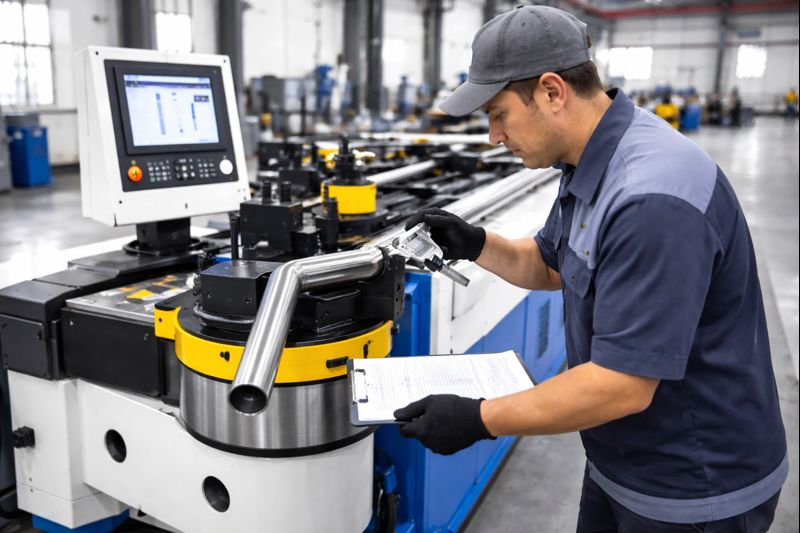
Accuracy testing is at the core of Tube Bender Installation Acceptance. I usually start with simple bends and gradually move to more complex multi-radius or multi-plane bending tests. Bending angle, radius, and rotation accuracy are measured using calibrated tools.
Repeatability tests are especially important. The same program is run multiple times to ensure consistent results. Stable repeatability confirms that mechanical rigidity, servo control, and tooling setup are all functioning correctly.
Production Simulation With Real Materials
To truly validate performance, I recommend testing the tube bender using actual production materials rather than standard test tubes. Different materials and wall thicknesses can reveal issues that might not appear during basic tests.
This production simulation helps confirm that lubrication, mandrel selection, clamping force, and feed speed are properly configured for real-world operation.
Acceptance of Auxiliary Systems and Tooling
Tooling Installation and Alignment Checks
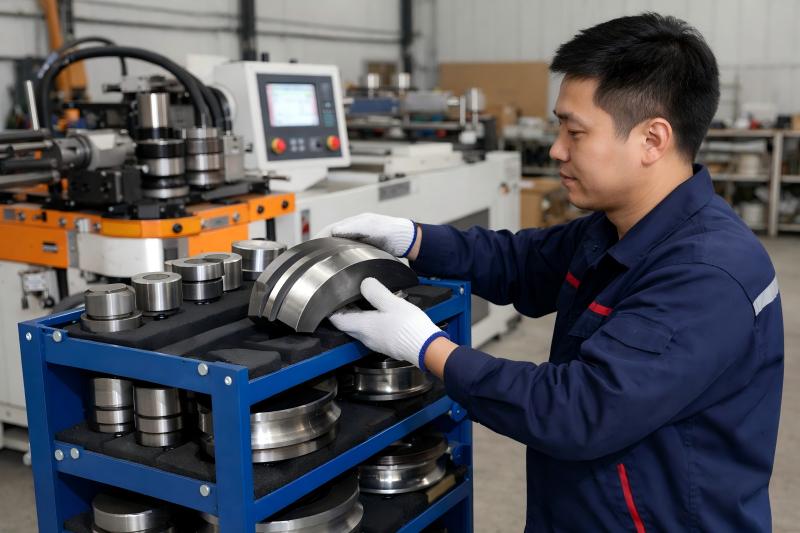
Tooling quality and setup have a direct impact on bending results. During acceptance, I carefully inspect bending dies, clamps, pressure dies, and mandrels for correct installation and alignment. Improper tooling setup can cause surface scratches, deformation, or dimensional errors.
If multiple tooling sets are supplied, each should be checked and documented during Tube Bender Installation Acceptance to avoid confusion during future production changes.
Hydraulic, Lubrication, and Cooling Systems
I also verify that hydraulic pressure is stable, lubrication points are functioning, and cooling systems operate within normal temperature ranges. Abnormal noise, pressure fluctuation, or overheating at this stage should never be ignored, as these issues often worsen over time.
Final Acceptance Documentation and Sign-Off
Acceptance Records and Operator Confirmation

Once all tests are completed, the results should be recorded in a formal acceptance checklist. This document typically includes safety checks, accuracy results, test samples, and system verification records.
I strongly recommend involving operators during the final acceptance. When operators understand machine behavior from day one, it reduces errors and speeds up the transition to stable production.
Handover to Production and Training Support
Tube Bender Installation Acceptance is not complete without proper handover. This includes confirming operator training, maintenance guidelines, and spare parts recommendations. A clear handover ensures that the machine continues to perform as expected long after installation.
FAQs
What is included in Tube Bender Installation Acceptance?
Tube Bender Installation Acceptance typically includes safety inspection, mechanical and electrical checks, control system verification, bending accuracy testing, repeatability validation, and final documentation sign-off.
How long does Tube Bender Installation Acceptance usually take?
The acceptance process usually takes one to three days, depending on machine complexity, tooling quantity, and the scope of production simulation testing.
Can acceptance be completed without real production materials?
While basic testing is possible, I always recommend using real materials during Tube Bender Installation Acceptance to identify potential issues that may not appear in standard tests.
Who should participate in the acceptance process?
Ideally, the acceptance process should involve the supplier’s engineer, the customer’s technical team, and machine operators to ensure all perspectives are covered.
Conclusion
Tube Bender Installation Acceptance is far more than a formality—it is the foundation for long-term accuracy, safety, and production stability. By following a structured acceptance process, you can detect issues early, confirm real performance, and start production with confidence. If you are planning a tube bender installation or need support with acceptance testing, feel free to contact the HARSLE technical team for professional guidance and on-site assistance.


