


Tube Bender Productivity Maintenance is often the missing link when production managers notice unstable tube bending output even though the machine appears to be operating normally. If you are looking for a clear explanation of how maintenance directly influences daily production efficiency, bending accuracy, and unplanned downtime, this article is designed for you. Here, I’ll explain why Tube Bender Productivity Maintenance goes far beyond routine technical tasks and should be treated as a daily production strategy that helps ensure consistent output, minimize unexpected stoppages, and safeguard your equipment investment. Whether you run a single CNC tube bender or oversee an entire bending line, understanding this relationship will support smarter and more reliable operational decisions.
How Tube Bender Productivity Maintenance Supports Daily Output
Tube bending machines work under constant mechanical, hydraulic, and control-system stress. Without a structured productivity-focused maintenance approach, small issues quickly turn into production bottlenecks.
The Relationship Between Maintenance and Production Efficiency

Tube Bender Productivity Maintenance focuses on keeping the machine in its optimal working range. When guide rails, mandrels, clamps, and servo drives are properly maintained, the machine completes cycles faster and with fewer corrections. This directly improves cycle time consistency, which is critical in daily production planning. In my experience, machines that receive regular productivity maintenance show smoother motion, fewer alarms, and more predictable output.
Preventing Minor Issues From Becoming Major Downtime
Many production delays start with small warning signs: unusual noise, slight angle deviation, or slower axis response. Tube Bender Productivity Maintenance allows operators to identify and correct these issues early. By tightening fasteners, adjusting alignment, and checking lubrication points, you avoid sudden shutdowns that disrupt daily schedules and delivery commitments.
Key Tube Bender Productivity Maintenance Tasks for Daily Production
A productivity-oriented maintenance plan goes beyond basic cleaning. It focuses on components that directly influence bending speed, accuracy, and repeatability.
Daily Inspections That Protect Productivity
Before starting production, I always recommend a short daily inspection routine. Check mandrel alignment, clamp pressure stability, and die positioning. These simple checks help prevent scrap and rework during the shift. Daily Tube Bender Productivity Maintenance ensures the first part and the last part meet the same quality standard.

Lubrication and Its Impact on Bending Speed
Proper lubrication reduces friction on moving components such as guide rails, rotary axes, and mandrel rods. When lubrication is neglected, resistance increases, slowing down movements and causing servo overload warnings. Consistent lubrication is a core part of Tube Bender Productivity Maintenance because it keeps motion smooth and cycle times stable.
Monitoring Tooling Wear and Alignment
Worn or misaligned tooling directly affects bending accuracy and production efficiency. I recommend regularly inspecting pressure dies, wiper dies, and mandrels for wear marks. Replacing or regrinding tooling at the right time helps maintain bending quality without sacrificing speed, which is essential for daily production targets.
How Preventive Maintenance Improves Tube Bender Productivity
Preventive maintenance is the foundation of long-term productivity. It allows you to plan maintenance around production, rather than reacting to breakdowns.
Scheduled Maintenance vs Emergency Repairs

Tube Bender Productivity Maintenance emphasizes scheduled inspections and adjustments instead of emergency repairs. Planned maintenance can be performed during off-peak hours, while unexpected breakdowns often stop production completely. From a productivity standpoint, preventive maintenance always costs less time and money than reactive repairs.
Maintaining Control System Stability

Modern CNC tube benders rely heavily on software, sensors, and servo systems. Productivity maintenance includes checking encoder signals, sensor calibration, and software parameter stability. A stable control system reduces cycle interruptions and ensures consistent bending angles throughout the production day.
Common Productivity Losses Caused by Poor Tube Bender Maintenance
When maintenance is ignored, productivity losses appear gradually but consistently.
Increased Scrap and Rework
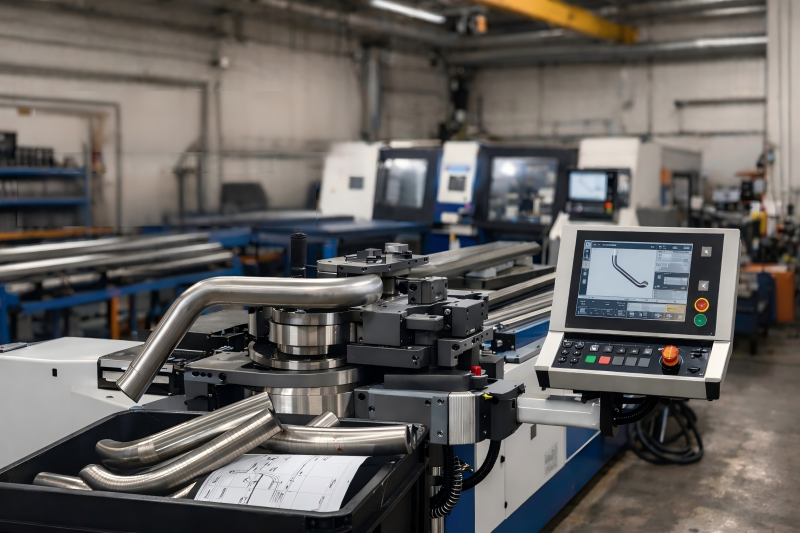
Poor Tube Bender Productivity Maintenance often leads to inconsistent bend radii and angles. This increases scrap rates and forces operators to slow down production to make manual adjustments. Over time, these inefficiencies significantly reduce daily output.
Longer Setup and Adjustment Times
Machines that are not properly maintained require more time for setup and correction. Loose components, inaccurate reference points, and unstable clamping all extend setup time between jobs. Regular productivity maintenance keeps setups predictable and fast.
FAQs
How often should Tube Bender Productivity Maintenance be performed?
Basic inspections and lubrication should be done daily, while more detailed productivity maintenance tasks such as alignment checks and parameter verification should be scheduled weekly or monthly, depending on production intensity.
Can Tube Bender Productivity Maintenance really reduce downtime?
Yes. By identifying wear, misalignment, and control issues early, productivity maintenance prevents sudden failures that cause unplanned downtime during daily production.
Does productivity maintenance affect bending accuracy?
Absolutely. Tube Bender Productivity Maintenance keeps tooling, axes, and control systems stable, which directly improves angle consistency and dimensional accuracy throughout the production shift.
Conclusion
Tube Bender Productivity Maintenance plays a critical role in daily production efficiency, accuracy, and reliability. By focusing on preventive inspections, proper lubrication, tooling condition, and control system stability, you can reduce downtime, minimize scrap, and maintain consistent output. In my experience, factories that treat maintenance as a productivity tool—not just a repair task—see better production planning and lower operating costs. If you want to improve daily tube bending performance or need support in building a productivity-focused maintenance plan, feel free to contact our team or explore more technical documentation on our website.


