


CNC Press Brake Care is essential for maintaining precision, preventing downtime, and extending the lifespan of electro-hydraulic press brakes. Learn the best maintenance practices for hydraulic systems, CNC controllers, servo valves, lubrication mechanisms, and daily inspection routines.
CNC Press Brake Care is fundamental to sustaining long-term bending accuracy and consistent machine performance, particularly for electro-hydraulic press brakes that rely on a closed-loop synchronization system governed by linear scales and high-response servo valves. Because CNC machines constantly adjust ram positioning in real time based on feedback signals, even minor issues—such as oil contamination, inadequate lubrication, or drifting sensor readings—can lead to noticeable variations in bending results. Accordingly, establishing a robust CNC Press Brake Care program not only preserves accuracy and stability but also reduces downtime, lowers maintenance costs, and greatly extends the operational lifespan of the machine.
Hydraulic System Maintenance
The hydraulic system is the operational heart of any CNC press brake, and its condition directly determines whether the machine can maintain stable pressure output and smooth cylinder synchronization. Effective CNC Press Brake Care requires operators to recognize that hydraulic quality, filtration efficiency, and thermal stability are all interconnected factors that influence servo responsiveness and, ultimately, bending precision.
1. Hydraulic Oil Requirements and Replacement
Unlike general-purpose hydraulic machinery, CNC press brakes rely on oil cleanliness and temperature stability to maintain servo valve sensitivity. High-grade anti-wear hydraulic oil (ISO VG46) is recommended, yet the oil’s suitability depends not only on its type but also on how consistently it is monitored, filtered, and replaced.
A more advanced CNC Press Brake Care approach involves:
- Evaluating oil color, odor, and transparency
- Monitoring oil temperature trends during extended production
- Tracking machine hours to schedule replacements
- Ensuring the oil meets ISO 4406 / NAS cleanliness levels
Because even a slight increase in particulate contamination may obstruct servo valve movement or increase response lag, maintaining hydraulic oil quality becomes a proactive means of preventing synchronization drift and pressure instability.
2. Filtration, Cooling, and System Cleaning
In many cases, issues such as ram vibration, delayed pressure buildup, or inconsistent bending angles can be traced back to overlooked maintenance points—blocked coolers, saturated return-line filters, or minor external leakage. Therefore, CNC Press Brake Care should be viewed as a continuous monitoring process where operators not only replace filters on schedule but also regularly inspect valve blocks, tightening fittings when needed and ensuring oil coolers remain free of dust accumulation that may compromise temperature control.
Servo, Linear Scale & CNC System Maintenance
High-precision bending depends heavily on the accuracy and stability of the CNC system, servo valves, and feedback devices. Because these components operate with extremely fine tolerances, CNC Press Brake Care must include detailed and regular maintenance.
1. Servo Valve Care
Servo valves are sensitive components designed to react to minute electrical and pressure changes. Their failure often occurs gradually—starting as slight hesitation during cylinder movement and eventually developing into full synchronization errors. For this reason, CNC Press Brake Care should incorporate inspections that include verifying valve responsiveness, ensuring stable electrical signals, and maintaining oil cleanliness to prevent spool sticking or internal wear.
2. Linear Scale (Grating Ruler) Maintenance
The linear scale—responsible for real-time ram position feedback—plays a crucial role in closed-loop control. Even a thin layer of oil mist or dust can cause jitter in the feedback signal, resulting in inconsistent bend angles. As part of regular CNC Press Brake Care routines, operators should clean the linear scale surface using non-abrasive materials, secure all mounting brackets to prevent vibration, and check for signal drift whenever identical workpieces begin to show variation.

3. CNC Controller & Electrical Cabinet
Because CNC controllers govern every operational parameter, including crowning compensation, axis calibration, and bending sequences, their stability is essential. Effective CNC Press Brake Care includes maintaining clean airflow through cabinet ventilation, tightening terminal wiring to prevent intermittent alarms, backing up machine parameters, and periodically checking whether system fans are functioning properly. These steps ensure that communication between drives, sensors, and the controller remains stable.

Lubrication & Mechanical Structure Maintenance
1. Automatic Lubrication System
Many CNC press brakes use centralized lubrication systems that deliver measured quantities of lubricant to guideways and sliding surfaces. However, if operators assume this system is “always working” without verification, insufficient lubrication may occur. Proper CNC Press Brake Care requires confirming lubricant discharge at each cycle, ensuring distribution lines remain unobstructed, and refilling the reservoir with manufacturer-approved lubricants.
2. Backgauge Assembly & Guide Rails
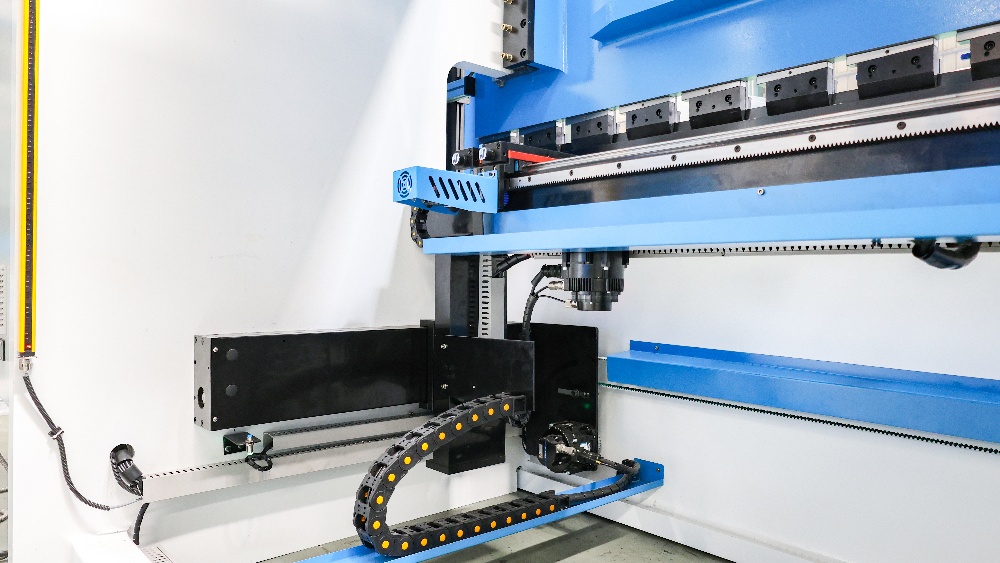
The accuracy of X, R, and Z axes depends on the cleanliness and lubrication of ball screws, linear guides, and sliding blocks. As part of CNC Press Brake Care, operators should remove accumulated dust or metal chips from these areas, lubricate ball screws weekly or monthly depending on usage intensity, and ensure the backgauge’s movement remains smooth across its full range. Any vibration or noise during axis motion should be investigated immediately.
Daily / Weekly / Monthly Maintenance Checklist
To achieve consistent CNC Press Brake Care, workshops benefit greatly from applying structured, time-based routines instead of handling maintenance reactively only when problems occur.
Daily Tasks
- Examine hydraulic oil levels and temperature trends
- Clean linear scale surfaces
- Inspect cylinder areas and pipes for leakage
- Verify smooth axis movement
- Listen for unusual pump noise
- Check for CNC alarms or communication warnings
Weekly Tasks
- Confirm automatic lubrication system cycle completion
- Clean guide rails and apply lubrication where necessary
- Inspect electrical cabinet temperatures and airflow
- Remove dust from oil coolers
- Verify hydraulic fittings remain tight
Monthly Tasks
- Deep-clean electrical cabinet wiring and ventilation
- Check servo valve responsiveness and pressure stability
- Inspect ball screw wear
- Test grounding and shielded cable integrity
- Re-evaluate bending accuracy and crowning settings
Consistent CNC Press Brake Care plays a decisive role not only in preserving the long-term accuracy of the machine but also in protecting the entire production workflow from unexpected interruptions. As CNC systems rely on complex interactions between hydraulic pressure, servo responsiveness, sensor feedback, and programmed compensation, even small deviations in maintenance quality can gradually accumulate into significant bending errors or equipment downtime. By implementing comprehensive routine care—covering hydraulic oil management, servo valve and linear scale cleaning, lubrication system monitoring, electrical cabinet stability checks, and structured daily-to-monthly inspections—manufacturers can maintain a level of operational reliability that directly translates into higher productivity, reduced wastage, and extended machine lifespan. Ultimately, a disciplined CNC Press Brake Care program becomes an investment that strengthens fabrication quality, stabilizes workflow, and maximizes the long-term return on the press brake itself.


