


Press Brake Guide Rail Lubrication is often the hidden reason behind sudden bending inaccuracies that many customers experience. When press brakes start producing inconsistent angles or uneven bends, the root cause is usually more basic than expected and closely related to lubrication quality. Proper lubrication directly determines how smoothly the ram moves, how evenly bending force is applied, and how stable the entire bending process remains over time. Based on real workshop experience, I’ll explain why guide rail lubrication matters so much, how it affects bending accuracy, and what operators should focus on during daily production.
How Press Brake Guide Rail Lubrication Influences Machine Movement
Friction and Resistance on Guide Rails

Press brake guide rails control the vertical movement of the ram. If lubrication is insufficient, friction increases between the guide rail and the sliding components. From what I’ve seen on shop floors, this extra resistance causes micro-stops and uneven motion during bending. Even small fluctuations in ram movement can translate into noticeable angle errors, especially when bending thin sheets or precision parts.
Uneven Ram Travel and Side Load Effects
Without proper Press Brake Guide Rail Lubrication, friction is rarely uniform on both sides of the machine. One side may move more smoothly than the other, creating uneven side loads. Over time, this leads to slight twisting of the ram, which directly affects parallelism between the upper and lower tools. Once parallelism is compromised, bending accuracy becomes unstable and difficult to correct through CNC compensation alone.
The Relationship Between Guide Rail Lubrication and Bending Accuracy
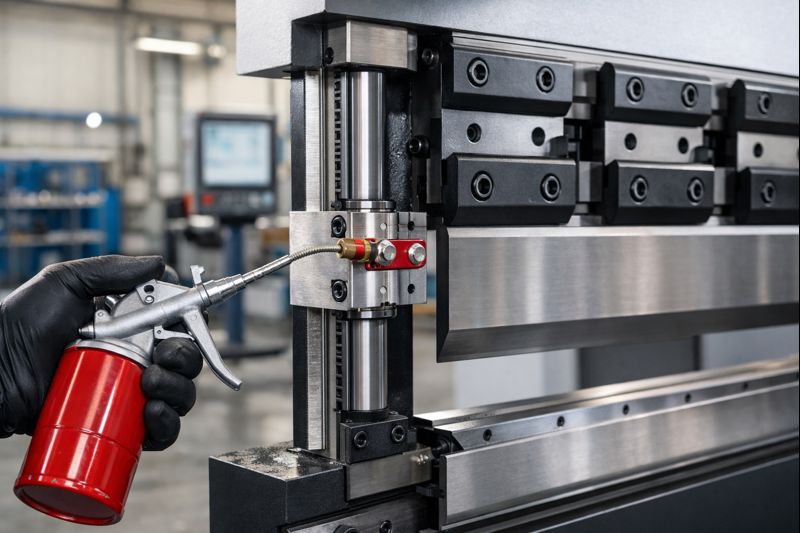
How Lubrication Affects Repeatability
In high-volume production, repeatability is everything. Poor lubrication increases mechanical drag, making ram positioning less predictable. I’ve seen machines that pass initial test bends but fail during long production runs simply because guide rails heat up and lubrication breaks down. Stable Press Brake Guide Rail Lubrication ensures consistent ram positioning cycle after cycle.
Impact on CNC Feedback and Compensation
Modern CNC press brakes rely on feedback systems to control accuracy. However, lubrication problems are mechanical, not software-related. When guide rails are dry or contaminated, CNC systems compensate based on incorrect movement assumptions. This mismatch leads to overcorrection or delayed response, reducing overall bending accuracy instead of improving it.
Common Lubrication Problems That Reduce Accuracy
Dry Guide Rails and Contaminated Lubricants
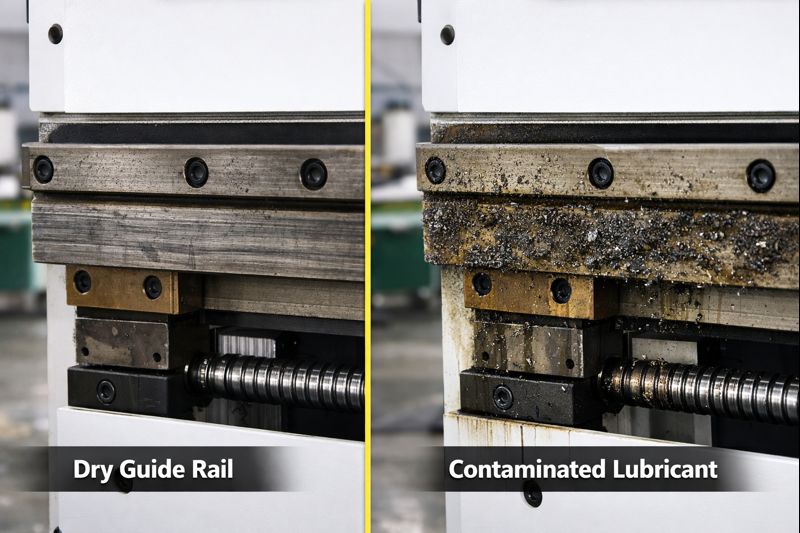
One of the most common issues I encounter is dry guide rails caused by skipped maintenance. Another frequent problem is contaminated lubricant mixed with dust, metal particles, or old grease. Instead of reducing friction, dirty lubrication increases wear and causes uneven sliding, directly affecting Press Brake Guide Rail Lubrication performance.
Over-Lubrication and Incorrect Lubricant Selection
More lubrication is not always better. Over-lubrication can trap debris, while using the wrong oil or grease may fail under load. I always recommend following manufacturer guidelines for lubricant type and viscosity, especially for CNC press brakes operating under high tonnage.
Best Practices for Press Brake Guide Rail Lubrication
Choosing the Right Lubricant

For most press brakes, high-quality slideway oil or manufacturer-approved grease works best. The lubricant should maintain a stable film under pressure and temperature changes. Proper Press Brake Guide Rail Lubrication depends as much on lubricant quality as on lubrication frequency.
Establishing a Consistent Lubrication Schedule
From my experience, lubrication should be part of daily or weekly maintenance, depending on workload. High-duty cycles require more frequent checks. A simple visual inspection combined with regular lubrication prevents accuracy issues long before they affect production quality.
Cleaning Before Lubrication
Before applying fresh lubricant, guide rails must be clean. Old oil, dust, and metal shavings should be wiped away. Clean rails allow new lubricant to work effectively and ensure smooth ram movement.
Long-Term Effects of Proper Guide Rail Lubrication
Reduced Wear and Extended Machine Life
Consistent Press Brake Guide Rail Lubrication reduces wear on sliding surfaces, ensuring guide rails maintain their geometry longer. This directly supports long-term bending accuracy and lowers maintenance costs.
Improved Stability During Precision Bending

For precision bending applications, stable lubrication is essential. Smooth ram travel means consistent force distribution across the tooling, resulting in better angle consistency and surface quality.
FAQ
How often should Press Brake Guide Rail Lubrication be performed?
In most workshops, guide rails should be inspected daily and lubricated weekly. For high-volume or heavy-load production, lubrication may be required more frequently to maintain bending accuracy.
Can poor guide rail lubrication really affect bending angles?
Yes. Increased friction and uneven ram movement caused by poor lubrication directly impact angle consistency and repeatability, especially on precision parts.
What type of lubricant is best for press brake guide rails?
Slideway oil or manufacturer-recommended grease is usually best. The lubricant must handle high pressure while maintaining a stable lubricating film.
Is CNC compensation enough to correct lubrication-related accuracy issues?
No. CNC systems cannot fully compensate for mechanical resistance caused by poor lubrication. Mechanical smoothness must come first.
Conclusion
From real production experience, I can say that Press Brake Guide Rail Lubrication is one of the most overlooked factors affecting bending accuracy. Smooth ram movement, stable repeatability, and reliable CNC performance all depend on proper lubrication practices. By choosing the right lubricant, cleaning guide rails regularly, and following a consistent lubrication schedule, you can significantly improve bending accuracy and extend machine life. If you want more detailed maintenance guidance or support tailored to your press brake model, feel free to contact our team or explore related documentation on our website.


