


If you want to fine-tune machine settings without risking access to protected factory data, understanding the ESA S875 User Parameters Mask is essential. The ESA S875 User Parameters Mask allows operators to safely adjust changeable parameters, including axis calibration corrections and selected configuration settings, without requiring a password. This makes it possible to compensate for mechanical wear, maintain accurate ram resetting heights, and optimize performance while protecting the core machine parameters. In this guide, I will explain how to access the ESA S875 User Parameters Mask, how to adjust axis calibration corrections properly, and how to manage other available parameters in a safe and controlled way.
Inroduction
The ESA S875 User Parameters Mask is a dedicated interface that allows end users to modify selected machine parameters without accessing protected factory settings. Unlike the main machine parameter area, the User Parameters Mask does not require a password. This design ensures that operators can safely adjust operational data while preventing unintended changes to core machine configurations.
The primary purpose of the User Parameters Mask is to provide controlled flexibility. Over time, mechanical components such as the ram, guides, or transmission systems may experience slight wear. These changes can affect resetting heights and axis positioning accuracy. Instead of modifying factory calibration data directly, the User Parameters Mask allows corrections to be applied as offsets.
To access the User Parameters Mask:
- Open the Settings mask.
- Press the Menu key.
- Select User Parameters (4).
- The ESA S875 User Parameters Mask window will open.

Once inside, only editable and safe parameters are displayed, ensuring secure parameter management.
How to Perform Axis Calibration Corrections
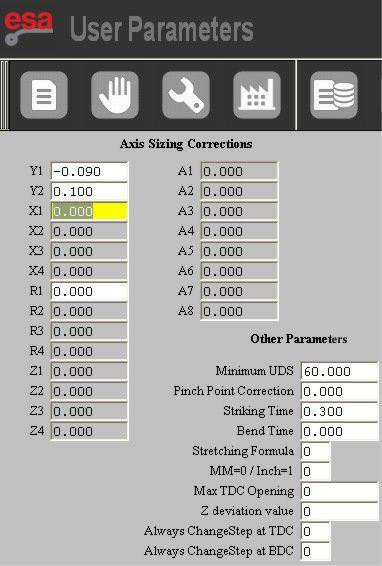
Inside the ESA S875 User Parameters Mask, one of the most critical areas is the section for corrections to axis calibration parameters. These fields allow adjustment of resetting heights compared to original factory values.
For example, assume the factory resetting heights are:
- Y1 = 230.93 mm
- Y2 = 230.09 mm
After long-term operation, measurement may indicate minor deviation. Suppose testing shows:
- Y1 needs -0.09 mm correction
- Y2 needs +0.10 mm correction
These correction values must be entered directly into the Y1 and Y2 fields inside the ESA S875 User Parameters Mask.
This adjustment compensates for mechanical variation without altering the stored factory data.
How the User Parameters Mask Applies Offsets
When you enter correction values in the User Parameters Mask:
- Factory data remain unchanged.
- The system applies the entered value as an offset.
- After calibration, Y1 resets to 230.84 mm.
- Y2 resets to 230.19 mm.
This means the User Parameters Mask works as a compensation layer. The original axis calibration remains intact, ensuring traceability and system safety.
This approach is especially useful when small mechanical deterioration affects repeatability. Instead of performing full recalibration procedures, operators can safely compensate through the User Parameters Mask.
How to Save Adjustments in ESA S875 User Parameters Mask
After entering calibration corrections, it is essential to save the parameters properly.
To save:
- Press the save key.
- The system will store the updated data in the file UserTara.par.
Saving ensures that corrections remain active after system restart. If you do not save the parameters, the changes will not be retained.
The ESA S875 User Parameters Mask separates temporary adjustments from permanent storage, which prevents accidental data loss.
What Happens When Factory Calibration Data Changes
If the press manufacturer updates the factory resetting heights of the axes, the User Parameters Mask automatically detects inconsistencies between the stored correction and the new baseline.
In this situation:
- A warning message appears on the display.
- The related correction value is automatically reset.
- The calibration height returns to the updated factory reference.

After the reset, the axis calibration correction table reflects the new factory baseline.
This automatic protection mechanism ensures that adjustments inside the ESA S875 User Parameters Mask do not conflict with manufacturer updates.
Other Adjustable Settings in ESA S875 User Parameters Mask
In addition to axis calibration corrections, the User Parameters Mask provides access to other operational settings.
These include parameters related to:
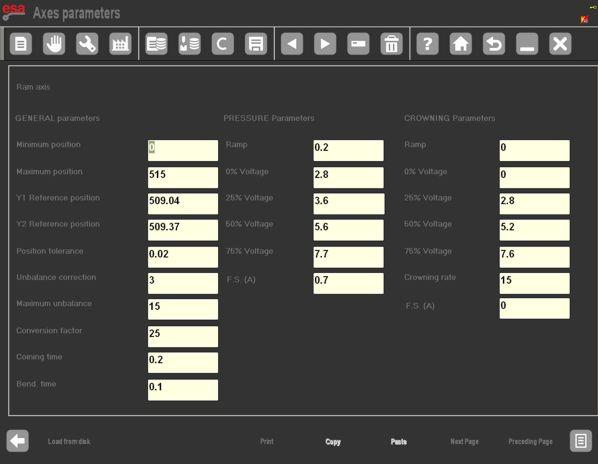
- Axis Parameters
- General Configuration Parameters
- General Parameters
The key difference is that these parameters are accessible without password authentication when using the ESA S875 User Parameters Mask. However, only selected and safe-to-modify data are displayed.
This controlled access structure allows operators to optimize workflow and adjust operational details without risking core system stability.
Step-by-Step Guide to Adjust ESA S875 User Parameters Mask Safely
To ensure safe and accurate modification of the ESA S875 User Parameters Mask, follow this structured process:
Step 1: Verify Mechanical Condition
Before entering any correction, measure the actual axis resetting height using accurate tools. Confirm that deviation is mechanical and not caused by programming errors.
Step 2: Calculate the Required Offset
Determine the difference between factory resetting height and measured value. Enter only the calculated correction value, not the final height.
Step 3: Enter Correction Values Carefully
Input the offset directly into the Y1 or Y2 field within the ESA S875 User Parameters Mask. Double-check numerical accuracy before confirming.
Step 4: Save Parameters
Press the save key to store the new correction values in UserTara.par.
Step 5: Perform Test Calibration
Run a reset cycle and verify that the axis reaches the corrected height accurately.
Following this method ensures that the ESA S875 User Parameters Mask is used as a precision adjustment tool rather than a trial-and-error solution.
Best Practices for Long-Term Stability
To maintain safe operation when working with the ESA S875 User Parameters Mask:
- Apply small incremental corrections.
- Record original factory values before adjustment.
- Avoid modifying unrelated parameters.
- Recheck axis positioning periodically.
- Coordinate with technical support if large deviations appear.
Using the ESA S875 User Parameters Mask responsibly ensures that mechanical wear compensation is controlled, calibration remains stable, and factory integrity is preserved.
By fully understanding how the User Parameters Mask works, operators can confidently adjust axis calibration corrections and other permitted parameters while maintaining machine accuracy and long-term performance reliability.
Frequently Asked Questions(FAQ)
Do I need a password to access the ESA S875 User Parameters Mask?
No, the ESA S875 User Parameters Mask can be accessed without a password. It is designed specifically for safe user-level adjustments. However, only parameters that are safe for operators to modify are visible in this interface.
Will adjusting parameters change the factory calibration values?
No. The ESA S875 User Parameters Mask does not modify the original factory calibration data. Instead, it applies offset corrections on top of the stored factory values, ensuring that the original reference data remains protected.
Where are the adjusted parameters saved?
When you save changes in the ESA S875 User Parameters Mask, the updated data is stored in the UserTara.par file. This ensures the corrections remain active even after the system restarts.
Conclusion
Proper configuration of the ESA S875 User Parameters Mask helps maintain accurate press brake calibration and stable machine performance. By correctly adjusting axis calibration corrections such as Y1 and Y2 resetting heights and saving the updated parameters, operators can compensate for mechanical wear without modifying the original factory settings.
Regularly checking and managing the ESA S875 User Parameters Mask ensures consistent bending accuracy and reliable operation. If you need more guidance on ESA controller settings or press brake optimization, feel free to contact our technical team or explore more of our technical support articles.


