


Press Brake Backgauge Positioning Inaccurate issues are often the hidden reason behind inconsistent part lengths and constantly changing flange dimensions. In my experience, the root cause is rarely the CNC controller itself, but rather mechanical wear, improper calibration, or neglected maintenance. In this article, I’ll break down the most common sources of backgauge positioning errors, explain how I diagnose them step by step, and share practical workshop solutions that help restore stable and precise bending accuracy.
Common Mechanical Causes of Press Brake Backgauge Positioning Inaccurate
Backgauge systems rely on precision mechanical transmission components. Even small deviations can cause millimeter-level errors in finished parts.
Worn Ball Screws and Linear Guides

One of the most frequent reasons for Press Brake Backgauge Positioning Inaccurate issues is wear in the ball screw or linear guide system. Over time, dust, metal particles, and insufficient lubrication increase friction and create backlash.
To check this:
- Move the backgauge forward and backward manually in jog mode.
- Listen for abnormal noise or vibration.
- Measure repeat positioning accuracy using a digital caliper.
If backlash exceeds tolerance, the ball screw may require adjustment or replacement. Regular lubrication and cleaning significantly extend service life.
Loose Couplings or Misaligned Drive Components
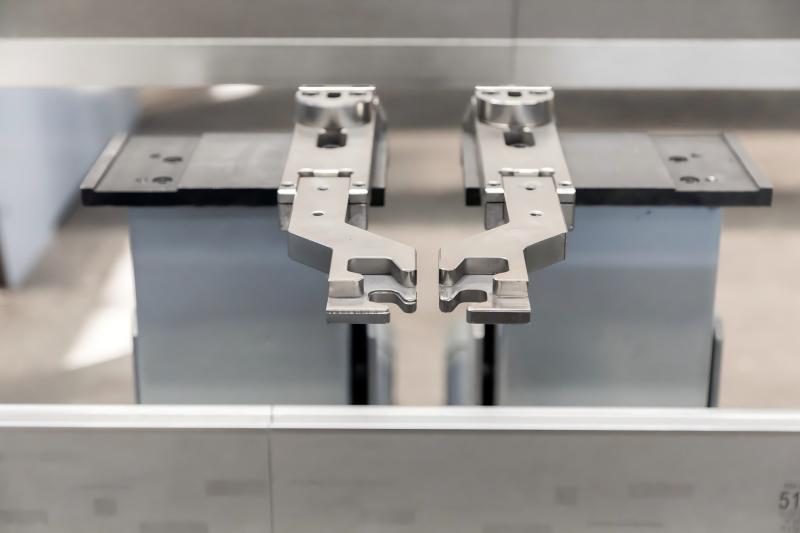
Servo motors transmit motion through couplings. If these become loose, positioning drift occurs.
I usually inspect:
- Motor mounting bolts
- Coupling tightness
- Alignment between motor and screw
Even slight misalignment can lead to repeated positioning errors.
Electrical and CNC System Factors Affecting Backgauge Accuracy
Modern CNC press brakes use servo-driven backgauge systems controlled by advanced controllers. Electrical issues can directly impact positioning precision.
Servo Motor Encoder Feedback Errors
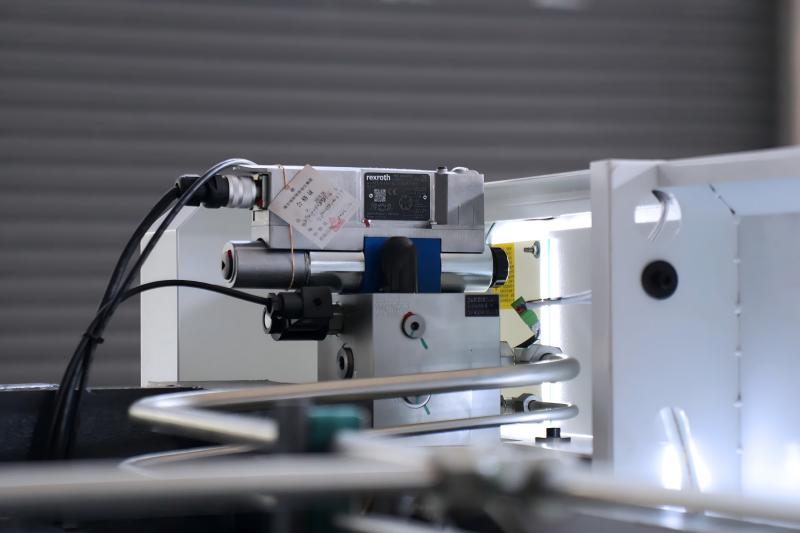
When the encoder signal becomes unstable, the controller cannot accurately detect position. This often results in:
- Inconsistent repeat positioning
- Alarm messages related to axis deviation
- Sudden dimension changes
To diagnose this, I check encoder cables, connectors, and grounding conditions. Shielded cables must be intact to prevent signal interference.
Incorrect Parameter Settings in CNC Controller

Sometimes the issue is purely software-related. Incorrect pitch compensation or scaling parameters can cause Press Brake Backgauge Positioning Inaccurate problems.
I recommend:
- Verifying screw pitch parameters in the controller.
- Checking electronic gear ratio settings.
- Recalibrating axis zero reference.
If you’re wondering how to calibrate a press brake backgauge, start by resetting the reference position and verifying actual movement against programmed values.
How to Calibrate a Press Brake Backgauge System
Calibration is one of the most effective ways to correct positioning errors.
Step 1: Inspect and Clean the Backgauge Assembly
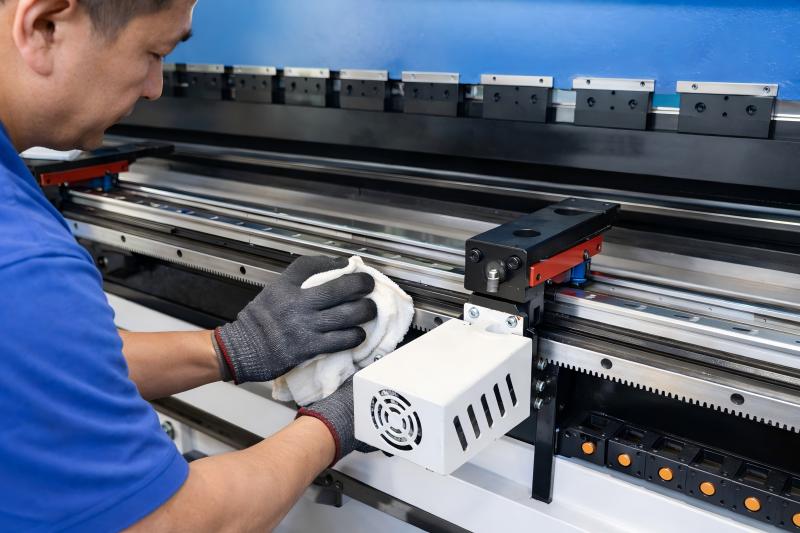
Before calibration, I always clean:
- Linear guides
- Ball screws
- Gauge fingers
- Sensor surfaces
Dirt buildup can cause inconsistent travel resistance.
Step 2: Check Mechanical Parallelism
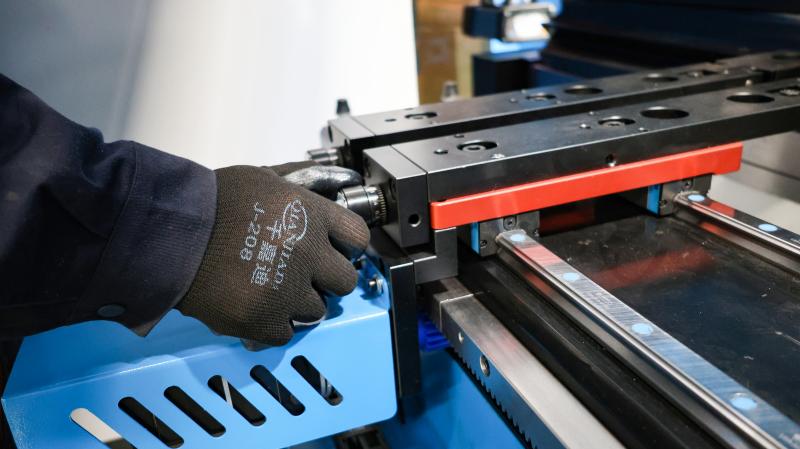
Use a precision ruler or dial indicator to confirm that both sides of the backgauge move evenly. If one side lags, synchronization adjustment is required.
Step 3: Perform CNC Axis Calibration
Most CNC systems allow manual calibration:
- Move the backgauge to a known reference position.
- Measure actual distance from tooling centerline.
- Input correction value into controller.
After calibration, run repeat positioning tests at different distances to confirm stability.
Maintenance Practices to Prevent Backgauge Positioning Errors
Prevention is always better than repair. In my experience, consistent maintenance reduces most Press Brake Backgauge Positioning Inaccurate cases.
Routine Lubrication and Cleaning
Backgauge linear guides require proper lubrication. I recommend:
- Weekly lubrication for high-usage machines
- Daily cleaning in dusty environments
Periodic Accuracy Testing
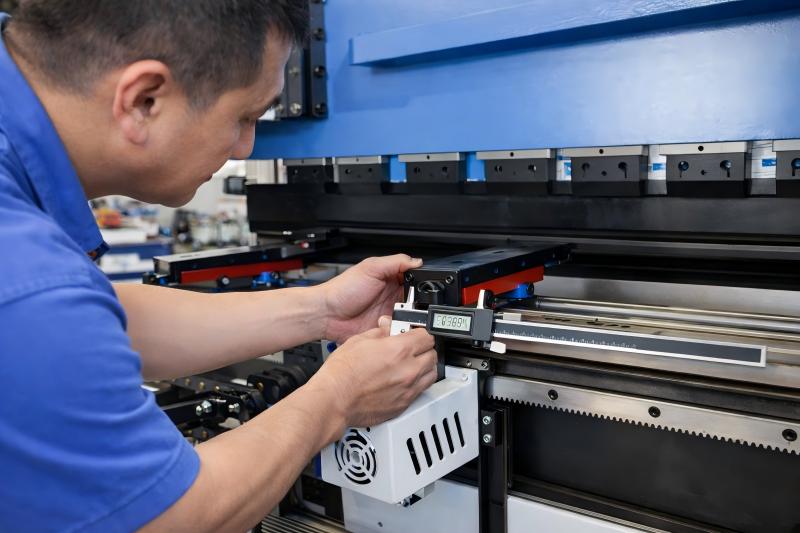
Every month, I test repeat positioning:
- Command 100 mm position repeatedly
- Measure actual result
- Compare deviation
If variation exceeds tolerance, immediate inspection is necessary.
Environmental Control
Temperature changes can cause expansion in mechanical components. If the workshop temperature fluctuates significantly, allow the machine to warm up before precision production.
FAQs
What is the most common reason for Press Brake Backgauge Positioning Inaccurate problems?
Mechanical wear in ball screws and insufficient lubrication are the most common causes, followed by loose couplings or encoder feedback issues.
How do I know if my backgauge needs recalibration?
If repeated bends show consistent dimensional deviation, especially in flange length, calibration should be performed.
Can CNC parameter errors cause backgauge positioning inaccuracy?
Yes. Incorrect pitch compensation or scaling parameters in the controller can directly affect axis accuracy.
How often should I check backgauge accuracy?
For active production environments, I recommend monthly accuracy checks and immediate inspection after any collision or overload event.
Conclusion
When Press Brake Backgauge Positioning Inaccurate issues appear, the cause is rarely random. It usually comes from mechanical wear, loose transmission components, electrical feedback problems, or improper calibration. By following a structured inspection process—checking mechanical parts, verifying servo feedback, and recalibrating the CNC axis—you can quickly restore positioning precision.
In my daily work with press brakes, I’ve seen how regular lubrication, routine accuracy testing, and proper calibration prevent costly scrap and rework. If you’re experiencing persistent backgauge positioning errors or need technical guidance, I recommend consulting a professional service team to ensure long-term bending stability and production efficiency.


