


Proper pressure release is an important part of the hydraulic press brake bending cycle. After the machine completes the pressing and dwell stages, hydraulic pressure must be released before the ram proceeds to the opening stage.
The ESTUN E315P Decompression Time parameter controls the duration assigned to this pressure-release process. Correct configuration helps maintain an appropriate transition between bending operations and supports consistent machine operation.
This guide explains the function of Decompression Time, its position within the bending sequence, how to adjust the parameter, and the precautions operators should consider during commissioning and production.
What Is ESTUN E315P Decompression Time?
The ESTUN E315P Decompression Time is a programming constant that determines the time allocated to releasing bending pressure after the pressing and dwell stages.
According to the ESTUN E315P operating manual, the parameter is identified as Decomp Time.
| Parameter | Specification |
|---|---|
| Parameter Name | Decomp Time |
| Default Value | 0.20 s |
| Setting Range | 0.00–99.99 s |
| Unit | Seconds (s) |
| Function | Sets the decompression duration after pressing and dwell |
The default value is 0.20 seconds. However, this is a controller default rather than a universally suitable setting for every hydraulic press brake.
The appropriate value should be determined according to the machine’s hydraulic configuration and actual operating conditions.
How Does Decompression Work During Bending?
To understand the ESTUN E315P Decompression Time, it is necessary to identify where decompression occurs within the bending cycle.
The E315P operating sequence includes several stages:
1. Fast Closing
The ram moves downward toward the workpiece during the fast-closing stage.
2. Pressing
The machine enters the working stroke and applies the force required for bending.
3. Dwell
The controller maintains the programmed dwell stage after pressing.
This stage is associated with the holding period during the bending operation.
4. Decompression
After the pressing and dwell stages, the controller enters the decompression stage.
The Decomp Time parameter specifies the duration allocated to releasing bending pressure.
5. Opening
Following decompression, the ram proceeds to the opening stage according to the machine’s configured operating sequence.
Understanding this order helps operators distinguish pressure release from other timing functions.
How to Adjust ESTUN E315P Decompression Time
The adjustment should be performed carefully, particularly when the machine is being commissioned or its operating parameters are being reviewed.
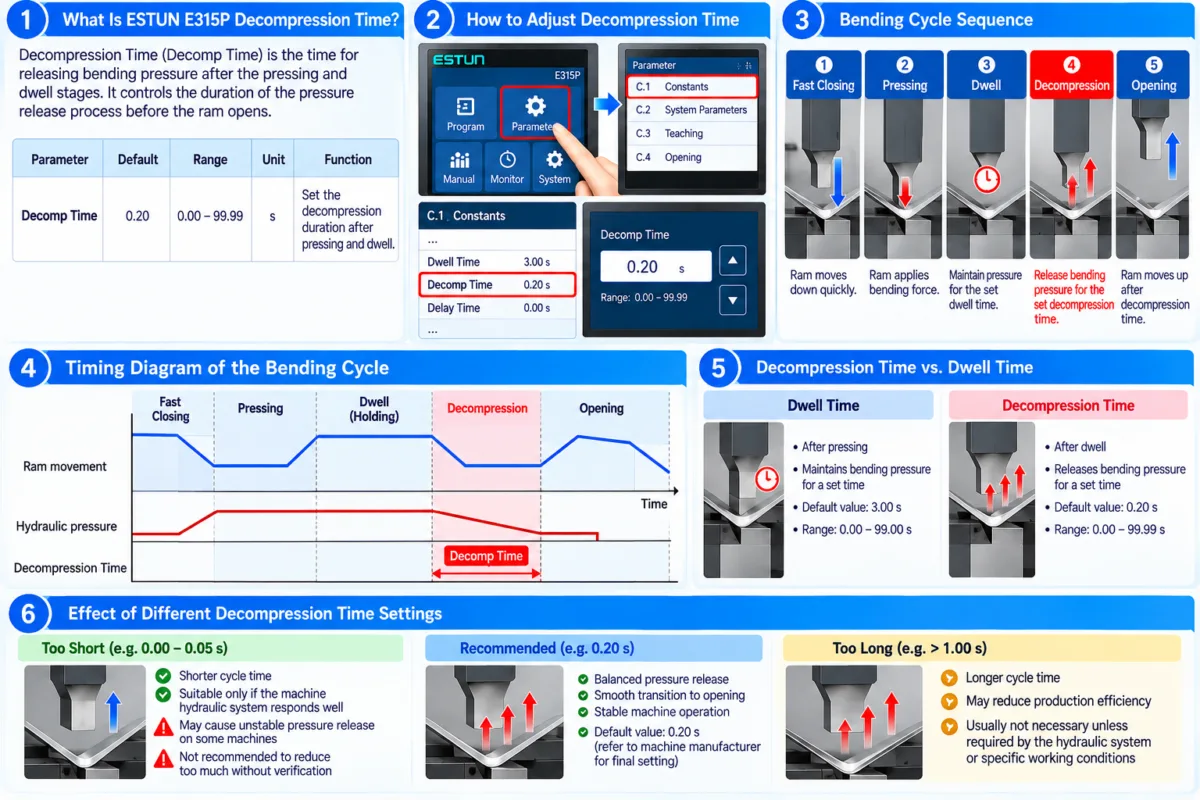
Step 1: Access the Programming Constants
Open the controller’s parameter settings and locate the C.1 Constants section described in the operating manual.
Find the parameter labeled Decomp Time.
Step 2: Check the Current Value
Review the existing decompression setting before making any changes.
The factory default listed in the manual is 0.20 seconds.
If the machine has already been commissioned successfully, record the existing value so it can be restored if necessary.
Step 3: Enter the Required Decompression Time
Adjust the parameter within the permitted range of 0.00–99.99 seconds.
Avoid selecting a value solely because it falls within the allowable range. The controller’s permitted range does not establish that every value is suitable for the machine.
Step 4: Verify the Bending Sequence
After adjusting the ESTUN E315P Decompression Time, perform a controlled test using appropriate operating procedures.
Observe the transition from dwell to decompression and then to opening.
Confirm that the machine completes the sequence normally before resuming regular production.
How Does Decompression Time Affect the Bending Cycle?
Decompression Time is one of the timing parameters involved in the complete bending sequence.
Changing its value changes the programmed duration of the decompression stage.
A longer setting allocates more time to pressure release, while a shorter setting reduces the time assigned to this stage.
However, the actual hydraulic response depends on the machine’s hydraulic system, valve configuration, and operating conditions.
Therefore, the ESTUN E315P Decompression Time should not be treated as an independent adjustment for bending force, bending angle, or hydraulic pressure.
Its primary purpose is to define the decompression interval within the programmed operating cycle.
Decompression Time vs. Dwell Time
Although both parameters are measured in seconds, they serve different functions.
| Parameter | Function | Operating Stage |
|---|---|---|
| Dwell Time | Determines the programmed holding period | After pressing |
| Decomp Time | Determines the pressure-release duration | After dwell, before opening |
The E315P manual lists a separate Default Dwell Time parameter with a default value of 3 seconds and a setting range of 0.00–99.00 seconds.
By comparison, Decomp Time has a default value of 0.20 seconds.
Operators should not confuse these settings when adjusting the bending sequence.
Increasing Dwell Time extends the programmed holding period, whereas increasing Decomp Time extends the programmed pressure-release interval.
Common Decompression Time Setting Mistakes
When adjusting the ESTUN E315P Decompression Time, several mistakes should be avoided.
Confusing Decompression with Dwell
These functions occur at different stages of the bending cycle. Changing one parameter does not replace the function of the other.
Using the Same Value for Every Machine
Different hydraulic configurations may require different operating settings.
A parameter suitable for one press brake should not automatically be applied to another machine.
Making Large Adjustments Without Verification
Significant timing changes should not be introduced without checking the resulting machine operation.
Use the machine manufacturer’s commissioning requirements when determining an appropriate setting.
Ignoring Abnormal Hydraulic Behavior
If the machine exhibits unusual pressure-release behavior, abnormal noise, unexpected ram movement, or hydraulic alarms, stop testing and investigate the underlying condition.
Changing Decomp Time alone should not be considered a solution to every hydraulic problem.
Practical Recommendations for Safe Adjustment
Before modifying the ESTUN E315P Decompression Time, ensure that the machine is in a safe condition and that the adjustment is performed by authorized personnel.
Record the original setting and confirm the intended bending program.
After making an adjustment, observe a complete bending cycle and verify the transition between dwell, decompression, and opening.
Do not attempt to compensate for suspected hydraulic faults by repeatedly increasing or decreasing the decompression interval.
For machines that have already been commissioned and operate normally, unnecessary parameter changes should be avoided.
Correct use of the ESTUN E315P Decompression Time helps maintain a properly configured pressure-release stage and supports consistent press brake operation.
Frequently Asked Questions
Can Decompression Time Be Set to Zero?
Yes. The permitted setting range is 0.00–99.99 seconds, so zero is an available parameter value. However, the manual does not establish that zero is suitable for every machine. Operators should follow the machine manufacturer’s commissioning recommendations before using this setting.
Does Decompression Time Control Hydraulic Pressure?
No. Decompression Time specifies the duration of the pressure-release stage. It does not directly set hydraulic pressure or bending force. These functions depend on other machine parameters and hydraulic components.
What Should Operators Check After Changing Decompression Time?
After adjusting the ESTUN E315P Decompression Time, operators should verify that the bending cycle completes normally, the transition from dwell to opening is appropriate, and no abnormal hydraulic behavior or alarms occur. The original parameter value should be retained for reference.
Conclusion
The ESTUN E315P Decompression Time is an important timing parameter that controls the pressure-release interval between the dwell and opening stages of a hydraulic press brake’s bending cycle.
According to the E315P operating manual, its default value is 0.20 seconds, with an adjustable range of 0.00–99.99 seconds. Although the controller allows a wide setting range, the appropriate value depends on the machine’s hydraulic configuration and operating conditions.
Operators should distinguish decompression from dwell, record existing settings before making adjustments, and verify the complete bending sequence after any modification.
By configuring the ESTUN E315P Decompression Time correctly and following appropriate commissioning procedures, operators can maintain a consistent pressure-release sequence while avoiding unnecessary changes to established machine settings.


