


The ESTUN E315P X-Retract Distance is an important parameter that determines how far the press brake backgauge retracts during bending operations. Proper configuration helps provide clearance between the backgauge fingers and the workpiece, reducing the risk of interference during the bending process.
According to the ESTUN E315P operating manual, the controller provides a Default X-Retract parameter that allows operators to configure the backgauge retraction distance. However, the appropriate value depends on the workpiece geometry, tooling arrangement, and actual machine conditions.
This guide explains how X-Retract Distance works, how to configure the parameter, and what operators should consider when adjusting backgauge movement.
What Is ESTUN E315P X-Retract Distance?
The ESTUN E315P X-Retract Distance refers to the programmed distance that the X-axis backgauge moves away from its positioning location during the retraction operation.
In the controller’s C.1 Constants section, this setting is identified as Default X-Retract.
According to the operating manual, the parameter has the following specifications:
| Parameter | Specification |
|---|---|
| Parameter Name | Default X-Retract |
| Default Value | 0.00 mm |
| Setting Range | 0.00–999.00 mm |
| Unit | Millimeters (mm) |
| Function | Sets the default X-axis retraction distance |
The default value is 0.00 mm, indicating that no additional retraction distance is specified through this default parameter.
A nonzero value defines a programmed retraction distance.
However, the controller’s available setting range does not mean that every value is suitable for a particular bending application.
Why Is X-Axis Retraction Important?
During sheet metal bending, the workpiece changes shape as the upper punch presses the material into the lower die.
Depending on the bending geometry, portions of the workpiece may move toward the backgauge fingers.
If the backgauge remains too close to the material, interference may occur during the bending operation.
The ESTUN E315P X-Retract Distance helps establish a programmed clearance by allowing the backgauge to move away from its initial positioning location.
Preventing Workpiece Interference
Backgauge retraction can provide additional space for material movement during bending.
This is particularly relevant when the workpiece geometry creates a potential collision with the backgauge fingers.
Protecting Backgauge Components
Appropriate retraction can reduce the risk of contact between the moving workpiece and backgauge components.
However, safe operation also depends on the timing of retraction and the actual machine configuration.
Supporting Consistent Bending Operations
A suitable retraction distance allows the backgauge to perform its programmed movement without introducing unnecessary travel.
The objective is to provide adequate clearance while maintaining an appropriate bending sequence.
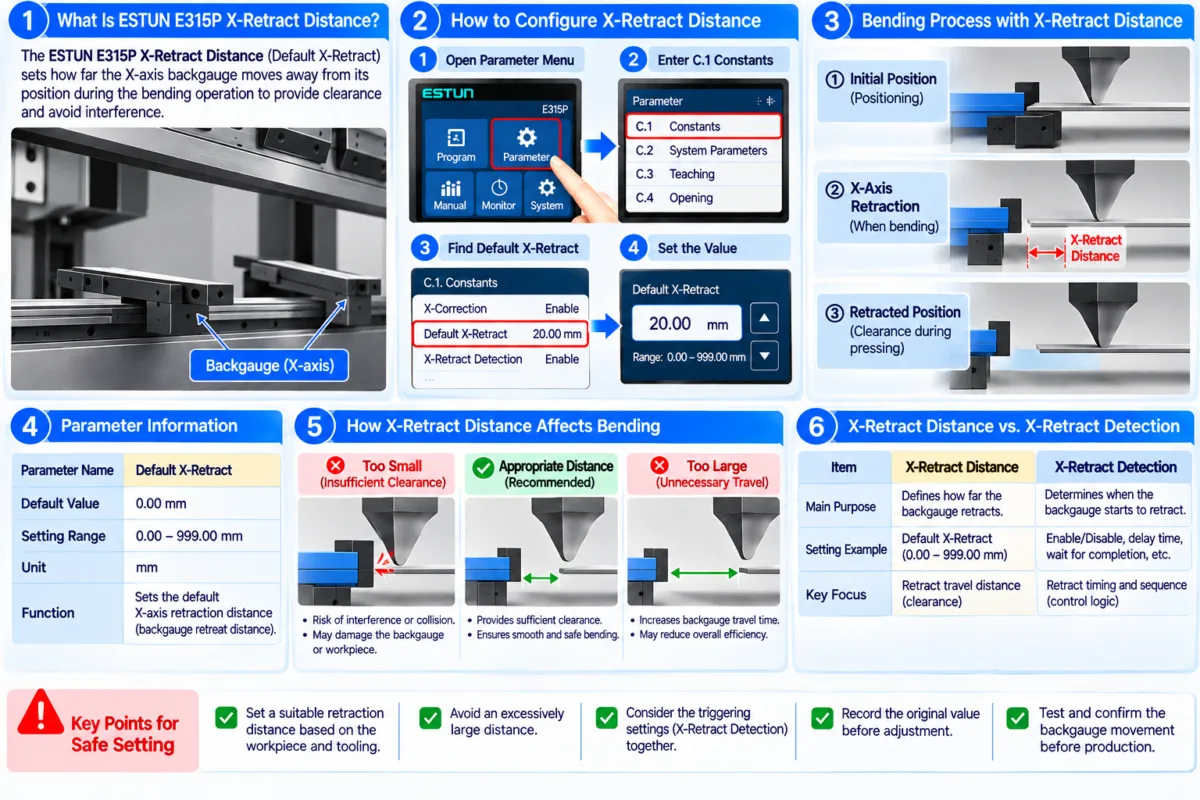
How to Configure ESTUN E315P X-Retract Distance
Before adjusting the parameter, operators should confirm the workpiece requirements and review the existing backgauge configuration.
Step 1: Access the Constants Settings
Open the ESTUN E315P controller’s parameter settings.
Locate the C.1 Constants section described in the operating manual.
Find the parameter labeled Default X-Retract.
Step 2: Check the Current Value
Review the existing retraction distance before making changes.
The manual specifies a default value of 0.00 mm.
If the machine has already been commissioned successfully, record the existing setting before modifying it.
Step 3: Enter the Required Distance
Adjust the ESTUN E315P X-Retract Distance within the permitted range of 0.00–999.00 mm.
The required value should be determined according to the actual clearance needed between the workpiece and backgauge fingers.
Avoid selecting an unnecessarily large distance simply because the controller permits it.
Step 4: Verify the Retraction Movement
After changing the parameter, perform an appropriate controlled test.
Observe the backgauge movement during the bending sequence and confirm that sufficient clearance is provided.
Check that the programmed movement does not create interference with other machine components.
Only resume normal production after verifying the operating sequence.
How Does X-Retract Distance Affect Bending?
The ESTUN E315P X-Retract Distance determines the programmed amount of backgauge retraction.
Changing this value affects the distance traveled during the retract operation.
Insufficient Retraction Distance
If the programmed distance is too small for the workpiece geometry, the backgauge fingers may remain within the material’s movement path.
This can increase the risk of interference during bending.
Excessive Retraction Distance
An unnecessarily large distance may increase backgauge travel and affect the overall movement sequence.
It may also be unsuitable for the machine’s available travel or operating requirements.
Appropriate Retraction Distance
The correct distance should provide sufficient clearance without introducing unnecessary movement.
The manual does not specify universal retraction distances for particular materials or sheet thicknesses.
Therefore, the setting should be verified according to the actual bending application.
X-Retract Distance vs. X-Retract Detection
Although these functions are related, they control different aspects of backgauge retraction.
| Function | X-Retract Distance | X-Retract Detection |
|---|---|---|
| Main Purpose | Defines retraction distance | Determines retraction triggering behavior |
| Relevant Setting | Default X-Retract | X-Retract detection and related timing settings |
| Main Concern | How far the backgauge retracts | When retraction begins |
| Operating Role | Backgauge clearance | Retraction sequence control |
The ESTUN E315P X-Retract Distance determines the programmed travel amount.
X-Retract Detection is associated with the conditions that trigger retraction during the bending sequence.
According to the E315P manual, the X-Retract Detection function uses the speed-change signal transition to initiate retraction after the configured delay.
The controller may also be configured to wait for the retract movement to finish before continuing the pressing operation.
Consequently, operators should verify both the retraction distance and the applicable triggering conditions.
A suitable distance alone does not guarantee that the backgauge will retract at the appropriate time.
Common X-Retract Distance Setting Mistakes
Several mistakes should be avoided when configuring the ESTUN E315P X-Retract Distance.
Using the Same Distance for Every Workpiece
Different workpiece geometries may require different clearances.
Operators should not assume that one retraction distance is suitable for every bending program.
Confusing Retraction Distance with X-Axis Position
The programmed X-axis position determines the backgauge location used for workpiece positioning.
X-Retract Distance defines the additional retraction movement during the bending operation.
These settings serve different purposes.
Ignoring Retraction Timing
Even when the programmed distance is appropriate, incorrect triggering conditions may affect the movement sequence.
Operators should verify the relevant detection and waiting settings.
Making Large Changes Without Testing
Significant changes to backgauge travel should not be introduced without checking the available clearance and machine operating conditions.
Practical Recommendations for Safe X-Retract Adjustment
Before modifying the ESTUN E315P X-Retract Distance, review the bending program, workpiece geometry, and tooling arrangement.
Confirm that the backgauge fingers have sufficient clearance during the expected material movement.
Record the existing parameter value and make adjustments systematically.
After changing the setting, verify the retraction distance, triggering conditions, and complete bending sequence under safe operating conditions.
Avoid using excessive retraction distances or changing unrelated axis parameters without a clear technical reason.
For machines that have already been commissioned and operate normally, unnecessary parameter changes should be avoided.
Proper configuration of the ESTUN E315P X-Retract Distance helps operators maintain suitable backgauge clearance, reduce interference risks, and support consistent press brake bending operations.
Frequently Asked Questions(FAQ)
Can X-Retract Distance Be Set to Zero?
Yes. The controller allows the Default X-Retract parameter to be set to 0.00 mm. This means that no additional retraction distance is specified through this parameter. However, a zero setting should only be used when the bending operation does not require additional backgauge clearance.
Does Increasing X-Retract Distance Improve Bending Accuracy?
Not directly. The ESTUN E315P X-Retract Distance primarily controls backgauge clearance during bending. It does not directly adjust bending angle accuracy or correct X-axis positioning errors. Bending accuracy depends on factors such as tooling, material properties, programmed dimensions, and machine calibration.
Conclusion
The ESTUN E315P X-Retract Distance is an important programming parameter that determines the default backgauge retraction distance during press brake bending operations. According to the E315P operating manual, the Default X-Retract parameter has a default value of 0.00 mm and an adjustable range of 0.00–999.00 mm.
Proper configuration helps provide sufficient clearance between the workpiece and backgauge fingers, reducing the risk of interference during bending.
However, retraction distance must be considered together with the applicable triggering conditions and machine movement sequence. An appropriate distance alone does not guarantee safe retraction timing.
Before adjusting the ESTUN E315P X-Retract Distance, operators should review the workpiece geometry, record existing settings, and verify the complete bending sequence under safe operating conditions.
By selecting a suitable retraction distance and confirming the actual backgauge movement, operators can improve clearance management, reduce collision risks, and support consistent press brake operation.


